
Part of our Medicare and Medicaid Help for Families guide
The Medicare Prescription Payment Plan: Spreading Drug Costs Across the Year

Here's the timing twist: if Mom joins the Medicare Prescription Payment Plan today, she has only 3 months left in 2026 to spread her drug costs. If she asks her plan now for 2027, she gets all 12.
The Medicare Prescription Payment Plan is a free, optional way to pay Part D drug costs in monthly bills from your plan instead of all at once at the pharmacy. It does not lower what you owe. You can join any time by contacting your plan, including now for 2027, when the yearly cap on covered drug costs is $2,400.
This guide is for US families helping a parent with a Medicare drug plan or a Medicare Advantage plan with drug coverage. You get the monthly bill math in plain English, a made-up example chart, a "should Mom sign up?" quiz, a sign-up walkthrough with a call script, myth vs fact cards, and a free printable call sheet.
Did you know? The pharmacy may bring it up first. Under the federal rule, when one covered drug would cost $600 or more out of pocket, the plan must tell the pharmacy, and the pharmacy must let you know you are likely to benefit from the payment plan. eCFR: 42 CFR 423.137
What is the Medicare Prescription Payment Plan?
It is a payment option every Medicare drug plan must offer. Instead of paying the pharmacy, you pay $0 at the counter and get a monthly bill from your plan. Medicare.gov says it costs nothing to join and works with your current coverage, but it doesn't save money or lower your drug costs.
People also call it the M3P, or the Medicare payment plan. Medicare.gov's overview sums up the key points:
- Who can use it: anyone with a Medicare drug plan or a Medicare health plan with drug coverage, like a Medicare Advantage plan with drug coverage.
- What changes: you stop paying at the pharmacy (including mail order and specialty pharmacies) for drugs covered by Part D. The plan bills you each month instead.
- What stays the same: your drugs, your copays, and your plan premium. The premium still comes on its own bill, if your plan has one.
- What it costs: nothing. No sign-up fee, and no interest.

How is the monthly bill calculated?
Every plan uses the same formula. The first month's bill is capped at the yearly limit, minus what you already paid this year, divided by the months left. After that, each bill is your unpaid balance plus new drug costs, divided by the months left in the year, counting the current month.
Here is the math in plain English, from Medicare.gov's "before you start" page and the federal rule:
- First month: take the yearly cap, subtract what you already paid this year, and divide by the months left. The plan bills you that amount or your actual costs, whichever is less.
- Every month after: add what you still owe to any new drug costs, then divide by the months left.
- The ceiling: for the year, you never pay more than you would have paid at the pharmacy, or more than the cap.
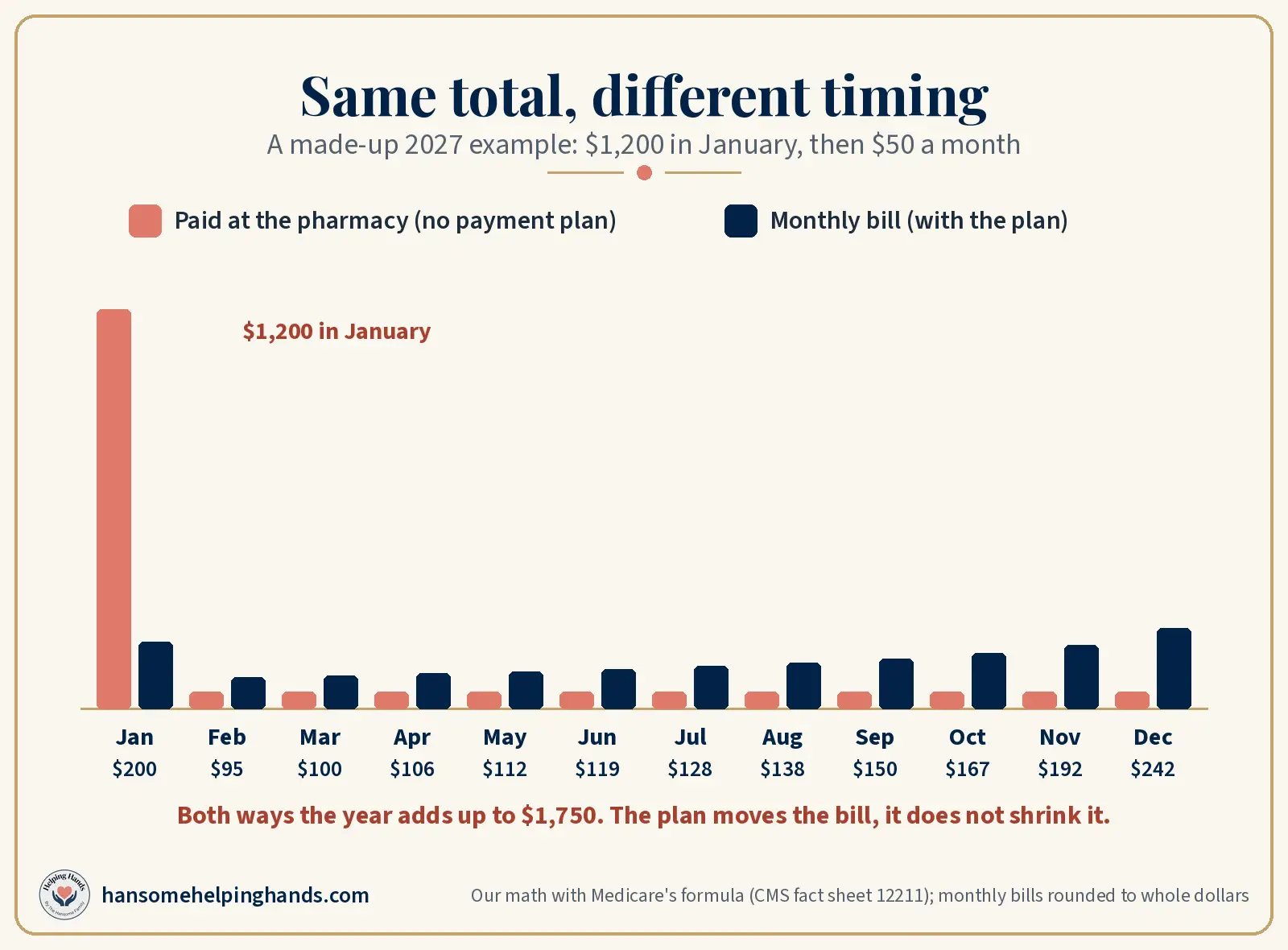
For example, imagine a made-up mom who joins for January 2027. One drug costs her $1,200 in January, and her other drugs cost $50 a month. Her first bill is $2,400 divided by 12, which is $200. The other $1,000 rolls into the next months.
| Month | Drug costs | How the bill is figured | Bill |
|---|---|---|---|
| January | $1,200 | $2,400 ÷ 12 months (less than $1,200) | $200 |
| February | $50 | ($1,000 owed + $50) ÷ 11 | $95.45 |
| March | $50 | ($954.55 owed + $50) ÷ 10 | $100.45 |
See the catch? Bills rise near the end of the year, because new costs get split across fewer months. In this example, December's bill is about $242, while she'd have paid $50 at the pharmacy. Medicare.gov warns about exactly this: your bill can change every month.
One more thing that trips up careful readers: Medicare.gov's examples page still uses 2026 numbers ($2,100 cap, $175 first-month limit), while the September 2026 CMS fact sheet 12211 uses 2027 numbers. Both are right for their year.
| Year | Yearly cap on covered drug costs | Most a January starter can be billed in month 1 |
|---|---|---|
| 2026 | $2,100 | $175 |
| 2027 | $2,400 | $200 |
Will the payment plan help Mom?
It helps most when drug costs are high and come early in the year. Medicare.gov says it may not be the best choice if yearly costs are low, the same every month, or you join after September, or if you get or qualify for Extra Help, a Medicare Savings Program, or a state drug program.
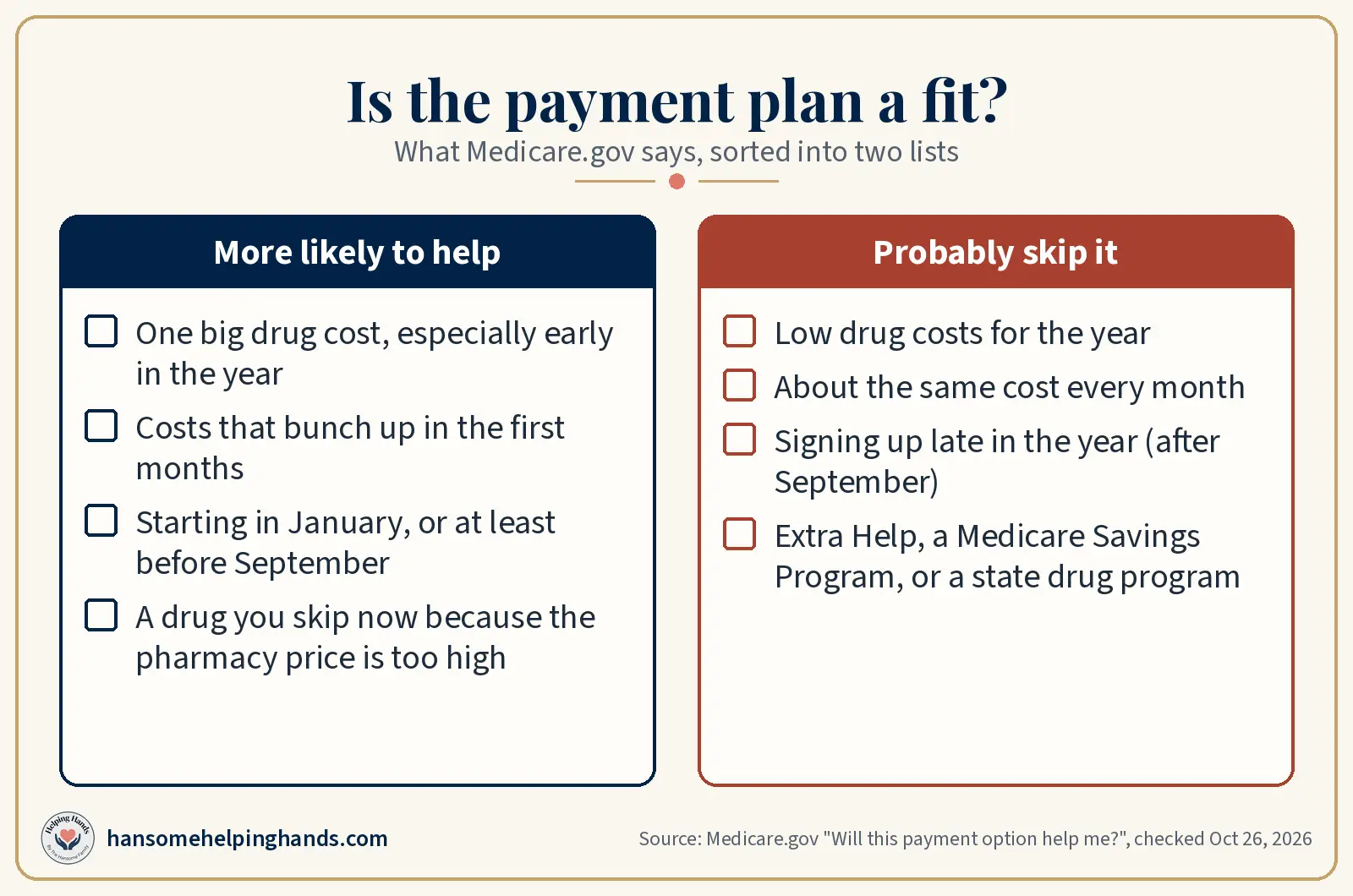
Medicare.gov also has a short Will this payment option help me? quiz. Ours is for practice, with made-up people. Guess first, then tap each card.
Quiz: should she sign up?
The answer depends on how big her costs are, when they hit, and whether she gets other help. Here are five made-up parents. Decide whether the payment plan is likely to help each one, then tap the card to see what Medicare.gov's guidance suggests. These are examples, not advice for your family.
Case 1: Mom starts a new drug in January that costs $900 out of pocket for the first fill.
Likely to help. A big cost early in the year is the textbook case. In 2027, her first bill would be capped at $200, and the rest spreads over the year.
Case 2: Dad pays about $40 a month for the same three drugs, every month.
Probably skip it. Medicare.gov says steady, low costs are not a good fit. With the plan, his bills would dip in the early months and climb near December, for the same yearly total.
Case 3: Grandma gets Extra Help and pays a few dollars per prescription.
Probably skip it. Medicare.gov says it may not be the best choice with Extra Help. She can still join, but Extra Help is what actually lowers her costs.
Case 4: It's November, and Mom's doctor prescribes a drug that costs $700 this month.
Maybe, but think twice. With only 2 months left, her bills would be large anyway. Medicare.gov says signing up after September may not help much. Asking now for 2027 makes more sense if the drug continues.
Case 5: Dad has been skipping a costly inhaler because the pharmacy price is too high in one go.
Worth a call. Medicare.gov says if a drug is too expensive at once, the payment plan might spread the cost enough to work. Ask the plan to confirm the drug is covered first.
How do you sign up for the Medicare Prescription Payment Plan?
Contact the drug plan, not Medicare and not the pharmacy. Use the plan's website, call member services, or mail its paper form. You can join any time during the year, or before the year starts, including during Open Enrollment, October 15 to December 7. The plan then sends a letter confirming you're in.
| When you ask | Plan must process a complete request within |
|---|---|
| Before the plan year (for example, now for 2027) | 10 calendar days |
| During the plan year | 24 hours |
| Request is missing information | The plan contacts you in the same window; you get 21 days to send it |
Step 1: Decide which year you're signing up for
It's late in 2026, so for most families the useful sign-up is for 2027. The federal rule says plans must let you opt in before the plan year starts, including during the annual Open Enrollment period.
Step 2: Check Extra Help first
If money is tight, Extra Help can lower the costs themselves. Our Extra Help guide has the 2026 limits and the free Social Security application.
Step 3: Confirm next year's plan
If Mom is switching plans for 2027, sign up with the new plan. Medicare.gov says that changing plans ends the payment plan, so you contact the new plan to join again.
Step 4: Call the plan
The number is on the back of the member card. The plan can also take a paper form or a website request, and it has to act fast (see the table above).
Step 5: Watch for the letter and the first bill
The plan confirms by letter and explains how to pay. The bill is separate from the premium bill.
Here is a short script you can read word for word:
Call script: joining the Medicare Prescription Payment Plan
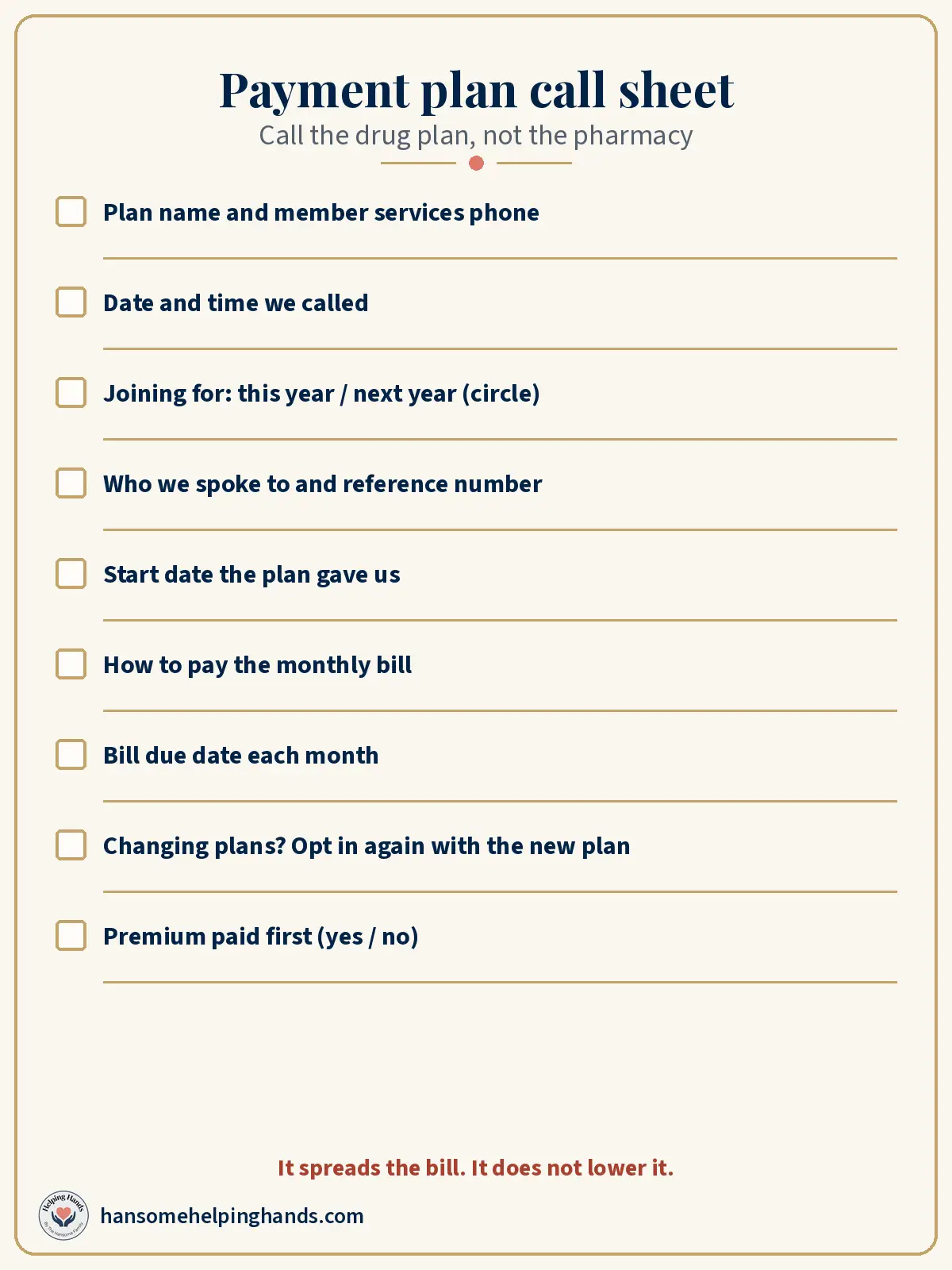
"Hi, I'm calling about the Medicare Prescription Payment Plan for [name], member ID [number]. [I'm her authorized representative.] We'd like to opt in for [the rest of this year or 2027]. Can you tell me the start date, how the monthly bill will be sent and paid, and the due date? And can you give me a reference number for this call?"
One thing we learned building our Pharmacy Said $0 organizer: once you join, two bills arrive each month, the premium and the payment plan bill. So the most important line on our fridge card is "pay the premium first." Medicare.gov says the same thing, so a missed payment never risks the drug coverage itself.
Did you know? If Mom stays in the same plan, she doesn't have to sign up again each year. CMS fact sheet 12211 says the plan automatically renews the payment plan every year, unless she changes plans or contacts the plan to opt out. CMS fact sheet 12211 (September 2026)
What happens if a payment plan bill is missed?
The plan sends a reminder. If the bill still isn't paid by the date in that reminder, she's removed from the payment plan, but she keeps her drug coverage. She still owes the balance, with no interest or fees, and can pay it all at once or in monthly bills.
That's from Medicare.gov's using this payment option page. The federal rule adds the details: the grace period is at least two months after the plan notifies her of the missed payment, and paying the overdue balance in full during that time keeps her in. A plan may refuse to let her rejoin the next year while she still owes that plan money.
| What happens | What it means for Mom |
|---|---|
| The plan sends a reminder | A grace period of at least two months starts |
| She pays the overdue amount in full | She stays in the payment plan |
| She doesn't pay by the reminder date | She is removed from the payment plan, not from her drug plan |
| She still owes a balance | No interest or fees; pay it all at once or in monthly bills |
If you think a bill is wrong, call the plan first. Medicare.gov says you can then use the grievance process in the plan's Evidence of Coverage.
How do you opt out of the payment plan?
Call the plan or use its website. Medicare.gov says you can leave any time, and leaving doesn't affect your drug coverage or other Medicare benefits. You still owe any balance, which you can pay all at once or in monthly bills. New drug costs after that are paid at the pharmacy again.
Tap to tick, your progress saves on this device
Myth or fact: what trips families up?
Most mix-ups come from the $0 at the pharmacy. It feels like a discount, but it is only a delay. Families also miss that switching plans ends the payment plan, and that Extra Help is a different program. Tap each card to check the official answer before you decide for Mom or Dad.
Myth: the payment plan lowers Mom's drug costs.
Fact: Medicare.gov says it doesn't save money or lower drug costs. It only spreads them out.
Myth: the monthly bill is the same every month.
Fact: the bill can change every month, and it often rises late in the year as new costs are split over fewer months.
Myth: if she switches plans for 2027, the payment plan comes with her.
Fact: Medicare.gov says changing plans ends it. Contact the new plan to join again.
Myth: people with Extra Help can't join.
Fact: the federal rule says they can. Medicare.gov just says it may not be the best choice, since Extra Help already keeps costs low.
Myth: a missed bill means she loses her drug plan.
Fact: she can be removed from the payment plan, but Medicare.gov says she stays enrolled in her drug or health plan.
Myth: there is a fee or interest for using it.
Fact: Medicare.gov says there is no cost to join, and no interest or fees, even on late payments.

Where can we get free help deciding?
Start with the drug plan, which runs the payment plan and can estimate the bills. For unbiased help, call your State Health Insurance Assistance Program at shiphelp.org. SHIP counseling is free and not tied to any insurance company. 1-800-MEDICARE (1-800-633-4227, TTY 1-877-486-2048) answers 24 hours a day, 7 days a week.
Shopping plans this fall? Our Medicare Open Enrollment checklist walks through the October 15 to December 7 window with the real drug list. If the pharmacy says a drug isn't covered at all, read how to ask for a Part D coverage determination. For the bigger picture, start at our Medicare and Medicaid help hub. For comparing next year's plans side by side, our Medicare Open Enrollment Kitchen Table Kit has drug and doctor grids laid out.
Want it on paper? Our Pharmacy Said $0: Medicare Prescription Payment Plan Organizer is an 8-page printable for this exact decision: a plain-English "what it is and isn't" page, a yes or no filter (including Extra Help), a call script, a fridge card for the monthly bill, Open Enrollment renew or switch reminders, and a follow-up log. It is not an enrollment form, and you never need it to join: the plan signs you up for free. Get it on Gumroad for $4.99 (price checked October 26, 2026) or see it on Etsy.
Frequently asked questions
How much do people on Medicare pay for prescriptions?
It depends on the plan and the drugs, but there is a yearly ceiling. Medicare.gov says out-of-pocket costs for covered Part D drugs are capped at $2,100 in 2026, and CMS fact sheet 12211 says $2,400 in 2027. With Extra Help in 2027, Medicare.gov lists up to $5.80 per generic and $14.40 per brand name drug.
Is the Medicare Prescription Payment Plan the same as Extra Help?
No. Extra Help lowers what you pay for drugs, and it is free to apply. The payment plan only spreads the same costs into monthly bills. Medicare.gov says the payment plan may not be the best choice if you get or qualify for Extra Help, so check Extra Help first if money is tight.
Can I sign Mom up at the pharmacy counter?
No. You sign up with the drug plan, on its website, by phone, or on its paper form. The federal rule says a complete request during the year must be processed within 24 hours. CMS fact sheet 12211 says that if you need to pick up a prescription urgently, call the plan to talk about your options.
Can I sign up for my parent?
Yes, if you are her authorized legal representative. The federal rule, 42 CFR 423.137, says the enrollee or the enrollee's authorized legal representative can opt in by paper, electronic form, or phone. Otherwise, sit with her while she calls and gives the plan permission to talk with you.
Does the payment plan change the yearly drug cap?
No. The federal rule says joining has no impact on how your out-of-pocket costs count toward the yearly cap. Medicare.gov says you will never pay more for the year than you would have paid at the pharmacy, or more than the cap, which is $2,100 in 2026 and $2,400 in 2027.
Is there interest or a fee if a bill is late?
No. Medicare.gov says there is no cost to join, and you will not pay interest or fees even if a payment is late. You still owe the balance. If the bill stays unpaid past the date in the reminder, you are removed from the payment plan but keep your drug coverage.
Please note: This guide explains official rules in plain English. It is not legal, financial, or insurance advice and we are not affiliated with Medicare or any government agency or drug plan. Confirm details with your plan, Medicare (1-800-MEDICARE), your State Health Insurance Assistance Program (SHIP), or an elder law attorney.
Sources
- Medicare.gov: What's the Medicare Prescription Payment Plan?. Checked 2026-10-26
- Medicare.gov: Before using this payment option (how the monthly bill is figured, who it may not help). Checked 2026-10-26 (2026 cap $2,100)
- Medicare.gov: Using this payment option (bills, missed payments, leaving, changing plans). Checked 2026-10-26
- Medicare.gov: Examples of this payment option (2026). Checked 2026-10-26
- Medicare.gov: Will this payment option help me?. Checked 2026-10-26
- CMS fact sheet 12211: What's the Medicare Prescription Payment Plan? (September 2026; 2027 cap $2,400, automatic renewal). Checked 2026-10-26
- eCFR: 42 CFR 423.137 (the federal Medicare Prescription Payment Plan rule). Checked 2026-10-26 (eCFR up to date as of 2026-10-22)
- CMS: Medicare Prescription Payment Plan. Checked 2026-10-26
- Medicare.gov: Help with drug costs (Extra Help 2027 costs). Checked 2026-10-26
- Medicare.gov: Joining a plan (Open Enrollment October 15 to December 7). Checked 2026-10-26
- SHIP: State Health Insurance Assistance Programs. Free local Medicare counseling
Save this guide for later
Keep reading
- Extra Help for Medicare Drug Costs: Who Qualifies and How to Apply
- The Pharmacy Said No: How to Ask for a Part D Coverage Determination
- Medicare Open Enrollment: A Kitchen-Table Checklist for Helping a Parent
- Medicare and Medicaid Help for Families: start here
- Does Medicare Pay for Home Help? Home Health vs Home Care, Sorted
- Got a NOMNC? How a Medicare Fast Appeal Works
- Medicare Savings Programs: Help Paying the Part B Premium
- Mom's Medicare Advantage Plan Is Ending or Her Doctor Left: What Now?
- Leaving Medicare Advantage: How the Medigap Trial Right Works
- Your Medicare Plan's Annual Notice of Change: What to Check Before December 7
- Medicaid Look-Back Period in Plain English: Myths vs Facts
- Who to Notify When Someone Dies: A Printable US Checklist
- How to Prepare for an IEP Meeting: A Parent's Countdown Checklist
- Dementia Behavior Log: How to Spot the Patterns the Doctor Needs to See
- Hospital Discharge Checklist: What to Ask Before Mom or Dad Leaves
- All guides