
Part of our Caring for an Aging Parent guide
Hospital Discharge Checklist: What to Ask Before Mom or Dad Leaves

Here's the surprise: your parent can spend the night in a hospital bed and still not be "admitted" at all.
Before a parent leaves the hospital, ask whether they were an inpatient or an outpatient under observation, which medicines are new, changed, or stopped, when follow-up visits are, what equipment or help is arranged, which warning signs mean call, and who to call with questions. Get it in writing you can read.
Did you know? Medicare says you are an inpatient only once a doctor writes an order formally admitting you. Without that order, you are an outpatient, even after a night in the hospital, and that status can change what you pay and whether Medicare covers a skilled nursing facility stay afterward. Medicare: Medicare Hospital Benefits
This guide is for US families helping a parent come home from the hospital. You will find the one status question to ask first, a discharge day timeline, six common mistakes that Medicare's own guidance helps you avoid, myth or fact cards, and a tickable, printable "ask before you leave" checklist.
What should I ask before my parent leaves the hospital?
Ask five things: hospital status (inpatient or observation), medicine changes, follow-up visits, equipment and home help, and who to call with questions or warning signs. Medicare's own discharge planning checklist says you and your caregiver are members of the planning team, so it is fine to ask until the answers are clear.
That last part matters. Medicare's discharge planning checklist tells patients and caregivers to talk with the doctor and staff, such as the discharge planner, social worker, or nurse, and to write down names and phone numbers. Here is the short version we use:
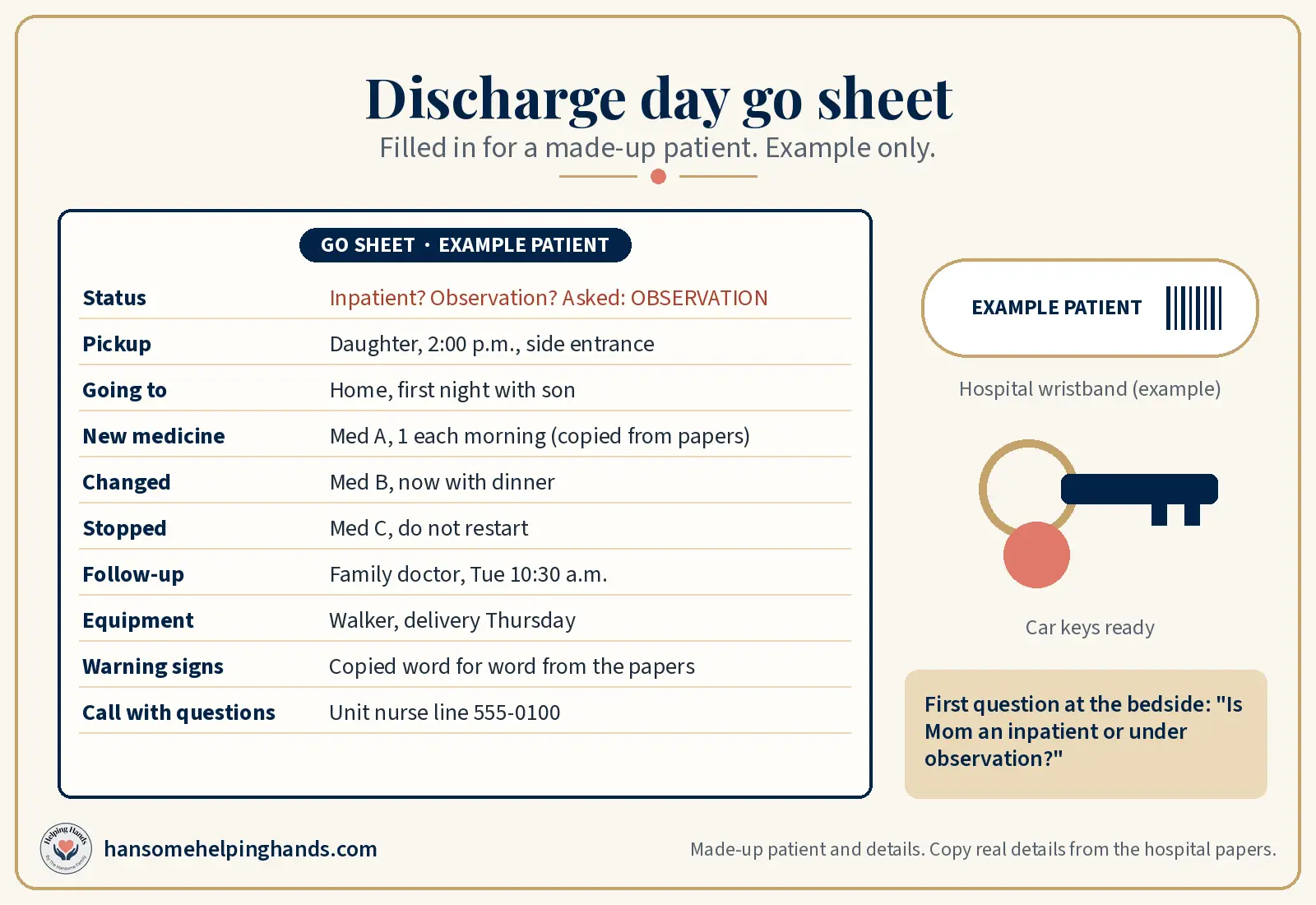
- Status: "Is Mom an inpatient or under observation?" Write the answer down.
- Medicines: Which are new, which changed dose, and which stopped? Who fills them, and when is the next dose due?
- Follow-up: Which doctor, where, and when? Is the appointment made, or do we call?
- Equipment and help: Is a walker, oxygen, or home health ordered? Is it covered, and who arranges delivery?
- Who to call: One name and number for questions once we are home, and which warning signs mean call right away.
Picture this (an example): the nurse says "discharge by noon," and suddenly someone is driving, someone is calling the pharmacy, and nobody wrote down the follow-up time. The go sheet at the top of this page is filled in for a made-up patient, so all five answers land on one page before anyone leaves the parking lot.
Is my parent an inpatient or under observation?
Your parent is an inpatient only if a doctor wrote an order formally admitting them. If not, they are an outpatient, often getting "observation services," even after a night in a regular hospital bed. Ask the doctor or hospital staff directly, because the answer affects the bill and later skilled nursing coverage.
Medicare describes observation as outpatient services a doctor orders to help decide whether you need to be admitted or can go home. It can happen in the emergency department or another part of the hospital. CMS requires hospitals to give people with Medicare a Medicare Outpatient Observation Notice, called a MOON, telling them they are outpatients getting observation services, not inpatients. If you see a MOON in the folder, that is your answer.

Why it matters, in Medicare's words from publication 11435:
| Question | Inpatient | Outpatient (observation) |
|---|---|---|
| What makes it so? | A doctor's order formally admitting them | No admit order, even after a night in a bed |
| Which part pays? | Part A for the hospital stay; Part B for most doctor services | Part B, usually with a copayment for each hospital service |
| Counts toward the 3-day stay for skilled nursing? | Yes, inpatient days count (not the discharge day) | No, observation days do not count |
| Notice you may get | Important Message from Medicare (appeal rights) | MOON (Medicare Outpatient Observation Notice) |
For context, Medicare.gov lists the 2026 Part A inpatient deductible as $1,736 per benefit period. Outpatient copays are per service. Medicare says a single outpatient service's copay can't be more than the inpatient deductible, but several services together can add up to more. If your parent has a Medicare Advantage Plan, costs and coverage may be different, so check with the plan.

What happens on discharge day?
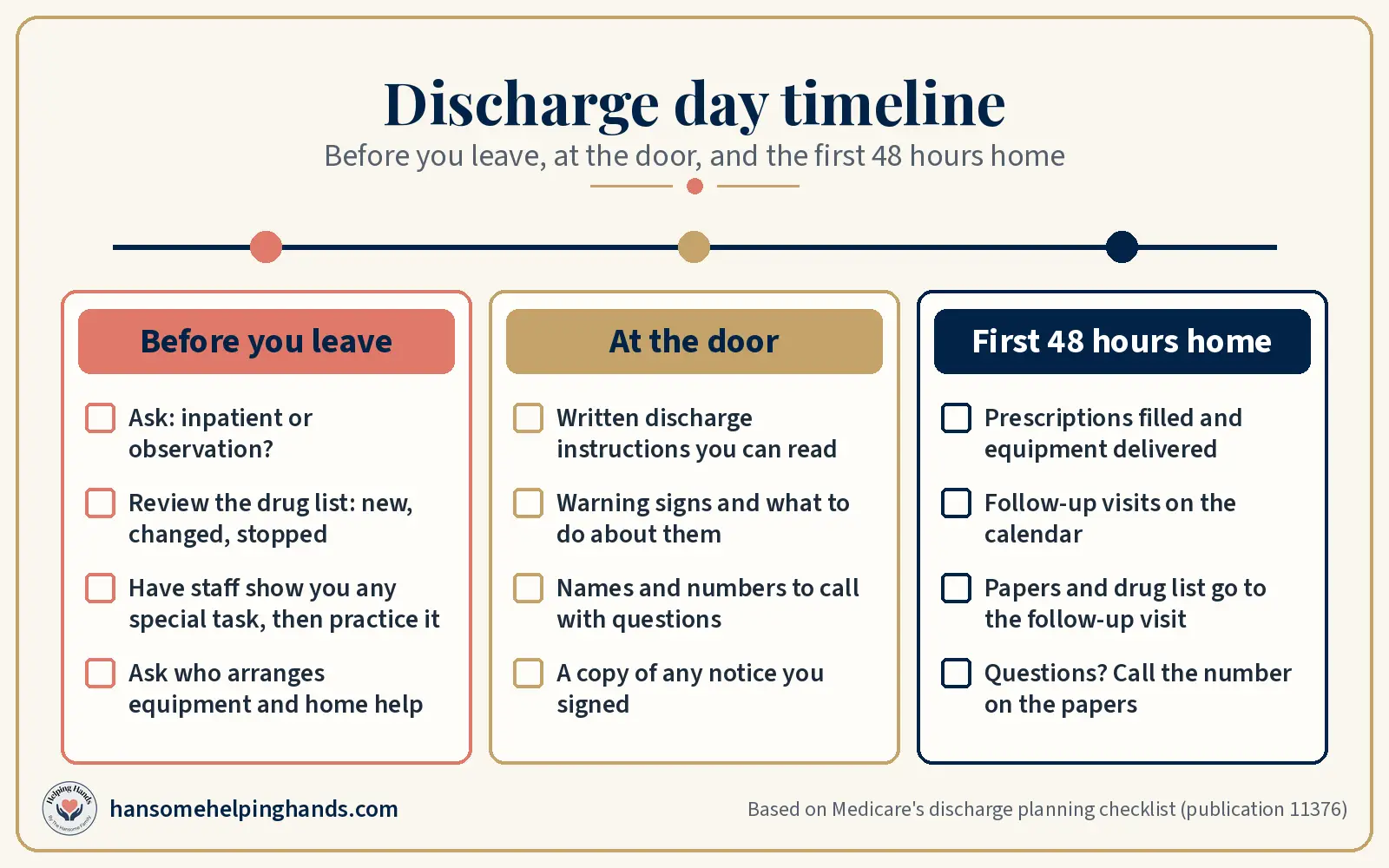
Think of discharge day in three parts: before you leave the room, at the door, and the first 48 hours home. Most of the important questions belong before you leave, while the doctor, nurse, and discharge planner are still down the hall and the paperwork can still be fixed.
Before you leave
Ask the status question. Go through the full drug list with the staff, including over-the-counter drugs and vitamins, and ask which ones to keep taking and at what dose. Medicare's checklist also says to have the staff show you and your caregiver how to do any special task, like changing a bandage or giving a shot, and then practice it yourself.
At the door
You want written discharge instructions that you can read and understand, plus a summary of current health status. Ask about complications to watch for and what to do about each. Keep a copy of any notice your parent signed.
The first 48 hours home
Medicare's checklist suggests the caregiver get prescriptions and run errands before discharge, so there are no extra trips with a tired parent in the car. Put follow-up visits on the calendar, and bring the instructions and drug list to the first appointment.
What mistakes do families make on discharge day?
The most common slips are assuming an overnight stay means admitted, leaving without a clear medicine list, choosing rehab before checking coverage, and walking out with instructions nobody can read. Each one is something Medicare's own guidance tells families to ask about, so a short checklist catches them all.
These six come straight from Medicare's hospital benefits fact sheet and discharge planning checklist, not from guesses:
- Assuming "overnight" means "admitted." Medicare is clear that an overnight stay can still be outpatient. Ask.
- Picking a skilled nursing facility before asking about coverage. Medicare generally covers skilled nursing care only after at least 3 inpatient days in a row, and observation days don't count. Ask the staff whether Medicare will cover the stay.
- Leaving with a fuzzy medicine list. The checklist says to review every drug with the staff and note changes. Copy the hospital's words; don't translate.
- Not practicing the hard task. If a bandage change or injection is coming home with you, practice it while a nurse is watching.
- No name to call. Write down who to call with questions or concerns before you leave. At 9 p.m. on night one, you will be glad you did.
- Signing papers without reading them. The Important Message from Medicare explains discharge appeal rights. Read it, and keep a copy.
One thing we learned making the Go Sheet: we kept it to 3 pages on purpose, because discharge papers already come in a thick folder. The job is to pull out the five answers above, in the hospital's own words, onto pages a sibling can read in the car.

What if we think discharge is too soon?
If your parent is an inpatient with Medicare, the hospital must give them the Important Message from Medicare, which explains how to appeal a discharge. Call the Quality Improvement Organization listed on that notice as soon as possible and before leaving. If you appeal before leaving, the notice says coverage continues while you wait.
CMS says hospitals must deliver the Important Message from Medicare to all Medicare inpatients, both Original Medicare and Medicare Advantage. The current notice says the Quality Improvement Organization will look at the records and give its decision about 2 days after you ask. If you appeal, the hospital gives you a Detailed Notice of Discharge explaining its reasons.
After the hospital, the paper changes. If your parent moves on to rehab in a skilled nursing facility, or gets home health or hospice, the notice that says Medicare coverage is ending is a NOMNC, with a noon deadline the day before the end date. Our guide to how a Medicare fast appeal works when you get a NOMNC walks through it step by step.
There is a separate case worth knowing. If your parent was admitted as an inpatient and the hospital then changed the status to outpatient getting observation services, Medicare.gov says you can ask for a fast appeal while still in the hospital if certain requirements are met. Medicare publication 11435 adds that the doctor must agree to the change and the hospital must tell you in writing before discharge.
Myth or fact?
Myth: if Dad slept in a hospital bed, he was admitted.
Fact: Medicare says you are an outpatient, even overnight, unless a doctor writes an order formally admitting you as an inpatient.
Myth: three days in the hospital always means Medicare covers rehab after.
Fact: only inpatient days count toward the 3-day stay. In Medicare's own example, one day of observation plus two inpatient days does not qualify.
Myth: the discharge day itself counts as an inpatient day.
Fact: Medicare says the day you're discharged doesn't count as an inpatient day.
Myth: families just have to accept the discharge time.
Fact: Medicare's checklist calls you and your caregiver members of the planning team, and inpatients can appeal a discharge they think is too soon through the Quality Improvement Organization.
Myth: Part B will pay for Mom's usual pills during an observation stay.
Fact: Medicare says that in most cases Part B doesn't pay for self-administered drugs in hospital outpatient settings. Bring her medicines or a list, if possible.
How do I use the ask before you leave checklist?
Tick each item as the staff answers it, write the answers in the hospital's words, and keep the page with the discharge folder. Your ticks save on this device. Print the page below so whoever drives home, or stays the first night, has the same answers you do.
Tap to tick, your progress saves on this device
Want this on paper with room to write? See what's inside the Hospital Discharge Go Sheet.

If your parent might move to assisted living after a hospital stay, our guide to questions to ask when touring assisted living has a printable scorecard. If behavior changes are hard to explain at follow-up visits, our dementia behavior log shows how to spot weekly patterns. For the bigger picture, see caring for an aging parent and our Medicare and Medicaid help hub. Each fall, the Medicare Open Enrollment checklist and our Annual Notice of Change decoder are a good time to check how a plan covers hospital and rehab stays. If a nursing home stay may follow and Medicaid comes up, our guide to the Medicaid look-back period explains the 60-month rule in plain English.
If you'd rather have this on paper already, our Hospital Discharge Go Sheet is a 3-page printable with a discharge snapshot, a medicine changes table, and a family task split.
Frequently asked questions
What is a MOON notice from the hospital?
MOON stands for Medicare Outpatient Observation Notice. CMS requires hospitals to give it to people with Medicare, including Medicare Advantage members, to tell them they are outpatients getting observation services, not inpatients. Medicare.gov says you get it if you are under observation as an outpatient for more than 24 hours. Keep it with the discharge papers.
Will Medicare cover rehab in a skilled nursing facility after the hospital?
Generally only after a qualifying inpatient stay: at least 3 days in a row as an inpatient, counting the admission day but not the discharge day. Observation and emergency room time before admission do not count. Some doctors have waivers, so Medicare says to always ask the staff whether the stay will be covered.
Can the hospital change my parent from inpatient to outpatient?
Yes, but Medicare says the doctor must agree and the hospital must tell you in writing before discharge. If your parent was admitted as an inpatient and then changed to outpatient observation, you can ask for a fast appeal while still in the hospital if certain requirements are met. Medicare.gov explains this on its hospital status change page.
Does Medicare Advantage follow the same rules?
Partly. Hospitals must give the Important Message from Medicare and the MOON to Medicare Advantage members too. But Medicare says that with a Medicare Advantage Plan, your costs and coverage may be different, including for skilled nursing care after a hospital stay. Call the number on the plan card and ask before you choose rehab or home care.
Should we bring Mom's own medicines to the hospital?
Medicare suggests bringing the medicines, or a list of them, if possible, and showing them to the staff so they know what is taken at home. For outpatients, Part B usually does not pay for everyday self-administered pills, and most hospital pharmacies are not in Part D networks, so a list also helps you sort out bills later.
Who is the Quality Improvement Organization and how do we reach it?
The Beneficiary and Family Centered Care Quality Improvement Organization, or BFCC-QIO, reviews discharge appeals and quality of care complaints for Medicare. Medicare says it is run by Commence or Acentra depending on your state. The name and toll-free number should be printed on the Important Message from Medicare, or call 1-800-MEDICARE for it.
Please note: This guide explains official Medicare guidance in plain English for family caregivers. It is not medical, legal, or insurance advice, and we are not affiliated with Medicare or any government agency. It does not replace the hospital discharge papers or your parent's doctors. Confirm details with the hospital, Medicare (1-800-MEDICARE), your plan, or your State Health Insurance Assistance Program (SHIP). In an emergency, call 911.
Sources
- Medicare: Medicare Hospital Benefits (CMS Product No. 11435, December 2025). Checked 2026-10-15 (inpatient vs outpatient, observation, 3-day inpatient stay for skilled nursing coverage)
- Medicare: Your discharge planning checklist (CMS Product No. 11376, December 2025). Checked 2026-10-15
- CMS: Important Message from Medicare (IM, CMS-10065) and Detailed Notice of Discharge. Checked 2026-10-15 (current IM form expires 03/31/2029)
- CMS: Medicare Outpatient Observation Notice (MOON, CMS-10611). Checked 2026-10-15
- Medicare.gov: Appealing a change in status during a hospital stay. Checked 2026-10-15
- Medicare.gov: Inpatient hospital care. Checked 2026-10-15 (2026 Part A deductible $1,736 per benefit period)
Save this guide for later

Keep reading
- Got a NOMNC? How a Medicare Fast Appeal Works
- Medicare Open Enrollment: A Kitchen-Table Checklist for Helping a Parent
- Questions to Ask When Touring Assisted Living (and What to Watch For)
- Dementia Behavior Log: How to Spot the Patterns the Doctor Needs to See
- Caring for an Aging Parent: start here
- The Medicare Prescription Payment Plan: Spreading Drug Costs Across the Year
- The Pharmacy Said No: How to Ask for a Part D Coverage Determination
- Who to Notify When Someone Dies: A Printable US Checklist
- Medicare Savings Programs: Help Paying the Part B Premium
- All guides