
Part of our Caring for an Aging Parent guide
Dementia Behavior Log: How to Spot the Patterns the Doctor Needs to See

Hard days with dementia can feel like a blur. A short log turns you into the detective who brings the doctor real clues, not just "afternoons are bad."
A dementia behavior log notes the date and time, what happened just before, what you saw, what you tried, and whether it helped. Over a week or two, patterns often appear: the same time of day, the same noise, a missed meal, or a new medicine. Bring those notes so the clinician can see the full picture.
Did you know? The National Institute on Aging says that besides brain changes from Alzheimer's, other factors may cause distressing behaviors, including pain, lack of sleep, hunger or thirst, constipation, side effects of new medicines, and a noisy or stressful environment. Writing down what happened before a hard moment helps you and the doctor spot what may be behind it. NIA: Managing personality and behavior changes
This guide is for US families caring for someone living with dementia. You will find a before, during, and after diagram, a made-up example week that shows a pattern by day 5, myth or fact cards, and a tickable, printable mini log page.
What is a dementia behavior log?
It is a simple written record of standout moments: when they happened, what was going on just before, what the person did or said, and what you tried next. It is not a clinical chart or a diagnosis. It is family notes that help a doctor see patterns you cannot hold in your head after a hard week.
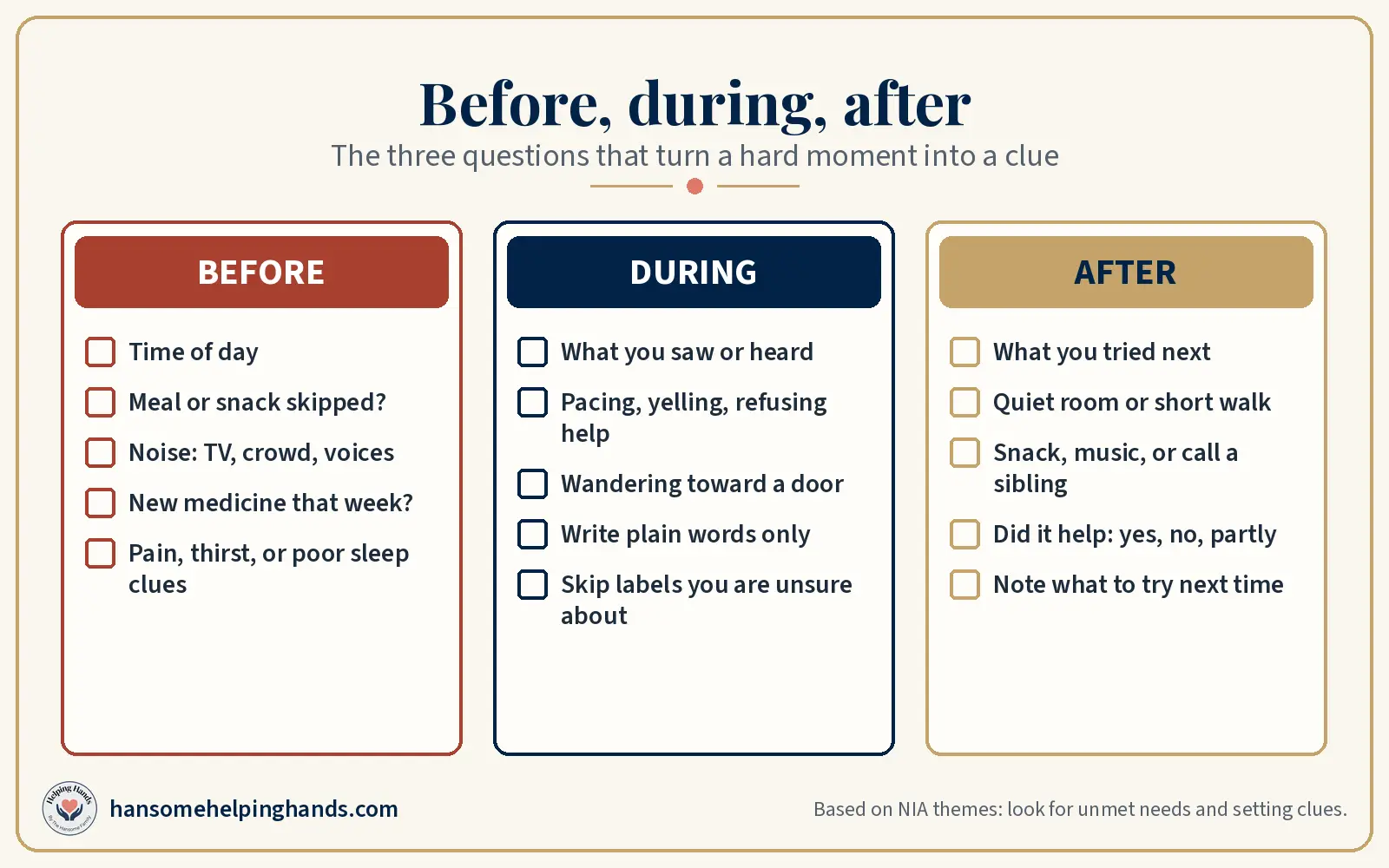
Think of three boxes every time:
- Before: time of day, meal, noise level, visitors, a new medicine, pain clues, or a change in routine.
- During: what you saw or heard, in plain words (pacing, yelling, refusing a bath, wandering toward the door).
- After: what you tried, and whether it helped (quiet room, snack, walk, music, calling a sibling).
Picture this (an example): it is Thursday night, and you are trying to tell the doctor next week that "Mom gets upset a lot." Without notes, that is all you have. With a log, you can say that four of five hard moments started after 3 p.m., when the TV news was loud and she had skipped her afternoon snack.
Why do behaviors change, and what should I look for?
NIA explains that the disease itself changes how a person acts, and that other factors can make moments harder: emotions like fear or confusion, pain, poor sleep, hunger or thirst, constipation, new medicines, and too much noise or stress. Your job is not to diagnose. Your job is to notice and write it down.
NIA's page on managing personality and behavior changes lists common changes such as getting upset more easily, pacing, wandering, hiding things, or seeming less interested. It also stresses that the disease, not the person, is driving many of these changes.
NIA's guidance on agitation and sundowning adds that late-afternoon and early-evening restlessness often has a reason worth finding: pain, too little rest, sudden changes, lonely feelings, or too many people in the room.
| Clue type | Examples to note | Why it helps |
|---|---|---|
| Body needs | Pain face, skipped meal, thirst, constipation, poor sleep | A doctor can check treatable causes |
| Setting | Loud TV, crowded room, many voices at once | You can lower noise before the next hard hour |
| Timing | Late afternoon or early evening spikes | May point to sundowning patterns NIA describes |
| Medicines | New prescription or dose change that week | Only a clinician decides medicine changes |

How do I spot a pattern in one week?
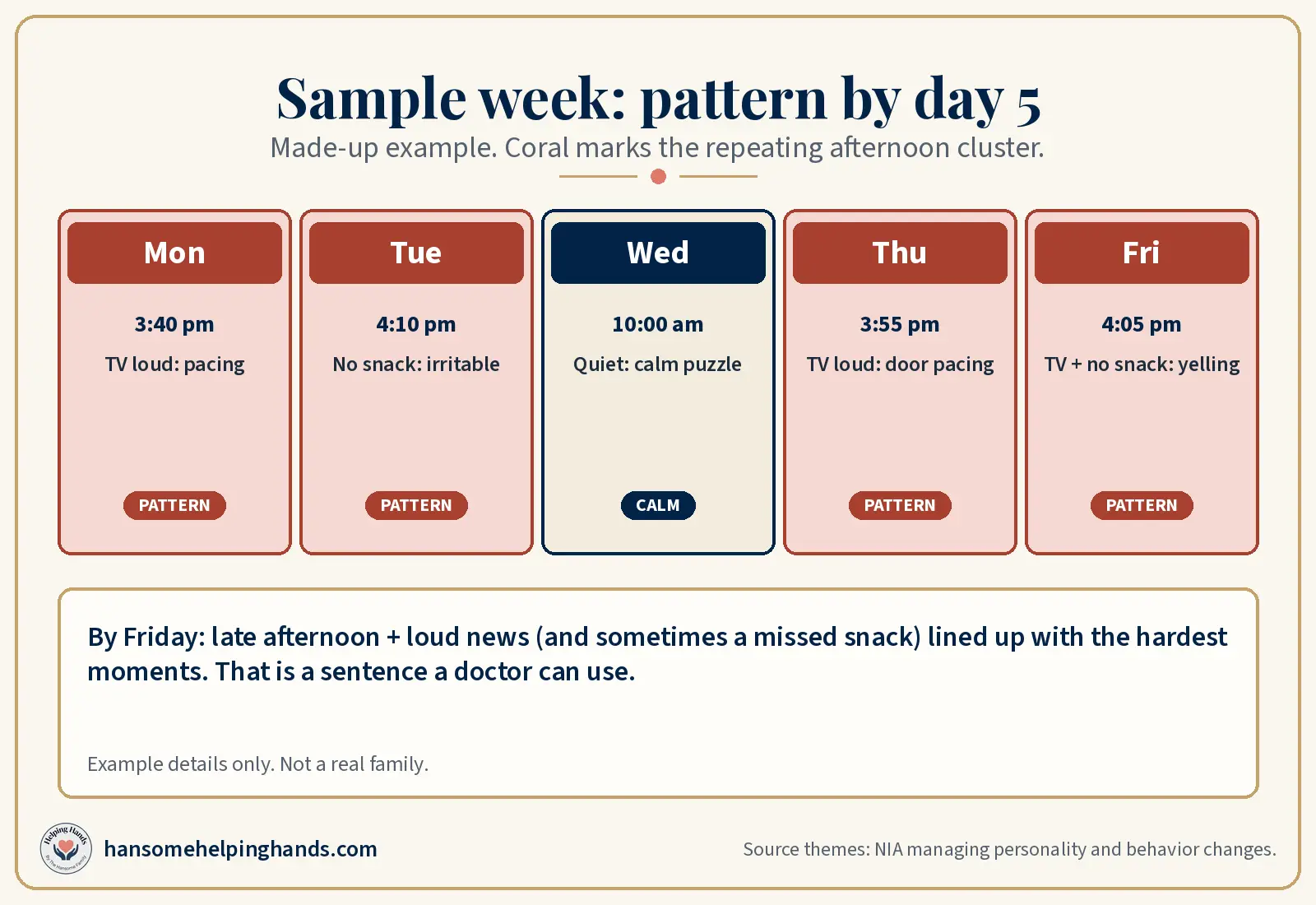
Log a few standout moments each day, not every hour. At the end of the week, circle anything that repeats: same time, same room, same trigger, same response that helped. Patterns often show by day 4 or 5 once you look at the page as a whole.
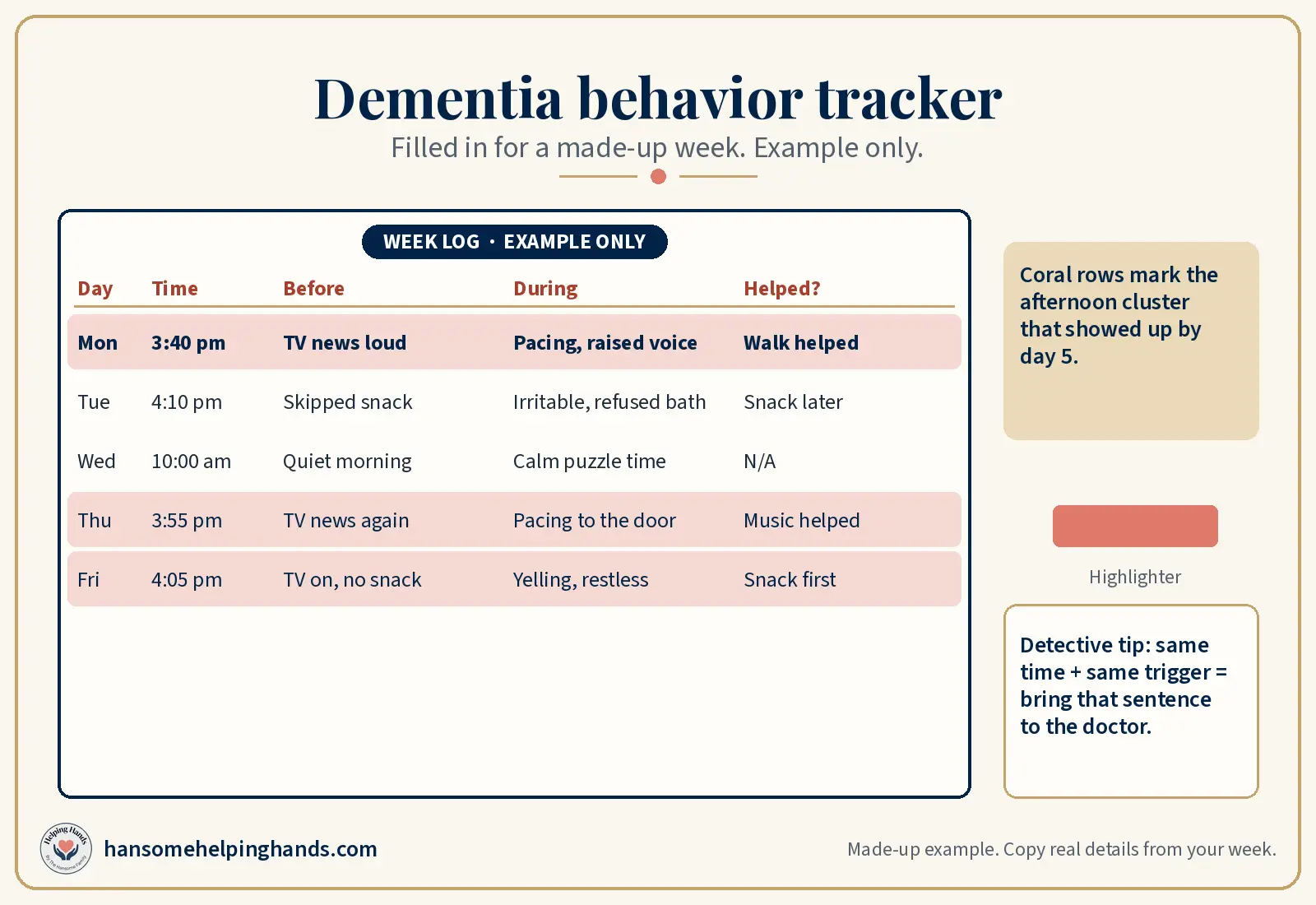
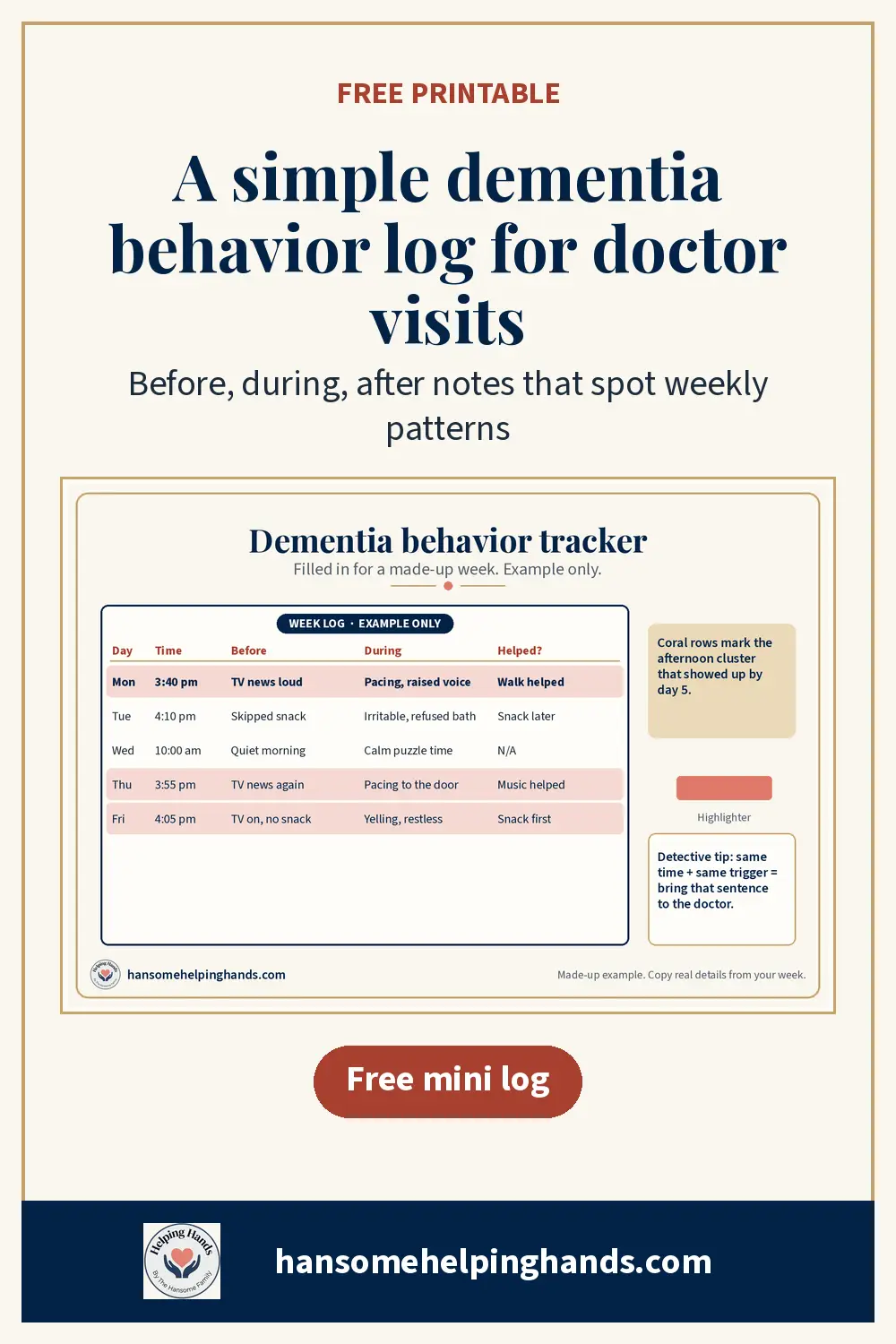
Here is a made-up example week for "Dad," living with dementia. The details are invented so you can see how a pattern forms. They are not a real family's notes.
| Day | Time | Before | During | After (what helped) |
|---|---|---|---|---|
| Mon | 3:40 p.m. | TV news on loud | Pacing, raised voice | Turned TV down, short walk |
| Tue | 4:10 p.m. | Skipped snack | Irritable, refused bath | Snack, bath later |
| Wed | 10:00 a.m. | Quiet morning | Calm puzzle time | Nothing needed |
| Thu | 3:55 p.m. | TV news again | Pacing to the door | Quieter room, favorite music |
| Fri | 4:05 p.m. | TV on, no snack | Yelling, restless | Snack first, then TV off |
By Friday in this example, the pattern is clear: late afternoon plus loud news (and sometimes a missed snack) lines up with the hardest moments. That is the kind of sentence a doctor can work with.
One thing we learned making the Tracker: families often try to write every hour and then stop. The useful version is thinner: a few clear standout moments, plus a one-page weekly summary you can hand to the clinician.
Myth or fact?
Myth: hard behavior always means the person is being difficult on purpose.
Fact: NIA says the disease, not the person, causes many of these changes. Looking for pain, hunger, noise, or fear is more useful than arguing about intent.
Myth: if I cannot explain every episode, the log is useless.
Fact: a few dated notes that show time of day or a repeated trigger are often enough for the doctor to ask better questions.
Myth: I should change medicines based on what the log shows.
Fact: never change medicines from a home log alone. Bring the notes to the prescribing clinician or pharmacist and ask.
Myth: sundowning is rare and not worth tracking.
Fact: NIA describes late-afternoon and early-evening restlessness as a known pattern. A log that notes the clock time helps you see whether it fits your household.
Myth: only a nurse can keep useful notes.
Fact: family notes in plain English are valuable. Write what you saw, not medical labels you are unsure about.

How do I use the printable mini log?
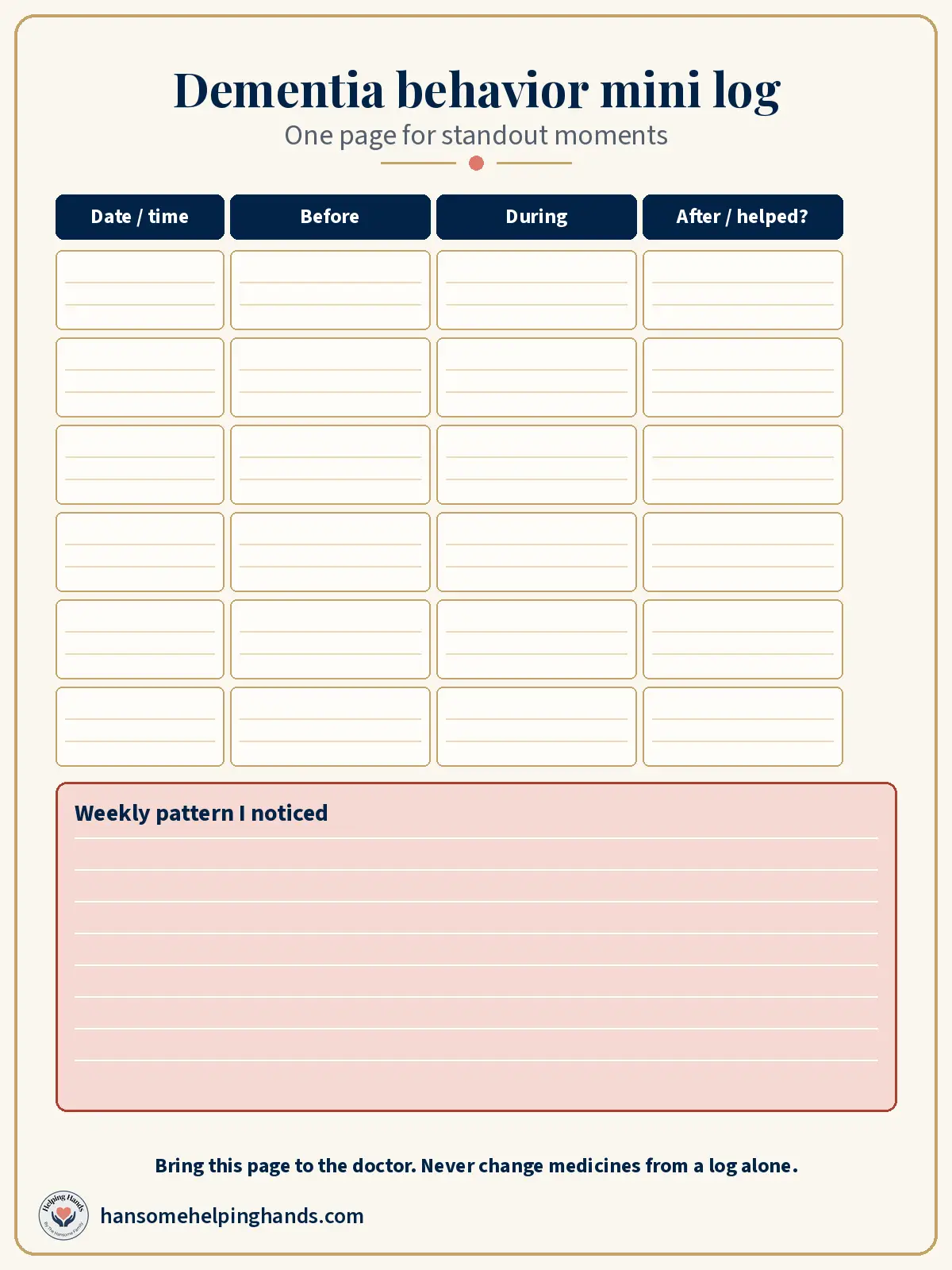
Print the page below, keep it on the fridge or in a folder, and fill one row for each standout moment. Tick the items on this page so your device remembers them too. Bring the filled page, or a photo of it, to the next appointment.
Tap to tick, your progress saves on this device
Want this on paper with room to write? See what's inside the Dementia Behavior Tracker.
For free local help, start with the Eldercare Locator or call 1-800-677-1116. For dementia questions around the clock, the Alzheimer's Association caregiving page lists the 24/7 helpline at 1-800-272-3900.
If a hospital stay is part of the story, our hospital discharge checklist covers what to ask before your parent leaves. When tours begin, see questions to ask when touring assisted living. For the bigger picture, start at caring for an aging parent. Keeping papers in one place pairs well with what to put in a death binder.
If you would rather have a full week of log pages, night notes, and a doctor visit prep sheet already laid out, our Dementia Behavior Tracker is a 13-page printable for exactly that.
Frequently asked questions
What should I write in a dementia behavior log?
Write the date and time, what was happening just before, what you saw or heard, what you tried, and whether it helped. Add notes on sleep, meals, pain clues, noise, and any new medicine. You do not need to write every hour. A few clear standout moments each week are enough for most doctor visits.
Why do behaviors change in people with dementia?
The National Institute on Aging explains that brain changes from the disease can change how a person acts, and that other factors can make hard moments worse. Those factors include pain, lack of sleep, hunger or thirst, constipation, side effects of new medicines, and a noisy or stressful setting. Looking for an unmet need is often the first step.
How long should I keep a behavior log before a doctor visit?
One to two weeks of standout notes is usually enough to show a pattern, such as the same time of day or the same trigger. Bring the weekly summary and a few sample entries. Ask the clinic how they prefer notes, paper or a short list of examples.
What is sundowning?
NIA describes sundowning as restlessness, agitation, irritability, or confusion that starts or gets worse in the late afternoon or early evening. Being overly tired can make it worse. A log that notes the time of day helps you and the doctor see whether late-day patterns are showing up.
Where can I get free caregiver help?
Start with the Eldercare Locator at eldercare.acl.gov or 1-800-677-1116 to reach your local Area Agency on Aging. The Alzheimer's Association runs a free 24/7 helpline at 1-800-272-3900 for dementia questions, crisis help, and local resources. Your parent's doctor can also refer you to local programs.
Please note: This guide is general education for family caregivers. It is not medical, legal, or placement advice, and it does not replace your loved one's doctors, a memory clinic, or professional care. Behavior changes can have many causes. Talk with a clinician about what you see. In an emergency, call 911.
Sources
- NIA: Managing personality and behavior changes in Alzheimer's. Checked 2026-10-16 (pain, hunger, thirst, sleep, new medicines, noisy settings as factors that may affect behavior)
- NIA: Coping with agitation, aggression, and sundowning. Checked 2026-10-16
- Alzheimer's Association: Caregiving (24/7 Helpline 1-800-272-3900). Checked 2026-10-16
- Eldercare Locator (Administration for Community Living). Checked 2026-10-16
Save this guide for later
Keep reading
- Hospital Discharge Checklist: What to Ask Before Mom or Dad Leaves
- Questions to Ask When Touring Assisted Living (and What to Watch For)
- Death Binder Checklist: What to Put in an In Case of Death Binder
- Caring for an Aging Parent: start here
- Got a NOMNC? How a Medicare Fast Appeal Works
- The Medicare Prescription Payment Plan: Spreading Drug Costs Across the Year
- The Pharmacy Said No: How to Ask for a Part D Coverage Determination
- Who to Notify When Someone Dies: A Printable US Checklist
- All guides