
Part of our Death Binder Checklist guide
Death Binder Checklist: What to Put in an In Case of Death Binder

Here's a quick test: if the hospital called tonight, could you find your parent's insurance cards, their doctor's number, and their will in 10 minutes?
An in case of death binder holds what your family would need in a hurry: who to call first, the will, insurance, health cards, doctors, accounts, bills, where passwords are kept, and funeral wishes. Take the 12 item self-check below. Anything you can't find becomes your to-do list.
Some families call it an in case of death binder, a just in case binder, or an emergency binder. It's the same idea. This guide is for US adult children and parents who want to get organized without a weekend of dread. You'll find a quiz style checklist you can tick on your phone or print, a map of what goes behind each tab, a few myths that trip families up, and a gentle way to bring it up.
Did you know? This isn't only an end of life idea. FEMA and the nonprofit Operation HOPE publish an Emergency Financial First Aid Kit, because the same papers matter after a fire, flood, or storm. Ready.gov says access to financial, insurance, and medical records is crucial for starting recovery quickly. Ready.gov: Financial Preparedness
Could you find these 12 things tonight?
Give yourself 10 minutes. Tick each item you could actually put your hands on, for yourself or for a parent. Your ticks save on this device, and the list prints on one page. Most families tick fewer boxes than they expect, and that's fine. Every empty box is simply the next thing to add to the binder.
Tap to tick, your progress saves on this device
Want this on paper with room to write? See what's inside the Just in Case Binder for Mom and Dad.
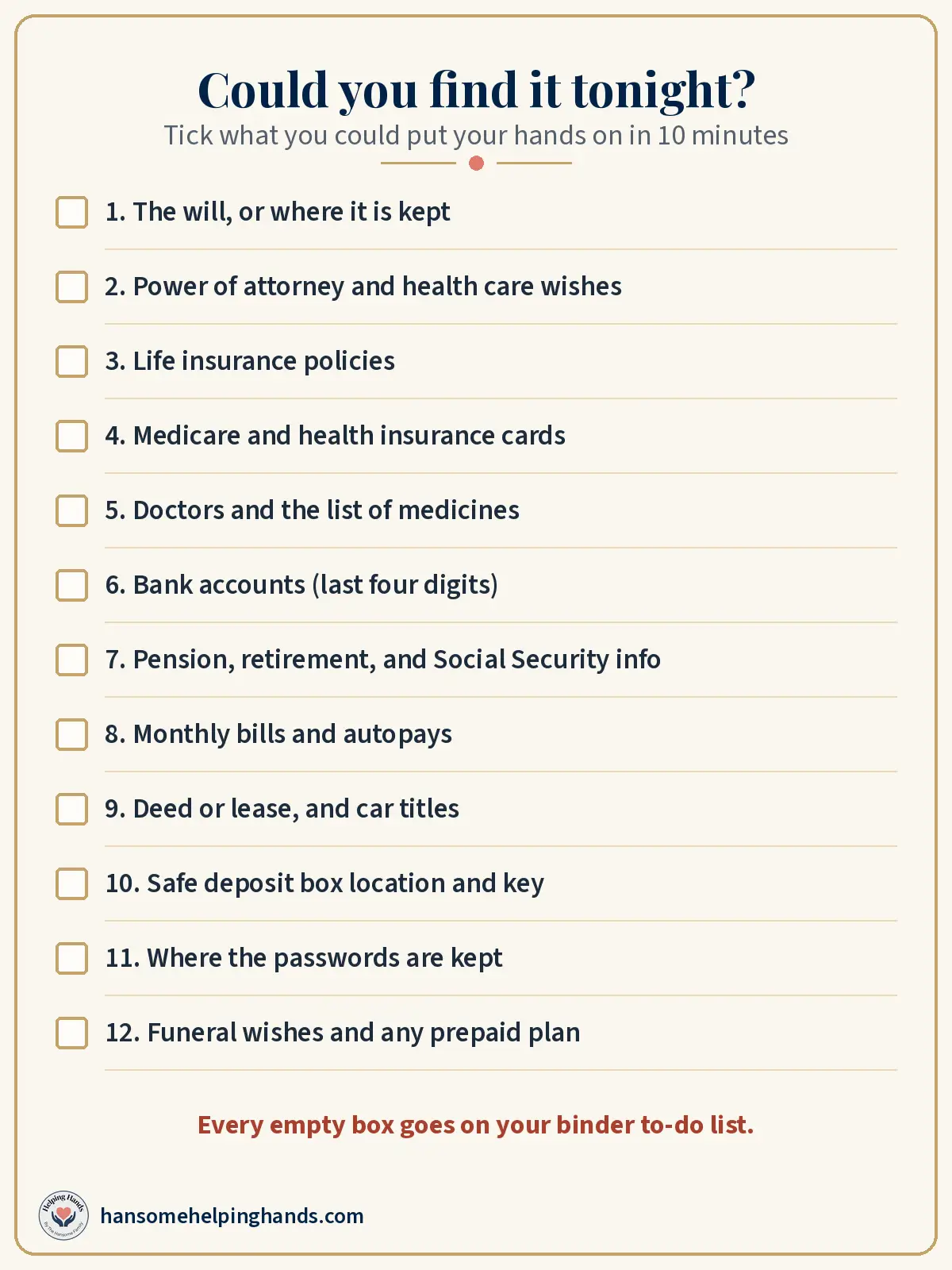
This list isn't something we made up from scratch. It follows the papers the National Institute on Aging's checklist names, including insurance with agents' names, bank names, the car title, the location of the safe deposit box and key, and where the most recent will is. The NIA even reminds families with pets to include the vet's name and address, so add that line if you have a dog or cat.
Free printable death binder checklist (PDF)
Prefer paper? Our free death binder checklist is one US Letter page with every item from this guide, sorted into the seven tabs below, with a tick box for each and a reminder of what to leave out. Print it, set a timer, and tick only what you could really find.
Download the free death binder checklist (PDF)


What do you put in a death binder, tab by tab?
Sort it into seven tabs: a one-page emergency summary, people and medical, where things are, money and bills, insurance and the home, digital accounts and pets, and wishes and letters. The summary page goes first, because in a crisis it may be the only page anyone reads.
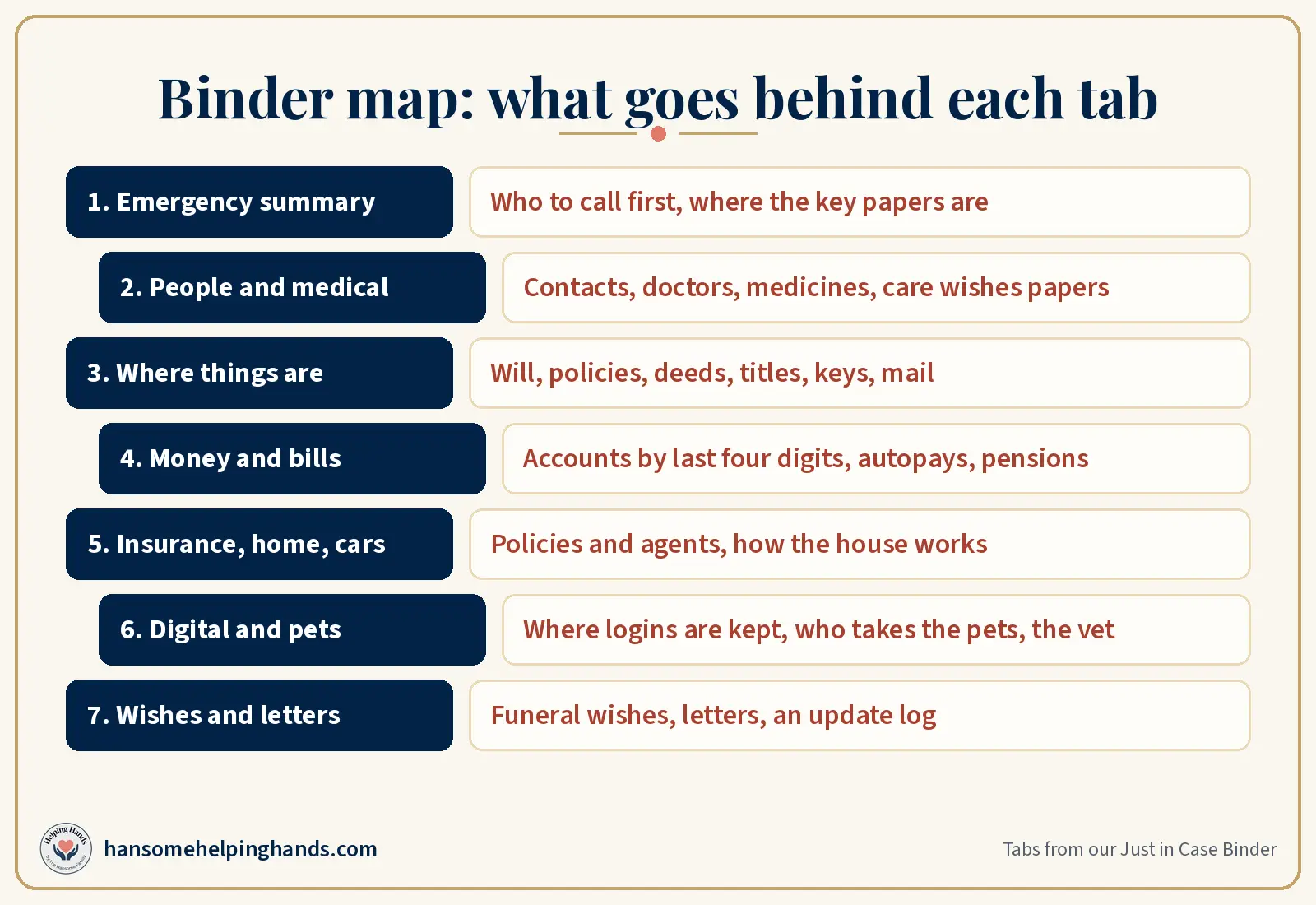
Here's the same map in words:
- Emergency summary: who to call first and where the key papers are.
- People and medical: family contacts, doctors, medicines, and where care wishes papers are kept.
- Where things are: will, policies, deeds, titles, keys, and where the mail goes.
- Money and bills: accounts by last four digits, autopays, pensions.
- Insurance, home, and cars: policies, agents, and how the house works (the water shutoff counts).
- Digital and pets: where logins are kept, who takes the pets, and the vet.
- Wishes and letters: funeral wishes, letters to loved ones, and an update log.
One thing we learned building our binder: the one-page summary in our hero picture is the page that gets used. When a parent is in the hospital, nobody reads 30 pages. They read one, so put the most important facts there and let the other tabs hold the detail.

How do you make a death binder?
Get a one-inch binder, seven tab dividers, and sheet protectors. Print the checklist above, fill the one-page emergency summary first, then do one or two tabs per sitting. Plan on about four short sittings. Tell one or two trusted people where the binder lives, and review it once a year.
- Gather supplies: a binder, seven tabs, sheet protectors for copies of cards, and the free checklist.
- Sitting one: the emergency summary and the people and medical tab. These are the pages most likely to be used.
- Sitting two: where things are, and money and bills, using the last four digits only.
- Sitting three: insurance, home, and cars, plus digital accounts and pets.
- Sitting four: wishes and letters. Save the most emotional tab for last, when the habit is already built.
- Finish: tell a trusted person where it's kept, and add a date to the update log.
Death binder myths: tap to see the facts
A few common beliefs can leave a family stuck at the worst moment, such as keeping funeral wishes only in the will or only in a safe deposit box. Tap each myth below to see what the FTC and the National Institute on Aging actually say, with the reason behind each one.
Myth: "My funeral wishes are in my will, so my family will know."
The FTC says not to put funeral preferences in your will, because a will often isn't found or read until after the funeral. Write your wishes down, give copies to family, and keep one in the binder.
Myth: "Everything important is safe in the bank safe deposit box."
The FTC warns against keeping the only copy of funeral wishes there, because your family may need to make arrangements on a weekend or holiday, before the box can be opened. The NIA says to keep copies of safe deposit papers in a file at home.
Myth: "We prepaid the funeral, so we're all set."
Only if your family knows. The FTC says if family members don't know a funeral was prepaid, they could end up paying for the same arrangements. Put the contract, or where it's kept, in the wishes tab.
Myth: "Someone needs to know all my private business."
Not at all. The NIA says you don't need to discuss your personal affairs. Someone you trust just needs to know where to find your papers in an emergency.
Myth: "It's only for when someone dies."
The same papers help after a fall, a hospital stay, or a disaster. Ready.gov's financial preparedness list includes insurance policies, doctors, health insurance information, and medications, much like a binder's first tabs.
What should you not put in a death binder?
Leave out passwords, PINs, full account numbers, and full Social Security numbers. A binder can be lost or seen by visitors. Instead, write where the password manager or sealed envelope is, the last four digits of each account, and who to call to reach the real details.

Ready.gov gives the same caution in its financial preparedness tips: be careful about sharing bank account numbers, Social Security numbers, and credit card numbers. And keep spare keys somewhere else. A binder that holds the keys to the house is a gift to anyone who picks it up.
The account list pays off later, too. It becomes the call list in our who to notify when someone dies checklist, so your family isn't guessing which banks and insurers to call.

How do I bring up a death binder with my parents?
Make it about you and the practical stuff, not about dying. Try "If you were in the hospital, I wouldn't know who your doctor is. Can we write that down?" Start with the easiest tab, like contacts and bills, and keep the first sitting short.
Three openers you can say out loud
- "I'm making one of these for myself. Want to do yours at the same time?"
- "If the hospital called me, I wouldn't know what insurance you have. Can we put the cards in one place?"
- "You don't have to tell me anything private. I just want to know where the folder is."
That last opener is backed by the NIA: someone should know where your papers are kept, without needing the details. The NIA's own example describes a woman who put her important papers in one place and told her son where to find them, long before she fell.
Each fall, keep the Medicare plan letters with those cards using our Medicare Open Enrollment checklist. When the family is also touring communities, keep licensing notes with questions to ask when touring assisted living. If pets are part of the plan, read who will take care of my pet if I die. And the accounts tab does double duty later: it's the list a family uses to figure out how many death certificates to order. If you'd rather not build the pages yourself, our Just in Case Binder for Mom and Dad has 30 large print pages, a four sitting plan, and the emergency summary page shown above.
Frequently asked questions
Is a death binder a legal document?
No. A death binder is an organizer that tells your family where things are and who to call. It does not replace a will, a power of attorney, or an advance directive. It helps your family find those documents fast, which is the point. An estate attorney can help with the legal papers themselves.
Where should I keep the binder?
Somewhere at home that a trusted person can reach, such as a desk drawer or a fireproof and waterproof safe, which the National Institute on Aging suggests for added security. If the originals are in a bank safe deposit box, the NIA says to keep copies in a file at home.
How often should I update a death binder?
At least once a year, and after big changes like a new bank, a move, a new doctor, or a new insurance policy. The NIA suggests checking each year for anything new to add. An update log page at the back makes it easy to see when the binder was last checked.
Should my parents and I each have a binder?
Many families do. Anyone with accounts, bills, or people who depend on them can use one. Starting your own binder at the same time can also make the conversation with your parents easier, because it shows you are doing it too, not singling them out.
What is an "in case of death" binder?
An in case of death binder, sometimes called a just in case or emergency binder, is one place that tells your family who to call, where important papers and keys are kept, what accounts and bills exist, and what your wishes are. It is an organizer, not a legal document, but it helps your family find the legal documents quickly.
Who should know where the binder is kept?
Tell at least one or two trusted people, such as an adult child or the person named in legal documents, where the binder is stored. The National Institute on Aging advises telling a trusted family member or friend where your important papers are. A binder nobody can find does not help anyone, so say it out loud.
Is there a free printable death binder checklist?
Yes. Our free one-page death binder checklist PDF lists every item on this page by tab, with tick boxes and a reminder of what to leave out. Print it, tick what you could find tonight, and use the empty boxes as your to-do list. It prints on US Letter paper.
Is there a free death binder template I can print without signing up?
Yes. Our free death binder checklist PDF downloads straight from this page with no email and no account. It works as a one-page template: tick what your family could find tonight, then build the tabs from the empty boxes. For every page laid out for you, our Just in Case Binder for Parents is a 30-page large-print template.
What is the difference between a free death binder checklist and a full death binder template?
A checklist tells you what belongs in the binder. A full template gives you a fill-in page for each section, so you write the answers once in one place. Start with the free checklist to see your gaps. Use a full template if your family wants one finished binder that anyone could pick up and follow.
Please note: This guide is general education, not legal or financial advice. A binder is an organizer, not a legal document. For wills, powers of attorney, and state rules, talk with an estate attorney.
Sources
- National Institute on Aging: Getting Your Affairs in Order Checklist. Checked 2026-10-09
- FTC: Planning Your Own Funeral. Checked 2026-10-09
- Ready.gov: Financial Preparedness and the Emergency Financial First Aid Kit. Checked 2026-10-09 (page last updated March 13, 2026)
- National Institute on Aging: AgePage, Getting Your Affairs in Order (PDF). Checked 2026-10-09
Save this guide for later

Keep reading
- How Many Death Certificates Do I Need? Count Yours in 5 Minutes
- Who to Notify When Someone Dies: A Printable US Checklist
- Who Will Take Care of My Pet If I Die? Myths, Facts, and a Simple Plan
- Death Binder Checklist: start here
- Got a NOMNC? How a Medicare Fast Appeal Works
- The Medicare Prescription Payment Plan: Spreading Drug Costs Across the Year
- The Pharmacy Said No: How to Ask for a Part D Coverage Determination
- Medicare Savings Programs: Help Paying the Part B Premium
- All guides