
Part of our Medicare and Medicaid Help for Families guide
The Pharmacy Said No: How to Ask for a Part D Coverage Determination

Picture this: Dad slides his card across the pharmacy counter, and the pharmacist says, "Your plan won't cover this one." Here's the reframe: that is not the plan's decision yet. It's your cue to ask for one.
A Part D coverage determination is your drug plan's official decision on whether it will cover or pay for a drug, and what you pay. You, your representative, or the prescriber can ask by phone or in writing. The plan must answer within 72 hours, or 24 hours for a fast request. Exceptions also need the doctor's statement.
This guide is for US families helping a parent with a Medicare drug plan or a Medicare Advantage plan with drug coverage. You get a decoder for the pharmacy's "no," a step by step walkthrough, a short call script, the deadlines on one card, a "which request fits Dad?" quiz, myth vs fact cards, and a free printable call sheet.
Did you know? The pharmacy is supposed to hand you something. Medicare.gov says that if your pharmacy can't fill a prescription as written, it will give you a notice explaining how you or your doctor can ask the plan for a coverage decision, including an exception. CMS calls it "Medicare Drug Coverage and Your Rights" (form CMS-10147). Medicare.gov: safety checks and the pharmacy notice
What is a Part D coverage determination?
It is the plan's formal answer about a drug. CMS lists six kinds: whether it will provide or pay for a drug, a formulary or tiering exception, what you pay, a quantity limit, a "try another drug first" rule, and prior authorization. A rejected claim at the counter starts the process. It doesn't end it.
The CMS coverage determinations page says a coverage determination is any decision the plan makes about a drug you believe may be covered, the amount you pay, a dose limit, a step therapy rule, or prior authorization. Three words to know:
- Formulary: the plan's list of covered drugs. Medicare.gov says each list includes at least 2 drugs in the most commonly prescribed categories and classes.
- Exception: a special kind of coverage determination. CMS says it is how you ask the plan to cover a drug that's not on its list, waive a rule, or charge the lower tier's price.
- Tier: the price level of a drug on the list. Lower tiers usually cost less.
Medicare.gov's How do drug plans work? page adds a reassuring detail: plans must include most drugs in six protected classes, which are cancer drugs, HIV/AIDS drugs, antidepressants, antipsychotics, anticonvulsants, and immunosuppressants for organ transplants.

| What you heard | What to ask the plan for | Doctor's statement needed? |
|---|---|---|
| Not on the plan's drug list | Formulary exception | Yes |
| Needs prior authorization | Prior authorization decision, or an exception to the rule | Often; yes for an exception |
| Try a cheaper drug first (step therapy) | Step therapy exception | Yes |
| Only a set number of pills is covered | Quantity limit exception | Yes |
| Covered, but on a high tier | Tiering exception (lower copay) | Yes |
| You already paid and want it back | Payment request, in writing | Only if it is also an exception |
Sometimes the fix is simpler than any request. Medicare.gov's Medicare Appeals booklet (April 2026) suggests asking the prescriber whether you already meet the prior authorization or step therapy rule, and whether a generic or lower cost drug could work just as well.
How do you ask for a coverage determination?
Call the plan's number on the back of the member card, write the plan a letter, or send the free CMS model form. Say the drug, the dose, the pharmacy, and the date it was refused. For an exception, the prescriber sends a supporting statement. If waiting could seriously harm health, ask for a fast decision.
Step 1: At the counter, get three facts and the notice
The pharmacy notice says to be ready to tell the plan the drug name with dose and strength, the pharmacy that tried to fill it, and the date. Write them down before you leave, and ask for the notice if nobody offers it.
Step 2: Ask about a temporary supply
If the plan is new to Dad, ask whether he can get a transition fill. Medicare.gov's drug plan rules page describes it as a one-time, 30-day supply of a drug he's been taking that the plan doesn't cover or puts under prior authorization or step therapy.
Step 3: Call the plan and say the words "coverage determination"
The number is on the back of the card. Using the official words helps the plan route the call. You can also ask for a decision before you go to the pharmacy, Medicare.gov says, so you know ahead of time.

Step 4: Get the doctor's statement moving
For any exception, CMS's Exceptions page says the prescriber must send a supporting statement, by phone or in writing. For a tiering exception, it says the cheaper drugs would not work as well, would cause bad effects, or both.
Step 5: Decide: standard or fast?
Ask for a fast (expedited) decision if waiting could seriously jeopardize Dad's life, health, or ability to regain maximum function. The CMS model form says that if the prescriber backs that up, the plan automatically decides within 24 hours.
Step 6: Write down the clock
Note the date and time you asked, the reference number, and when the answer is due. The call sheet at the end of this guide has a line for each.
Here is a short script you can read word for word:
Call script: asking the plan for a coverage determination
"Hi, I'm calling for my father, [name], member ID [number]. I'm his [daughter or son and representative]. I'd like to request a coverage determination for [drug, dose, and strength]. [Pharmacy name] couldn't fill it on [date] because [reason the pharmacy gave]. We're asking for [an exception or prior authorization], and his doctor, [name and phone], will send a supporting statement. [His doctor says waiting could seriously harm his health, so we're asking for a fast decision.] Can you give me a reference number and tell me when the decision is due?"
One thing we learned building our Pharmacy Said No file: the clock for an exception does not start when you call. It starts when the doctor's statement reaches the plan. So the call to the doctor's office often matters more than the call to the plan.
How long does the plan have to decide?
For a drug you haven't gotten yet, 72 hours for a standard request and 24 hours for a fast one. For an exception, the clock starts when the doctor's statement arrives. If you're asking to be paid back, the plan has 14 days. A missed deadline counts as a denial and goes to an independent reviewer.
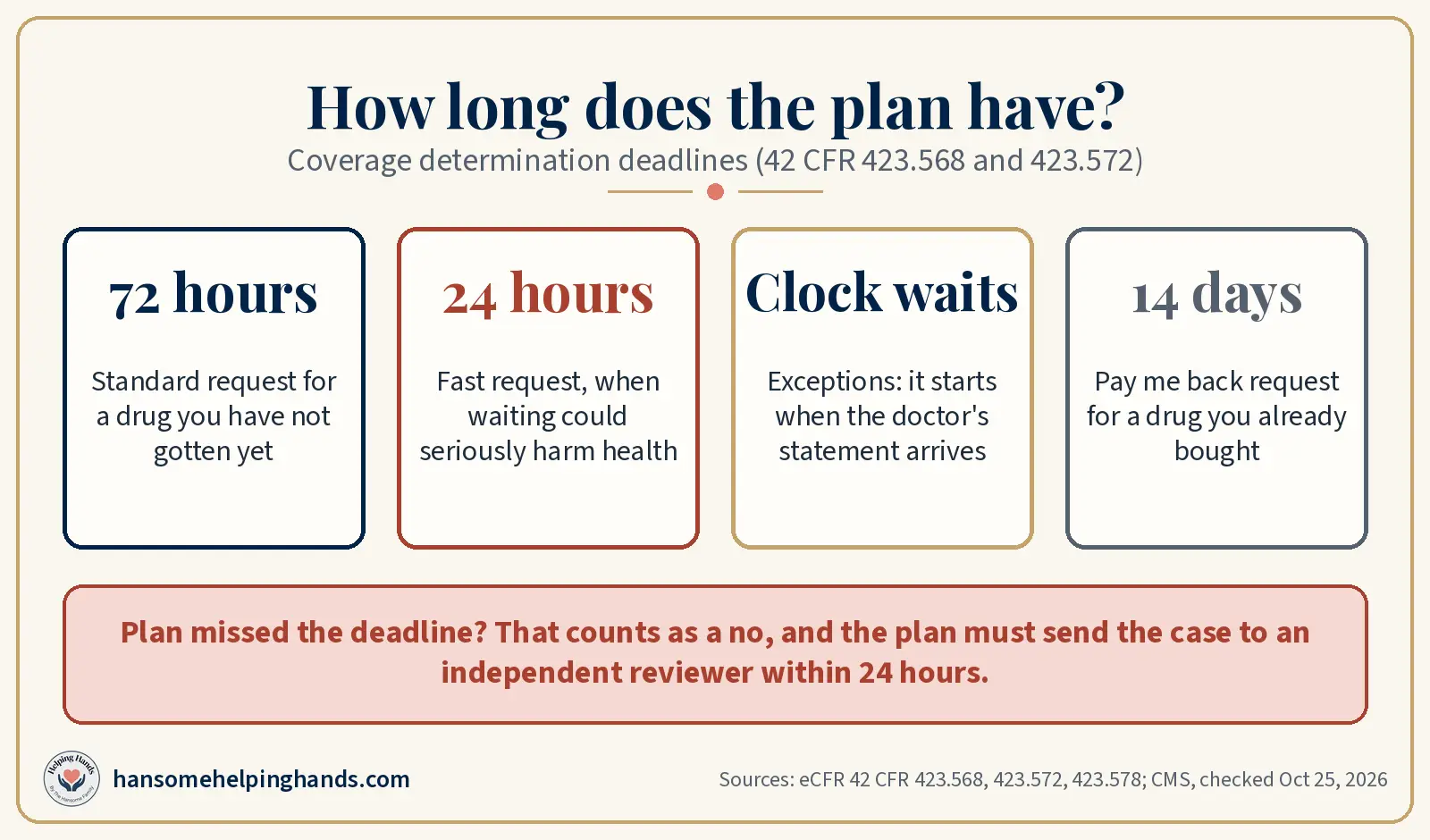
| Type of request | Plan must decide within | When the clock starts |
|---|---|---|
| Standard, drug not yet received | 72 hours | When the plan gets the request |
| Fast (expedited) | 24 hours | When the plan gets the request |
| Exception, standard or fast | 72 or 24 hours | When the doctor's supporting statement arrives |
| Pay me back (payment request) | 14 days | When the plan gets the request |
The federal rule at 42 CFR 423.568 adds a backstop. If the doctor's statement never arrives, the plan still has to decide within 72 hours (24 for a fast request) after 14 calendar days from the request. The plan can give the answer by phone first, but it must mail the written notice within 3 calendar days.
Did you know? A plan can't win by stalling. Under the federal rule, if the plan misses its deadline, that failure counts as a denial, and the plan must forward the request to the independent review entity within 24 hours. eCFR: 42 CFR 423.568
Quiz: which request fits Dad?
The right request depends on the exact words the pharmacy used. Here are six made-up situations for one made-up dad, a retired bus driver with four regular prescriptions. Guess which request fits each one, then tap the card to check. The answers come from CMS, Medicare.gov, and the federal rules.
Case 1: January 3. Dad joined a new plan for the year, and his inhaler isn't on its list.
Ask the pharmacy about a transition fill first. The federal rule gives new members a one-time temporary supply of at least a month during the first 90 days. Then ask the doctor about a covered alternative, or ask the plan for a formulary exception with the doctor's statement.
Case 2: The plan covers 30 tablets a month, but his doctor prescribed 60.
A quantity limit exception. The doctor's statement explains why the limited number of doses won't work for him.
Case 3: The plan wants him to try a cheaper drug first. He tried it two years ago and it made him dizzy.
A step therapy exception. The doctor's statement says the required drug caused, or is likely to cause, a bad reaction. Bring the old pharmacy records if you have them.
Case 4: His heart medicine is covered, but on a high tier. The cheaper drug on a lower tier didn't work for him.
A tiering exception. If the plan approves it, the federal rule says he pays the cost sharing of the preferred alternative drugs.
Case 5: The pharmacy says "prior authorization needed," and his doctor says he already meets the plan's criteria.
A prior authorization request. The doctor's office sends the plan the information that shows he meets the rule. If he doesn't meet it but needs the drug anyway, that's an exception to prior authorization.
Case 6: He paid full price on Saturday so he wouldn't miss a dose.
A payment request, in writing, with the receipt. The plan has 14 days to decide and pay if it approves. A fast decision isn't available for a drug he already got.
What happens if the plan approves it, or says no?
If the plan approves an exception, the federal rule says Dad doesn't have to ask again for each refill for the rest of the plan year, while his doctor keeps prescribing it and it stays safe. If the plan says no, he can appeal within 65 days of the date on the denial notice.
The first appeal is called a redetermination, and it goes back to the plan. Medicare.gov's drug plan appeals page says to include his name, address, Medicare Number, the drug, the reasons, and anything that helps, like the prescriber's statement. The plan decides a standard appeal in 7 days, a payment appeal in 14 days, and a fast appeal in 72 hours. If it still says no, he has 60 days to ask an independent review entity for the next level. Each denial letter explains the next step.
| Level | Who decides | Time to ask | Decision within |
|---|---|---|---|
| 1: Redetermination | The drug plan | 65 days from the date on the denial notice | 7 days standard, 14 days payment, 72 hours fast |
| 2: Reconsideration | Independent review entity | 60 days from the plan's decision | 7 days standard, 14 days payment, 72 hours fast |
Two more good things to know from the exceptions rule, 42 CFR 423.578:
- The drug counts toward the yearly cap. What he pays for a non-formulary drug covered through an exception counts toward his out-of-pocket limit. Medicare.gov's drug coverage booklet puts that cap at $2,100 in 2026.
- January is a new year. The approval runs through the plan year. If he stays in the same plan, the rule says the plan may choose to continue it. Ask the plan in the fall, and check the drug on the Annual Notice of Change.
What if the plan changes its drug list during the year?
Medicare.gov says that for most changes affecting a drug you take, the plan must either send written notice at least 30 days ahead, or give a month's supply at your next refill under the old rules. A plan can remove a drug right away if the FDA calls it unsafe or the maker pulls it from the market.
Medicare.gov adds one more case: plans that meet certain rules can swap a brand name drug for a new generic as soon as it comes out, and tell you afterward. That 30 day window is the time to call the doctor and ask the plan for an exception. Medicare.gov's drug coverage booklet says so directly: you may need to change the drug or pay more, and you can also ask for an exception. And if a letter says the plan is changing a drug for next year, our Annual Notice of Change decoder shows what to circle before December 7.
Tap to tick, your progress saves on this device

Myth or fact: what trips families up?
Most mix-ups come from treating the pharmacy's screen as the final word. The plan hasn't made a formal decision until you ask for one, and you don't need a lawyer or a special form to ask. Tap each card to check the official answer before you give up on a drug.
Myth: when the pharmacy says no, that is the plan's final answer.
Fact: a rejected claim at the counter is not a coverage determination. Medicare.gov says the pharmacy should give you a notice explaining how to ask the plan for one.
Myth: only the doctor can ask the plan.
Fact: CMS says the enrollee, the prescriber, or the enrollee's representative can ask.
Myth: you have to fill out an official form.
Fact: a phone call or letter works for a drug not yet received. CMS says written requests can use the model form, the plan's form, or any written document.
Myth: fast decisions are only for emergencies.
Fact: the test is whether waiting could seriously jeopardize life, health, or the ability to regain maximum function. If the doctor says so, the plan must expedite.
Myth: an approved exception has to be approved again at every refill.
Fact: the federal rule says not for the rest of the plan year, as long as the doctor keeps prescribing it and it stays safe.
Myth: drugs covered through an exception don't count toward the yearly cap.
Fact: the federal rule says costs for a non-formulary drug covered this way count toward the out-of-pocket limit, which Medicare.gov lists as $2,100 in 2026.

Where can we get free help with a Part D denial?
Start with your State Health Insurance Assistance Program at shiphelp.org. SHIP counseling is free, local, and not tied to any insurance company. The plan's member services line handles the request itself, and 1-800-MEDICARE (1-800-633-4227, TTY 1-877-486-2048) can help you reach the plan. Bring the call sheet to every call.
Is the cost the real problem? Read Extra Help for Medicare drug costs for the 2026 limits and the free Social Security application. Covered, but the bill arrives all at once? The Medicare Prescription Payment Plan spreads it into monthly bills. Shopping plans this fall? Our Medicare Open Enrollment checklist walks through the October 15 to December 7 window with the real drug list. For the bigger picture, start at our Medicare and Medicaid help hub. For comparing next year's plans, our Medicare Open Enrollment Kitchen Table Kit has drug and doctor grids laid out.
Want the paperwork already laid out? Our Pharmacy Said No: Part D Coverage Determination and Formulary Exception File is a 14-page printable for this exact job: a denial type decoder, a rights notice log, a deadline clock worksheet, a doctor supporting statement checklist, a case and call log, call scripts, and a redetermination path. It does not include any government form, and you never need it to ask: the plan takes coverage determination requests by phone or letter for free. Get it on Gumroad for $12.99 (price checked October 25, 2026) or see it on Etsy.
Frequently asked questions
Is a coverage determination the same as prior authorization?
Not quite. Prior authorization is one plan rule, and asking the plan to approve it is one kind of coverage determination. CMS says a coverage determination is any plan decision about whether it will provide or pay for a drug, what you pay, or whether a rule like prior authorization, step therapy, or a quantity limit applies to you.
Where do I get the coverage determination request form?
You don't have to use a form. CMS says you can call, write a letter, or use the free Model Coverage Determination Request Form from the Downloads section of the CMS coverage determinations page. Many plans also post their own form. Requests to be paid back must be in writing unless the plan accepts phone requests.
Can Mom switch Part D plans midyear if her plan stops covering her drug?
Usually not right away. Most people switch during Open Enrollment, October 15 to December 7. Medicare.gov says people with Medicaid or Extra Help can change once a calendar month, and Medicare Advantage members get January 1 to March 31. Meanwhile, the plan must give 30 days notice or a month's supply, and she can ask for an exception.
Can I ask for a coverage determination for my parent?
Yes, as her representative. CMS says the enrollee, the prescriber, or the enrollee's representative can ask. The CMS model form says that if someone other than the enrollee or prescriber files it, they should include proof of authority, like a completed CMS-1696 representative form or an equivalent. Ask the plan what it accepts.
What if Dad already paid for the drug out of pocket?
Keep the receipt and ask the plan to pay him back. Medicare.gov says a request for money back must be made in writing, by letter or on the model form. CMS says the plan must decide and pay, when it approves, within 14 days. A fast decision is not available for a drug he already received.
Please note: This guide explains official rules in plain English. It is not legal, medical, or insurance advice and we are not affiliated with Medicare or any government agency or drug plan. Confirm details with your plan, Medicare (1-800-MEDICARE), your State Health Insurance Assistance Program (SHIP), or an elder law attorney.
Sources
- CMS: Coverage Determinations (what counts, who can ask, 72 and 24 hour deadlines, 14 days for payment). Checked 2026-10-25 (Model Coverage Determination Request Form in Downloads)
- CMS: Exceptions (formulary and tiering exceptions, prescriber supporting statement). Checked 2026-10-25
- CMS: Plan Sponsor Notices (pharmacy notice CMS-10147, denial notice CMS-10146). Checked 2026-10-25 (current denial notice gives 65 days to appeal)
- Medicare.gov: Appeals in a Medicare drug plan. Checked 2026-10-25 (65 days to appeal; 7 days, 14 days, 72 hours)
- Medicare.gov: Drug plan rules (prior authorization, step therapy, quantity limits, transition fill). Checked 2026-10-25
- Medicare.gov: Safety checks and the pharmacy notice. Checked 2026-10-25
- Medicare.gov: Your Guide to Medicare Drug Coverage (publication 11109; drug list changes during the year, 2026 cap). Checked 2026-10-25
- eCFR: 42 CFR 423.568 (standard deadlines, missed deadline goes to the independent reviewer). Checked 2026-10-25 (also 423.572 for fast decisions)
- eCFR: 42 CFR 423.578 (exceptions process; approval lasts the plan year). Checked 2026-10-25
- eCFR: 42 CFR 423.120 (transition supply in the first 90 days of a new plan). Checked 2026-10-25
- Medicare.gov: Medicare Appeals (publication 11525, April 2026; talk to your prescriber first). Checked 2026-10-25
- Medicare.gov: Special Enrollment Periods (Extra Help and Medicaid: once a calendar month). Checked 2026-10-25
- SHIP: State Health Insurance Assistance Programs. Free local Medicare counseling
Save this guide for later

Keep reading
- Extra Help for Medicare Drug Costs: Who Qualifies and How to Apply
- The Medicare Prescription Payment Plan: Spreading Drug Costs Across the Year
- Your Medicare Plan's Annual Notice of Change: What to Check Before December 7
- Medicare Open Enrollment: A Kitchen-Table Checklist for Helping a Parent
- Medicare and Medicaid Help for Families: start here
- Got a NOMNC? How a Medicare Fast Appeal Works
- Medicare Savings Programs: Help Paying the Part B Premium
- Mom's Medicare Advantage Plan Is Ending or Her Doctor Left: What Now?
- Leaving Medicare Advantage: How the Medigap Trial Right Works
- Medicaid Look-Back Period in Plain English: Myths vs Facts
- Who to Notify When Someone Dies: A Printable US Checklist
- How to Prepare for an IEP Meeting: A Parent's Countdown Checklist
- Dementia Behavior Log: How to Spot the Patterns the Doctor Needs to See
- Hospital Discharge Checklist: What to Ask Before Mom or Dad Leaves
- All guides