
Part of our Medicare and Medicaid Help for Families guide
Medicaid Look-Back Period in Plain English: Myths vs Facts

Picture this: years ago, Mom wrote her grandson a $3,000 check for his first car. It was a happy day. On a nursing home Medicaid application, it is a line the state may ask about.

For long-term care Medicaid, such as nursing home care, the state looks back 60 months, five years, from the application date. It checks for gifts or transfers made for less than fair market value, which can delay coverage with a penalty period. Normal bills and fair sales are not gifts, and good records help you explain each one.
Did you know? The penalty clock does not start on the day the gift was made. For transfers made on or after February 8, 2006, CMS explains that the penalty begins on the gift date or the date the person is in a nursing home and would otherwise qualify for Medicaid to pay, whichever is later. CMS: Transfer of Assets in the Medicaid Program
This guide is for US families helping a parent or spouse who may need nursing home care. You will find a made-up 60-month timeline, a plain-English table of what the state may ask about, the federal penalty math with example numbers, myth vs fact cards, and a tickable, printable "what to gather" checklist.
How far back does Medicaid look?
Sixty months. The Deficit Reduction Act of 2005 set the look-back for long-term care Medicaid at five years before the date the person applies. For someone already in a nursing home, federal law counts back from the first date they are both in care and have applied. Your state Medicaid agency applies the details.
The CMS backgrounder on transfer of assets describes the look-back as a review of whether the person, or their spouse, gave away assets "for less than fair market value." Its own examples are cash gifts to children and transferring home ownership.
That is the whole idea in one sentence: the state is asking whether money or property left without something of equal value coming back.
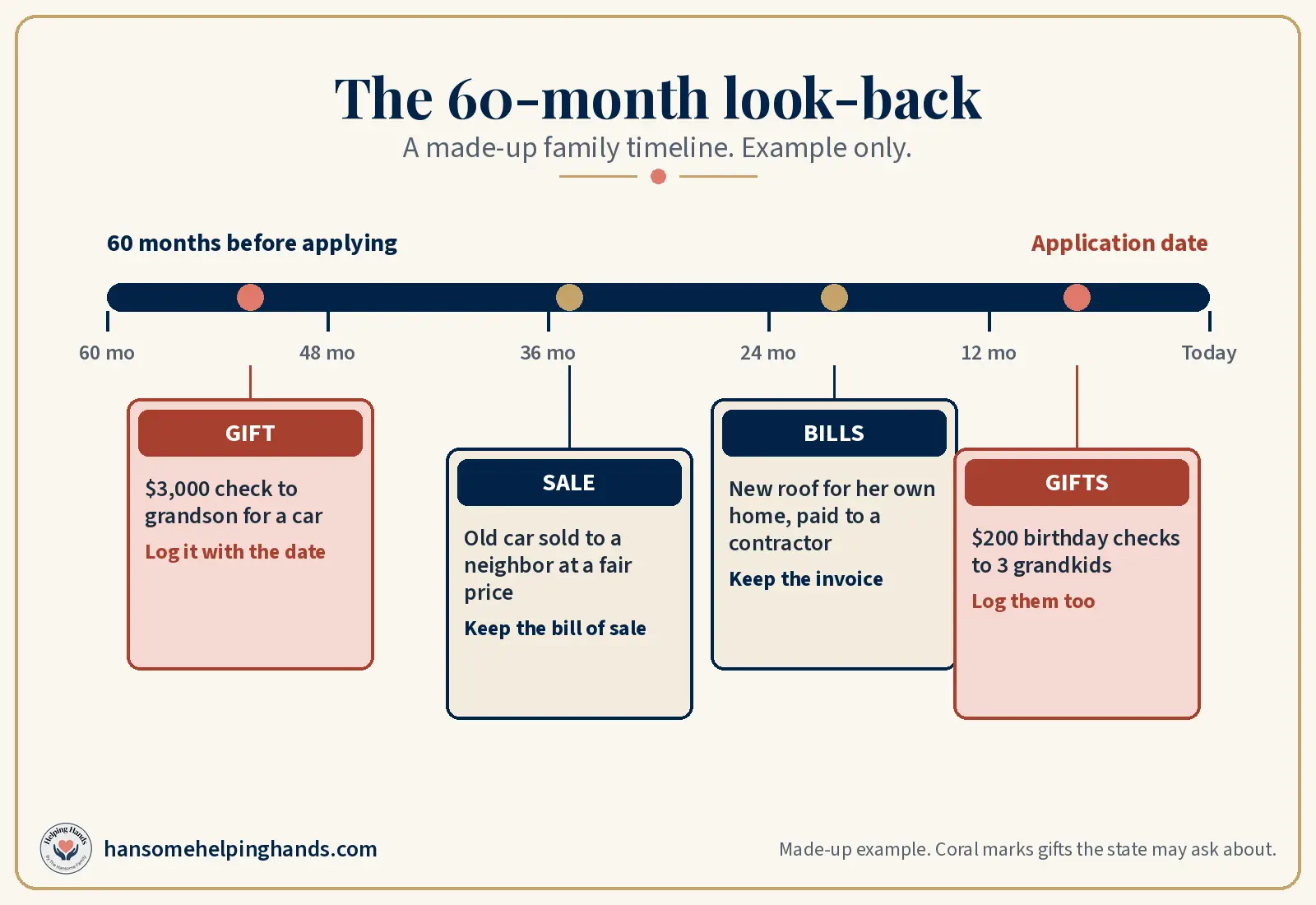
In this example, the roof repair and the fair car sale are normal money moves with paper to prove them. The two coral items are gifts, so they belong in a gift log with dates, amounts, and the reason.
What counts as a transfer during the look-back?
A transfer the state may ask about is money or property given away, or sold for less than it is worth, during the 60 months. Paying normal bills, buying things for the person, and selling at a fair price are not gifts. Keep receipts so you can show the difference. Your state decides how each item is treated.
| Example | Why the state may ask | Paper that helps |
|---|---|---|
| Cash gift to a child or grandchild | Money left with nothing of equal value back | Gift log: date, amount, who, why |
| House or car put in a child's name | CMS lists home transfers as an example | Deed or title records, any exception that applies |
| Car sold to a neighbor | Only if the price was below its value | Bill of sale and a value estimate |
| Roof repair, groceries, medical bills | Usually normal spending for the person | Invoices and receipts for large items |
Federal law also lists exceptions in section 1917 of the Social Security Act. For example, transfers to a spouse do not cause a penalty, and a home can go to a child who is under 21 or blind or disabled. A home can also go to a son or daughter who lived there for at least two years and gave care that kept the parent at home, as the state determines. These are exactly the cases where proof matters, so ask your state what it needs to see.
One thing we learned making the Look-Back File: the hardest part is rarely the rule. It is finding month 41 of a checking account that was closed three years ago. Start a list of banks, account numbers, and which months you still need on day one.
What happens if there was a gift?
A gift during the look-back can mean a penalty period: months when Medicaid will not pay for long-term care. Federal law divides the total value of the gifts by your state's average monthly private-pay nursing home cost. The result is the number of months. A penalty delays coverage; it does not ban someone from Medicaid.
The formula is written into section 1917(c) of the Social Security Act. It also says states may not round down or ignore a fraction of a month. Here is how that works with made-up numbers.
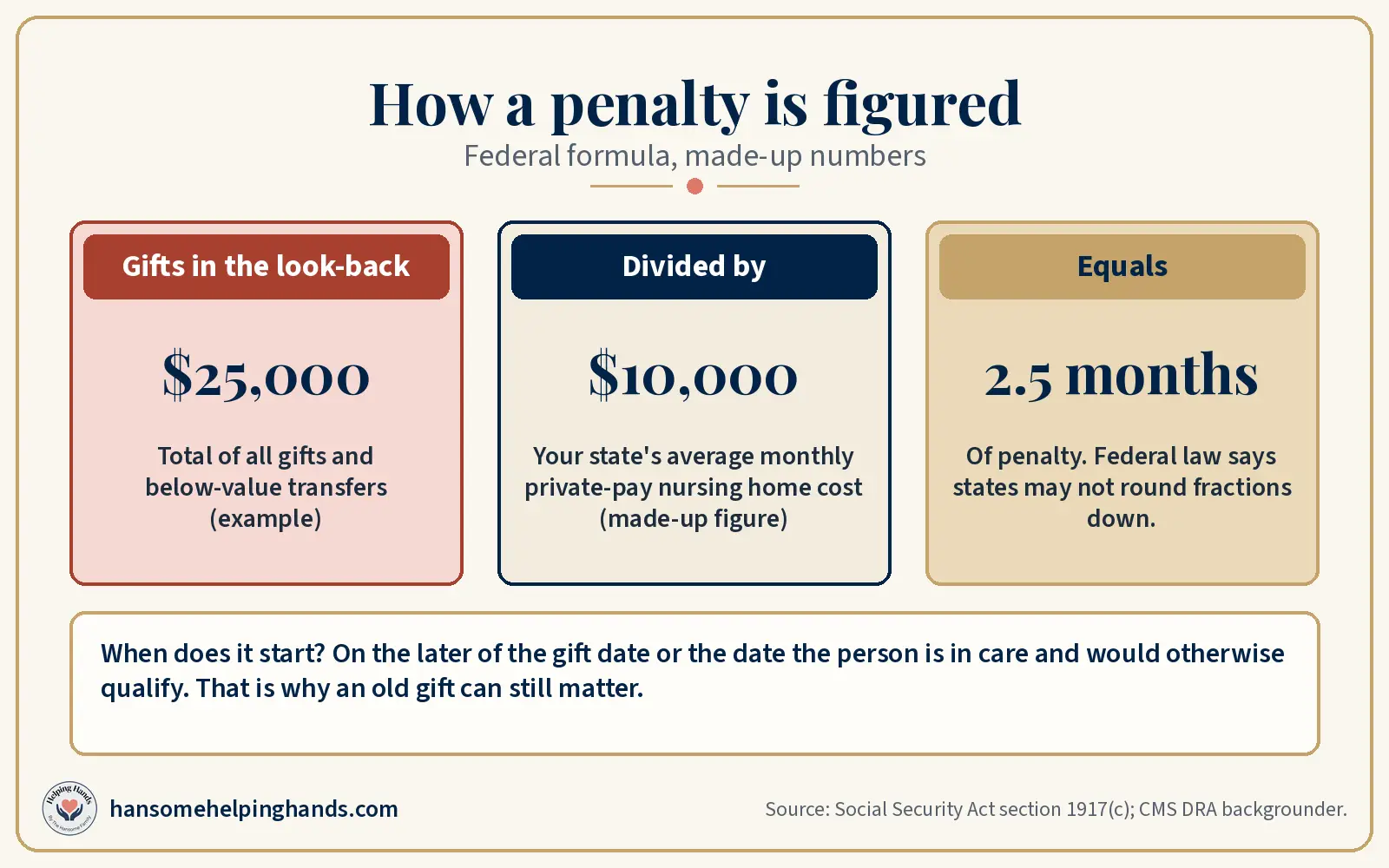
Imagine $25,000 in gifts during the look-back, and a state whose average monthly private-pay cost is $10,000 (a made-up figure; every state sets its own). That is 2.5 months of penalty. Because of the start rule in the fact box above, those months begin when the person is in care and would otherwise qualify, not back when the checks were written.
There are two safety valves in federal law. A penalty does not apply when all of the transferred assets are returned, or when the family shows the transfer was made only for another reason, not to qualify for Medicaid. States must also have an undue hardship waiver for cases where a penalty would threaten health or life or leave someone without food, clothing, or shelter. The CMS backgrounder notes that a nursing home can request the waiver for a resident, with consent.
Myth or fact?
Tap each one to check it against the official source.
Myth: small gifts to the grandkids never count.
Fact: the federal rule asks about transfers for less than fair market value, and CMS's own example is cash gifts to children. The IRS yearly gift amount is a tax rule, not a Medicaid rule. Log every gift and ask your state how it treats small ones.
Myth: the five years count back from the day Mom moves in.
Fact: CMS says the look-back covers the 60 months before the date of the Medicaid application. For someone already in care, federal law counts back from the first date they are both in care and have applied.
Myth: Medicare will pay for the nursing home, so none of this matters.
Fact: Medicare.gov says Medicare does not pay for long-term care, also called custodial care. Medicaid may, if your parent meets the rules in their state.
Myth: one gift means no Medicaid, ever.
Fact: a gift can cause a penalty period, a set number of months without long-term care coverage. It is a delay, figured with a federal formula, and states must offer an undue hardship waiver.
Myth: every state handles the look-back exactly the same way.
Fact: the 60-month rule is federal, but each state runs its own Medicaid program and applies the details. Ask your state Medicaid agency, not a neighbor or a forum.
Myth: it is smart to skip mentioning old gifts.
Fact: the state reviews the whole look-back period, and the honest path is the safe one. Explain each item with its paper trail and let the state decide. Never move money or property to beat the rules without advice from a qualified elder law attorney.
Who decides, and who can help for free?
Your state Medicaid agency decides the application and applies the look-back. For free local help, the Eldercare Locator connects you with your Area Agency on Aging. A qualified elder law attorney or legal aid office can explain your state's rules before anyone moves money. SHIP counselors help with the Medicare side.
| Who | What they help with |
|---|---|
| Your state Medicaid agency | Takes the application and is the only place that can tell you what it needs to see |
| Eldercare Locator, 1-800-677-1116 | Finds your local Area Agency on Aging, which can point you to benefits help and legal services for older adults |
| Elder law attorney or legal aid office | Questions about gifts, homes, trusts, or a spouse who still lives at home |
| Medicare.gov: long-term care | What Medicare does and does not cover, which is usually the first surprise |
What should we gather before applying?
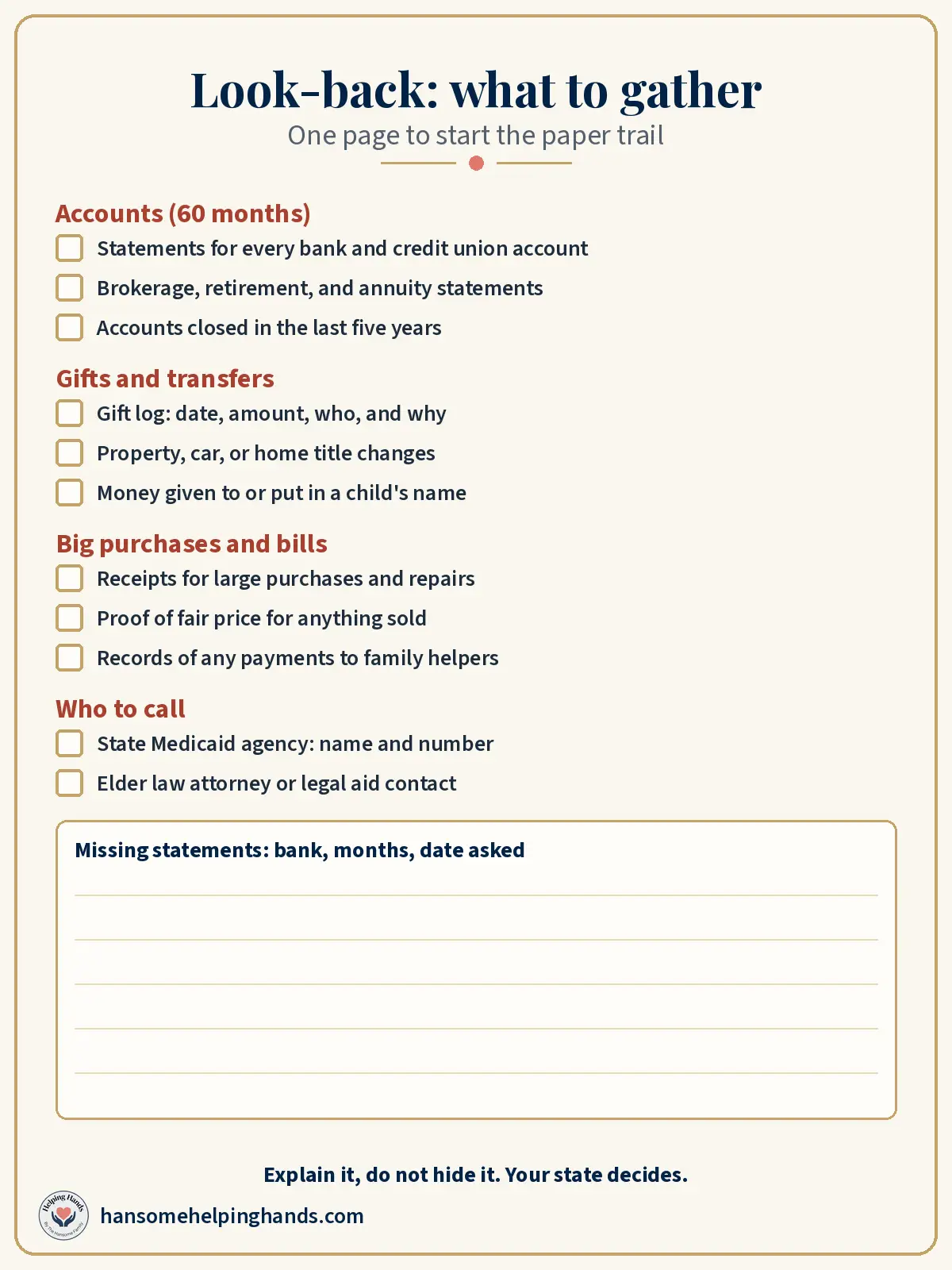
Gather five years of statements for every account, including closed ones, a dated log of gifts and transfers, title or deed changes, and receipts for large purchases. Write down banks that cannot find old records and when you asked. Tick the list below as you go; it saves on this device and prints.

Tap to tick, your progress saves on this device
Want this on paper with room to write? See what's inside the Medicaid Look-Back File.
If a nursing home move is on the horizon, our guide to questions to ask when touring assisted living compares assisted living and nursing homes. After a hospital stay, the hospital discharge checklist covers what to ask before leaving. For the bigger picture, start at our Medicare and Medicaid help hub, and keep the finished file with the rest of the family papers from what to put in a death binder.
If you would rather have the 60-month statement checklist, gift log, spending explanation slips, and bank request log already laid out, our Medicaid Look-Back File is a 12-page printable for exactly that.
Frequently asked questions
Does Medicaid check five years of bank statements?
For long-term care Medicaid, states review transfers made during the 60 months before the application, so many ask for statements covering that time. The exact list of papers is set by your state. Ask the caseworker early which accounts and months they need, and keep a log of any bank that cannot provide old records.
Does the look-back apply to every kind of Medicaid?
No. The federal look-back is part of applying for Medicaid long-term care, such as nursing home care and some home and community-based services. Other kinds of Medicaid usually work differently. Each state runs its own program, so ask your state Medicaid agency which programs use the look-back where your parent lives.
What if a gift is returned?
Federal law says the penalty does not apply when all assets transferred for less than fair market value are returned to the person. How a state handles timing, partial returns, and proof is a state detail. Talk with your state Medicaid agency or an elder law attorney before you move any money back.
What is an undue hardship waiver?
Federal law requires states to have a process to waive a transfer penalty when it would cause undue hardship, such as threatening the person's health or life or leaving them without food, clothing, or shelter. A nursing home can apply on a resident's behalf with consent. Ask your state how to request one.
Where can we get free help with the look-back?
Start with your state Medicaid agency, which decides the application. The Eldercare Locator at eldercare.acl.gov or 1-800-677-1116 connects you with your local Area Agency on Aging, which can point you to benefits counseling and legal help for older adults. For Medicare questions, free SHIP counselors are at shiphelp.org.
Please note: This guide explains official rules in plain English. It is not legal, financial, or insurance advice, and we are not affiliated with Medicaid, Medicare, or any government agency. Rules vary by state. Confirm details with your state Medicaid agency or a qualified elder law attorney before you move money or property.
Sources
- CMS: Transfer of Assets in the Medicaid Program (Deficit Reduction Act backgrounder). Checked 2026-10-17 (60-month look-back before the application date; penalty start rule for transfers on or after February 8, 2006; hardship waiver)
- Social Security Administration: Social Security Act section 1917 (transfer of assets rules). Checked 2026-10-17 (penalty months formula, no rounding down, exceptions, returned assets, undue hardship)
- Medicare.gov: Long-term care. Checked 2026-10-17 (Medicare does not pay for long-term care; Medicaid may, if you meet your state's rules)
- Eldercare Locator (Administration for Community Living). Checked 2026-10-17
Save this guide for later
Keep reading
- Questions to Ask When Touring Assisted Living (and What to Watch For)
- Hospital Discharge Checklist: What to Ask Before Mom or Dad Leaves
- Death Binder Checklist: What to Put in an In Case of Death Binder
- Medicare and Medicaid Help for Families: start here
- Does Medicare Pay for Home Help? Home Health vs Home Care, Sorted
- Got a NOMNC? How a Medicare Fast Appeal Works
- The Medicare Prescription Payment Plan: Spreading Drug Costs Across the Year
- The Pharmacy Said No: How to Ask for a Part D Coverage Determination
- Medicare Savings Programs: Help Paying the Part B Premium
- Extra Help for Medicare Drug Costs: Who Qualifies and How to Apply
- Mom's Medicare Advantage Plan Is Ending or Her Doctor Left: What Now?
- Leaving Medicare Advantage: How the Medigap Trial Right Works
- Your Medicare Plan's Annual Notice of Change: What to Check Before December 7
- Medicare Open Enrollment: A Kitchen-Table Checklist for Helping a Parent
- Who to Notify When Someone Dies: A Printable US Checklist
- How to Prepare for an IEP Meeting: A Parent's Countdown Checklist
- Dementia Behavior Log: How to Spot the Patterns the Doctor Needs to See
- Who Will Take Care of My Pet If I Die? Myths, Facts, and a Simple Plan
- All guides