
Part of our Medicare and Medicaid Help for Families guide
Medicare Savings Programs: Help Paying the Part B Premium

Picture this: Mom holds up her Social Security letter and taps one line. $202.90 comes out every month for Medicare Part B. A Medicare Savings Program is the state help that can pay that line for her.
Medicare Savings Programs are four state-run programs that help pay Medicare premiums, and in the QMB program also deductibles and copays. The 2026 Part B premium is $202.90 a month. Federal limits start at $1,350 a month in income and $9,950 in resources for one person, and some states allow more. You apply free through your state Medicaid office.
This guide is for US families helping a parent who is stretched by Medicare costs. You get the four programs on one card, a "which program fits?" quiz with made-up examples, a five step application walkthrough, what QMB means at the doctor's office, myth vs fact cards, and a free one-page prep sheet.
Did you know? Medicare.gov's own advice is to apply even if you don't think you qualify. The limits you see online are federal ones, and some states don't count certain types or amounts of income or resources. So a parent a little over the numbers below may still be approved in her state. Medicare.gov: Medicare Savings Programs
What are the Medicare Savings Program income limits for 2026?
Medicare.gov lists 2026 monthly income limits for one person of $1,350 for QMB, $1,616 for SLMB, and $1,816 for QI, with a resource limit of $9,950. For a married couple the limits are $1,824, $2,184, and $2,455, with $14,910 in resources. Limits are slightly higher in Alaska and Hawaii and go up each year.
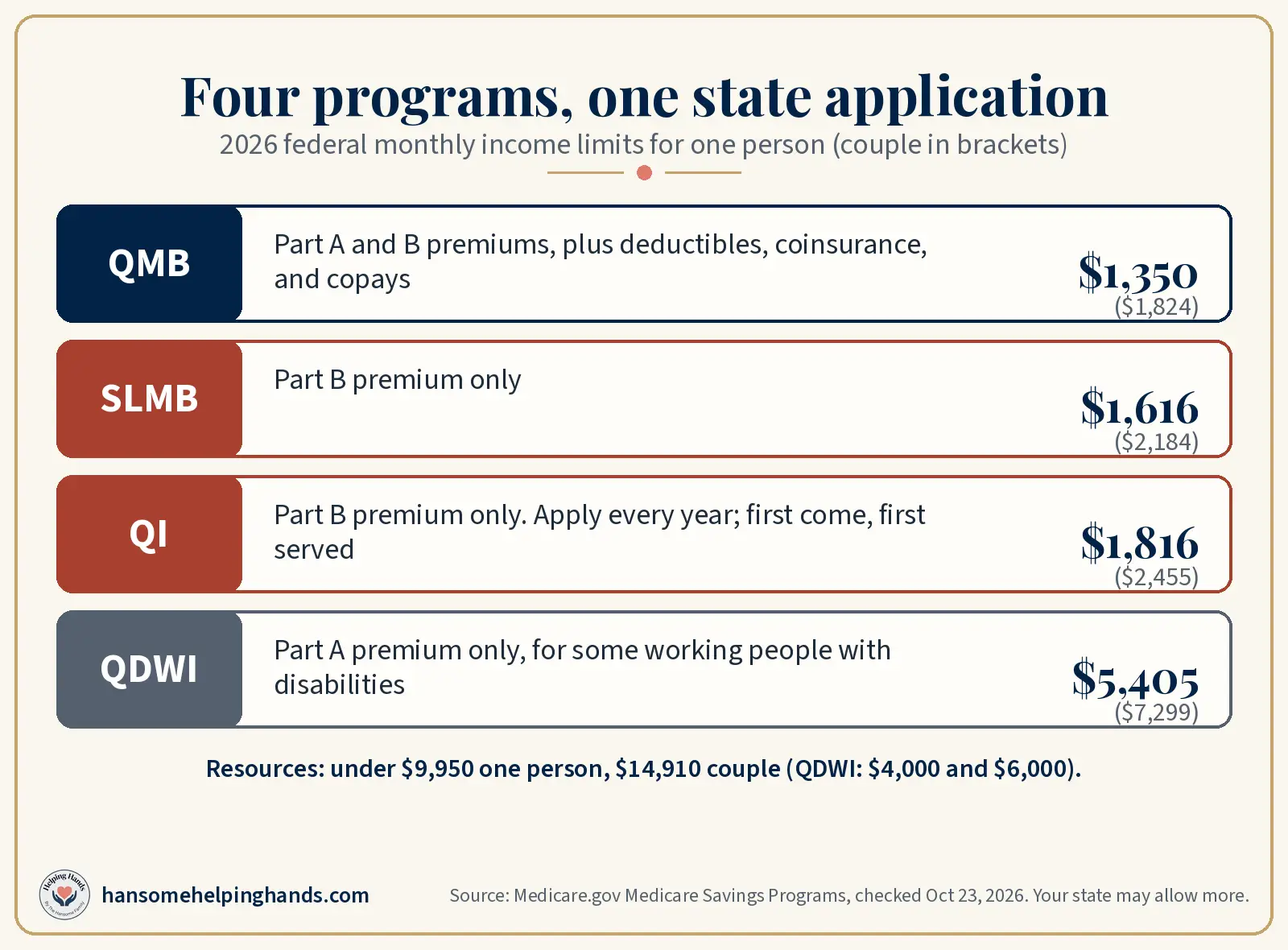
Here is the same information as a table, from Medicare.gov's Medicare Savings Programs page:
| Program | Helps pay | One person | Married couple |
|---|---|---|---|
| QMB (Qualified Medicare Beneficiary) | Part A premium if she pays one, Part B premium, deductibles, coinsurance, and copays | $1,350 | $1,824 |
| SLMB (Specified Low-Income Medicare Beneficiary) | Part B premium only | $1,616 | $2,184 |
| QI (Qualifying Individual) | Part B premium only | $1,816 | $2,455 |
| QDWI (Qualified Disabled and Working Individual) | Part A premium only | $5,405 | $7,299 |
The resource limit is $9,950 for one person and $14,910 for a couple in QMB, SLMB, and QI ($4,000 and $6,000 for QDWI). SLMB and QI require both Part A and Part B. QDWI is for people with a disability who are working and lost premium-free Part A because they went back to work.
What counts as a resource?
Medicare.gov says states count money in checking, savings, or retirement accounts, plus stocks and bonds. States don't count her home, one car, a burial plot, up to $1,500 set aside for burial expenses, furniture, or other household and personal items.
When we built our Savings Programs Apply Pack, we left a box to write in the limits instead of printing them, because they change every year and some states use their own. Do the same on your notes: write the year and the state next to every number.
Which Medicare Savings Program fits Mom?
The state decides which program fits when you apply, mostly by monthly income. Under the federal limits, the lowest income band gets QMB, the next SLMB, and the next QI, as long as resources are under the limit. Try the made-up examples below, then let the state make the real call, because its limits may be higher.
For example, imagine each person below is single, has Part A and Part B, and has under $9,950 in countable savings unless the card says otherwise. Tap each one to see where the 2026 federal limits put them.
Mom: $1,200 a month from Social Security, $4,000 in savings
QMB range. Her income is under $1,350, so the state could pay her Part B premium and her Medicare deductibles, coinsurance, and copays.
Dad: $1,500 a month from Social Security and a small pension
SLMB range. He is over $1,350 but under $1,616, so the state could pay his Part B premium.
Grandma: $1,750 a month
QI range. She is under $1,816. QI pays the Part B premium, but she must apply every year, and states approve QI on a first come, first served basis, with priority for people who had it the year before.
A married couple living together: $2,000 a month combined
SLMB range for a couple. They are over $1,824 but under $2,184, so the state could pay the Part B premium for each of them.
Uncle: $1,300 a month but $25,000 in a savings account
Over the federal resource limit. Still worth asking: Medicare.gov says some states don't count certain resources and you may qualify even above the federal limits. Call his state Medicaid office.
Not sure what counts as income in her state? That is a question for the state Medicaid office or a free SHIP counselor, not a guess. Write the monthly amounts down before you call.
How do you apply for a Medicare Savings Program?
Apply with your state Medicaid office, for free. Medicare.gov's "Talk to someone" page links to every state's office. When you apply, the state decides which program fits. Have proof of monthly income and the latest statement for every account ready. A free SHIP counselor can help you through it.

Step 1: Find the state office
Use the "Find your state office" button on Medicare.gov's Talk to someone page, or call 1-800-MEDICARE (1-800-633-4227, TTY 1-877-486-2048) and ask for the state Medicaid office number.
Step 2: Gather the papers
Medicare.gov lists what states count, so have the latest statement for each: checking, savings, retirement accounts, stocks, and bonds. Add proof of monthly income, like her Social Security benefit letter and any pension statement, and her Medicare card. Note any money set aside for burial.
Step 3: Apply, even if you are not sure
Medicare.gov says to apply even if you don't think she qualifies. You don't have to pick a program. The state decides which one, or ones, she qualifies for.
Step 4: Watch the mail and the deposit
Social Security's staff manual (POMS HI 00815.039) says Social Security sends a notice with the date the state starts paying. After that, the Part B premium no longer comes out of her check, so her monthly payment goes up. If she was billed directly instead, those bills stop.
Step 5: Mark the calendar if it is QI
QI must be renewed every year. Put a reminder in the calendar for the renewal, and keep the state's approval letter with her Medicare card.
Did you know? Mom may get money back. Social Security's staff manual says she gets a refund of any Part B premiums deducted or paid for months she was on the program, and that the refund does not count as income when deciding eligibility for assistance. SSA POMS HI 00815.039

There is a shortcut, too. Medicare.gov says Social Security sends Extra Help applications to the state to start a Medicare Savings Program application, unless you say no on the form. And it works the other way: people in a Savings Program get Extra Help with drug costs automatically.
What does QMB protect Mom from at the doctor's office?
If Mom is in QMB, Medicare providers are not allowed to bill her for Medicare deductibles, coinsurance, or copays on covered services. CMS says this applies to every Original Medicare and Medicare Advantage provider, even ones that don't accept Medicaid. She may still get a small Medicaid copay bill if one applies.
The CMS fact sheet Prohibition on Billing Qualified Medicare Beneficiaries (September 2025) says federal law bars providers and suppliers, including pharmacies, from billing QMB members for Part A or Part B cost sharing. Here is Medicare.gov's advice, in order:
- Show both cards every visit: her Medicare card and her Medicaid or QMB card. With Original Medicare, a Medicare Summary Notice also shows she is in QMB.
- Got a bill for Medicare charges? Tell the provider or debt collector she is in QMB and can't be charged Medicare deductibles, coinsurance, or copays.
- Already paid one? She has the right to a refund. Contact the state Medicaid office to ask how.
- In a Medicare Advantage plan? Contact the plan and ask it to stop the charges.
- Still being billed? Call 1-800-MEDICARE (1-800-633-4227, TTY 1-877-486-2048).
One more bonus from Medicare.gov's penalties page: generally, you won't pay a Part B late enrollment penalty if you enroll in a Medicare Savings Program. If Mom signed up for Part B late and pays extra every month, ask the state about it when you apply.
Tap to tick, your progress saves on this device
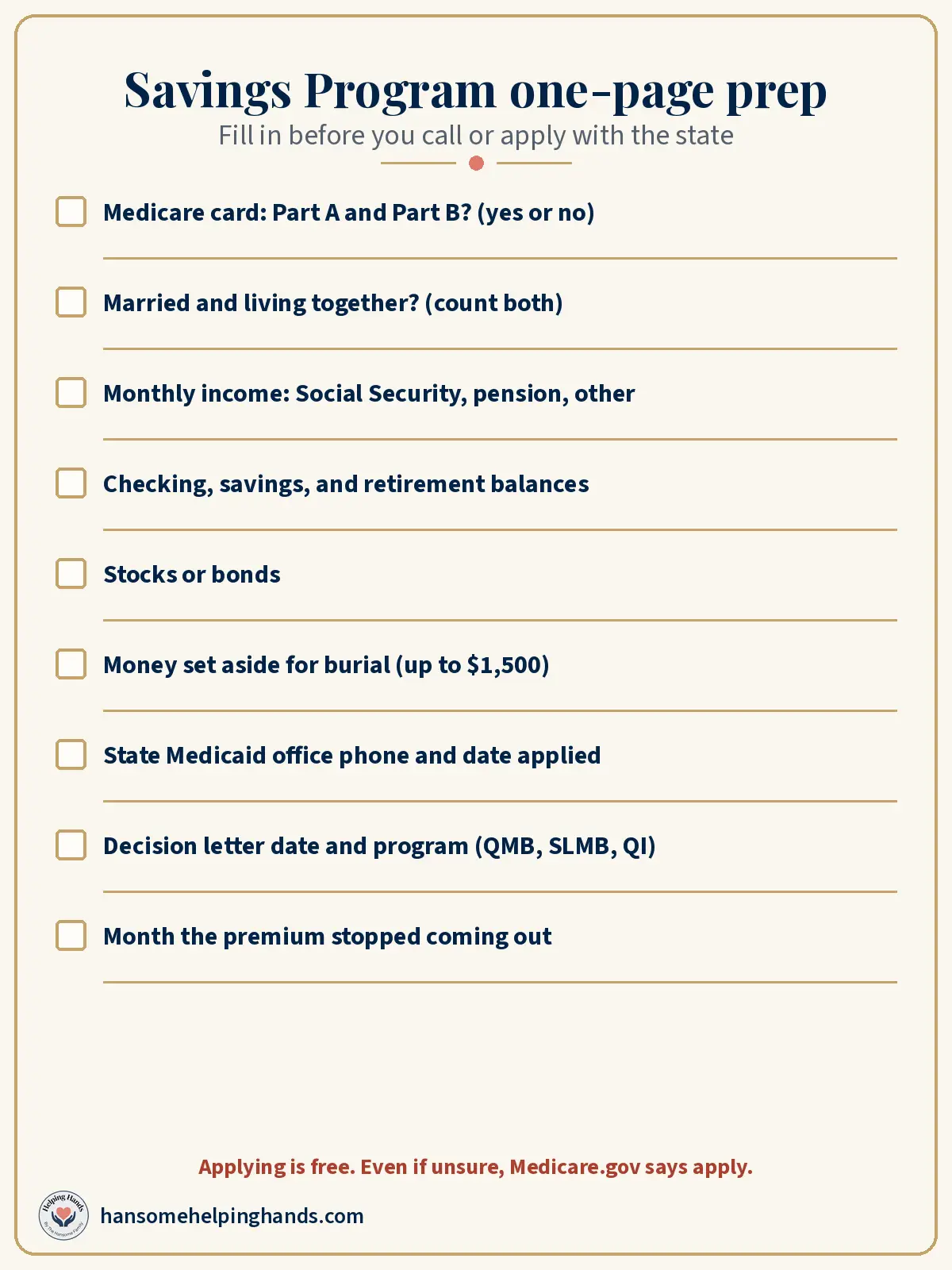
Myth or fact: what stops families from applying?
Mostly mix-ups. Families think Extra Help already covers the Part B premium, that owning a home rules Mom out, or that being a little over the posted limits means there is no point applying. Each of those is wrong for most people. Tap each card to check the official answer before you decide not to apply.
Myth: Extra Help pays the Part B premium.
Fact: Extra Help is for Part D drug costs. Help with the Part B premium comes from a Medicare Savings Program through the state. Being in a Savings Program does give her Extra Help automatically.
Myth: owning a house means Mom won't qualify.
Fact: Medicare.gov says states don't count her home, one car, a burial plot, furniture, or household and personal items.
Myth: if she is over the limits on this page, don't bother.
Fact: those are federal limits. Medicare.gov says some states don't count certain income or resources, and to apply even if you don't think you qualify.
Myth: a doctor who doesn't take Medicaid can still bill a QMB patient the 20%.
Fact: CMS says all Medicare providers, not only those that accept Medicaid, are barred from billing QMB members for Medicare cost sharing.
Myth: once she gets QI, she has it for good.
Fact: QI has to be renewed every year, and states approve it first come, first served, with priority for people who had it the year before.
Myth: her Part B late penalty can never go away.
Fact: Medicare.gov says you generally won't pay a Part B late enrollment penalty if you enroll in a Medicare Savings Program.

Where can we get free help applying for a Medicare Savings Program?
Start with your State Health Insurance Assistance Program at shiphelp.org. SHIP counseling is free, local, and not tied to any insurance company. The state Medicaid office takes the application and answers questions about its own limits, and 1-800-MEDICARE helps with billing problems. Bring the prep sheet to every call.
Drug costs too? Read Extra Help for Medicare drug costs for the 2026 limits and the free Social Security application. Shopping plans this fall? Our Medicare Open Enrollment checklist walks through the October 15 to December 7 window, and the Annual Notice of Change decoder shows what to circle on the fall letter. For the bigger picture, start at our Medicare and Medicaid help hub. For the full plan comparison, our Medicare Open Enrollment Kitchen Table Kit has drug and doctor grids laid out.
Want the paperwork already laid out? Our Medicare Savings Programs Apply Pack is an 11-page printable for this exact job: an eligibility worksheet, a document staging checklist, a state apply path sheet, a submission log, a worksheet for refunded Part B premium months, a QMB billing protection fridge sheet, and a QI renewal calendar. It does not include any government form, and you never need it to apply: your state Medicaid office takes applications for free. Get it on Gumroad for $8.99 (price checked October 23, 2026) or see it on Etsy.
Frequently asked questions
Is the Medicare Savings Program income limit monthly or yearly?
Monthly. Medicare.gov lists the 2026 limits as monthly income. For one person they are $1,350 for QMB, $1,616 for SLMB, and $1,816 for QI. Income limits are slightly higher in Alaska and Hawaii, and your state may allow more, so check with the state Medicaid office before deciding not to apply.
Does Extra Help pay the Part B premium?
No. Extra Help lowers Part D drug costs. Help with the Part B premium comes from a Medicare Savings Program through your state. The two are linked, though: people in a Medicare Savings Program get Extra Help automatically, and an Extra Help application starts a Savings Program application unless you say no.
Will the Part B premium refund come in Mom's Social Security deposit or as a separate payment?
Social Security's staff manual says she gets a refund of any Part B premiums deducted or paid for months she was on the program, and that the refund does not count as income for assistance. It does not say how the refund is paid. Call Social Security at 1-800-772-1213 to ask about her case.
If Mom has a Medicare Advantage plan, can she still get a Medicare Savings Program?
Yes. Medicare.gov says she must keep paying the Part B premium to stay in a Medicare Advantage plan, and a Savings Program can pay that premium. CMS says QMB billing protections apply to Medicare Advantage providers too. If she gets a bill for covered services, Medicare.gov says to contact the plan and ask it to stop the charges.
What if Mom loses the program later?
Social Security sends a notice with the date the state stopped paying. If she gets a Social Security check, the premium comes out again starting the month after the program ended, and she may owe up to 3 months of premiums depending on when the change was processed. Ask the state why it ended and whether she can reapply.
Please note: This guide explains official rules in plain English. It is not legal or insurance advice and we are not affiliated with Medicare, Medicaid, Social Security, or any government agency. Confirm details with your state Medicaid office, Medicare (1-800-MEDICARE), your State Health Insurance Assistance Program (SHIP), or an elder law attorney.
Sources
- Medicare.gov: Medicare Savings Programs (4 programs, 2026 limits, what counts, QMB bills). Checked 2026-10-23 (2026 income and resource limits copied from this page)
- Medicare.gov: Costs (2026 Part B premium $202.90 and deductible $283). Checked 2026-10-23
- Medicare.gov: Avoid late enrollment penalties (Part B penalty and Medicare Savings Programs). Checked 2026-10-23
- Medicare.gov: Help with drug costs (Extra Help automatic for Savings Program members, MSP referral). Checked 2026-10-23
- SSA POMS HI 00815.039: Effect of buy-in on the individual (premium deduction stops, refund, buy-in ending). Checked 2026-10-23
- CMS MLN7936176: Prohibition on Billing Qualified Medicare Beneficiaries (September 2025). Checked 2026-10-23
- Medicare.gov: Talk to someone (find your state Medicaid office). Checked 2026-10-23
- SHIP: State Health Insurance Assistance Programs. Checked 2026-10-23
Save this guide for later
Keep reading
- Extra Help for Medicare Drug Costs: Who Qualifies and How to Apply
- Medicare Open Enrollment: A Kitchen-Table Checklist for Helping a Parent
- Your Medicare Plan's Annual Notice of Change: What to Check Before December 7
- Medicare and Medicaid Help for Families: start here
- Got a NOMNC? How a Medicare Fast Appeal Works
- The Medicare Prescription Payment Plan: Spreading Drug Costs Across the Year
- The Pharmacy Said No: How to Ask for a Part D Coverage Determination
- Mom's Medicare Advantage Plan Is Ending or Her Doctor Left: What Now?
- Leaving Medicare Advantage: How the Medigap Trial Right Works
- Medicaid Look-Back Period in Plain English: Myths vs Facts
- Who to Notify When Someone Dies: A Printable US Checklist
- How to Prepare for an IEP Meeting: A Parent's Countdown Checklist
- Dementia Behavior Log: How to Spot the Patterns the Doctor Needs to See
- Hospital Discharge Checklist: What to Ask Before Mom or Dad Leaves
- All guides