
Part of our Medicare and Medicaid Help for Families guide
Got a NOMNC? How a Medicare Fast Appeal Works

Here's the date families misread: the deadline on a NOMNC is not the end date printed in big letters. It's noon the day before.
A NOMNC (Notice of Medicare Non-Coverage) says Medicare coverage for rehab, home health, hospice, or outpatient rehab is ending. To appeal, call the BFCC-QIO named on the notice by noon the day before the end date. An independent reviewer looks at the records, usually within a couple of days, and services continue during the appeal.
This guide is for US families with a parent in a skilled nursing facility, on home health, or in hospice, under Original Medicare or a Medicare Advantage plan. You get the noon clock in plain English, a "which notice is this?" decoder, a practice quiz, a call script, myth vs fact cards, and a free printable call sheet.
Did you know? In a fast appeal, the provider has to prove it is right, not you. The federal rule says the burden of proof rests with the provider (or, in a Medicare Advantage plan, the plan) to show that ending coverage is the correct decision. eCFR: 42 CFR 405.1202(d)
What is a NOMNC?
It is a one-page Medicare form, CMS-10123, that tells you the date Medicare coverage of your current services will end. Skilled nursing facilities, home health agencies, hospices, and outpatient rehab facilities (CORFs) must give it at least 2 calendar days before covered services end. It also explains how to ask for a fast appeal.
Here is what the real notice says, in order, from the current CMS version:
- The headline: "Medicare Coverage of Your Current [type] Services Will End on [date]."
- Your right to appeal: an independent medical review right away, and "your services will continue during the appeal."
- The deadline: "You must ask for a timely appeal no later than noon of the day before the above date."
- Who to call: your Quality Improvement Organization (QIO), with its name and toll free number filled in.
- A signature line: to show you received and understand the notice.
A few details trip families up. CMS's instructions say the two days are calendar days, "not a 48-hour requirement." If care isn't daily, like home health visits twice a week, the notice comes by the second to last visit. And the BFCC-QIO is run by Commence or Acentra, depending on your state, according to Medicare.gov.
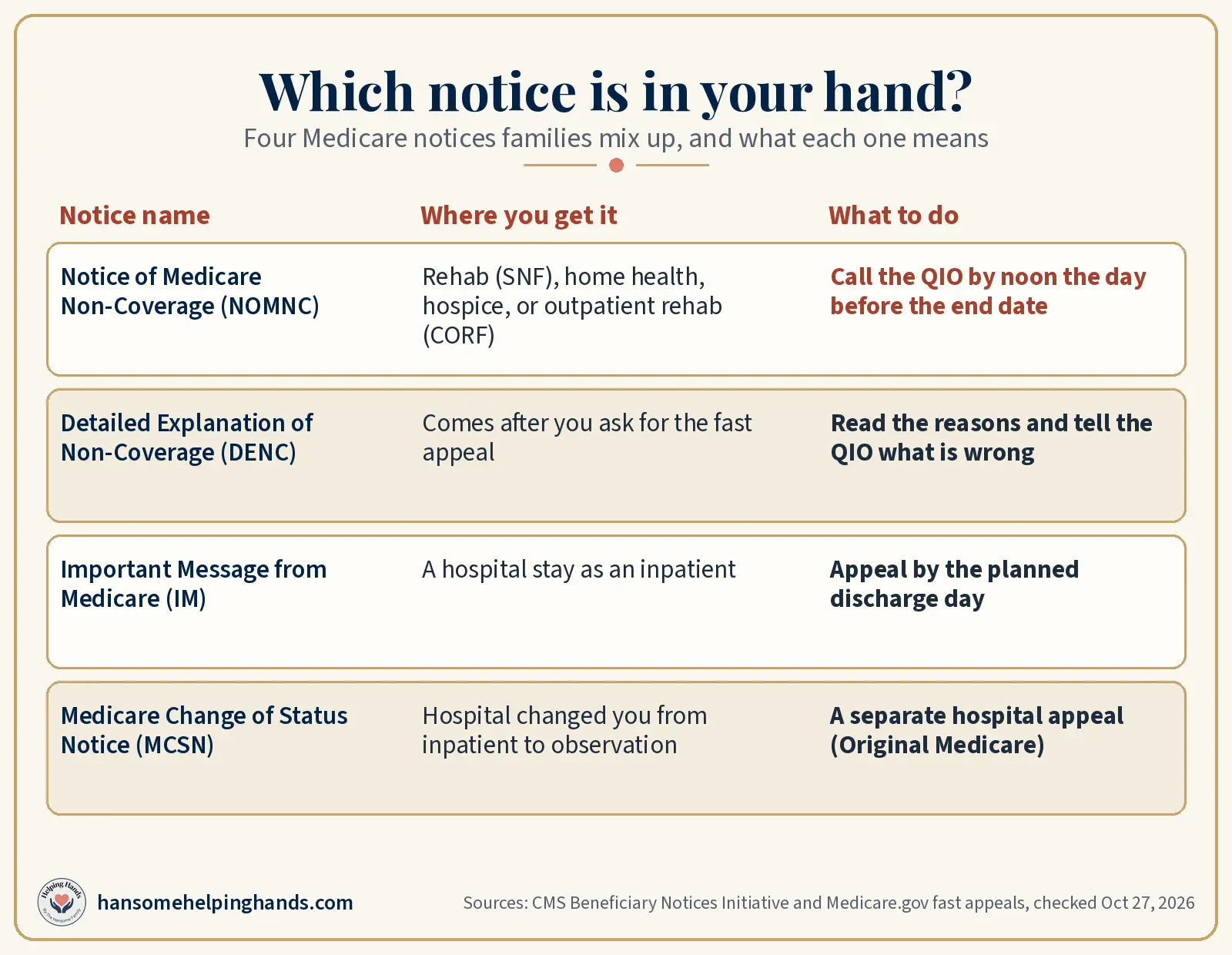
Not every notice is a NOMNC. A hospital inpatient gets the Important Message from Medicare instead, with its own deadline, the planned discharge day. If a hospital changes a stay from inpatient to observation, Original Medicare patients get a Medicare Change of Status Notice. For the hospital side, see our hospital discharge checklist.
How do you appeal a NOMNC?
Call the BFCC-QIO at the number on the notice before noon the day before the end date. Say you want a fast appeal, give the patient's name, the provider, and the end date, and ask for a reference number. You don't have to write anything. The QIO asks for your side and reviews the records.
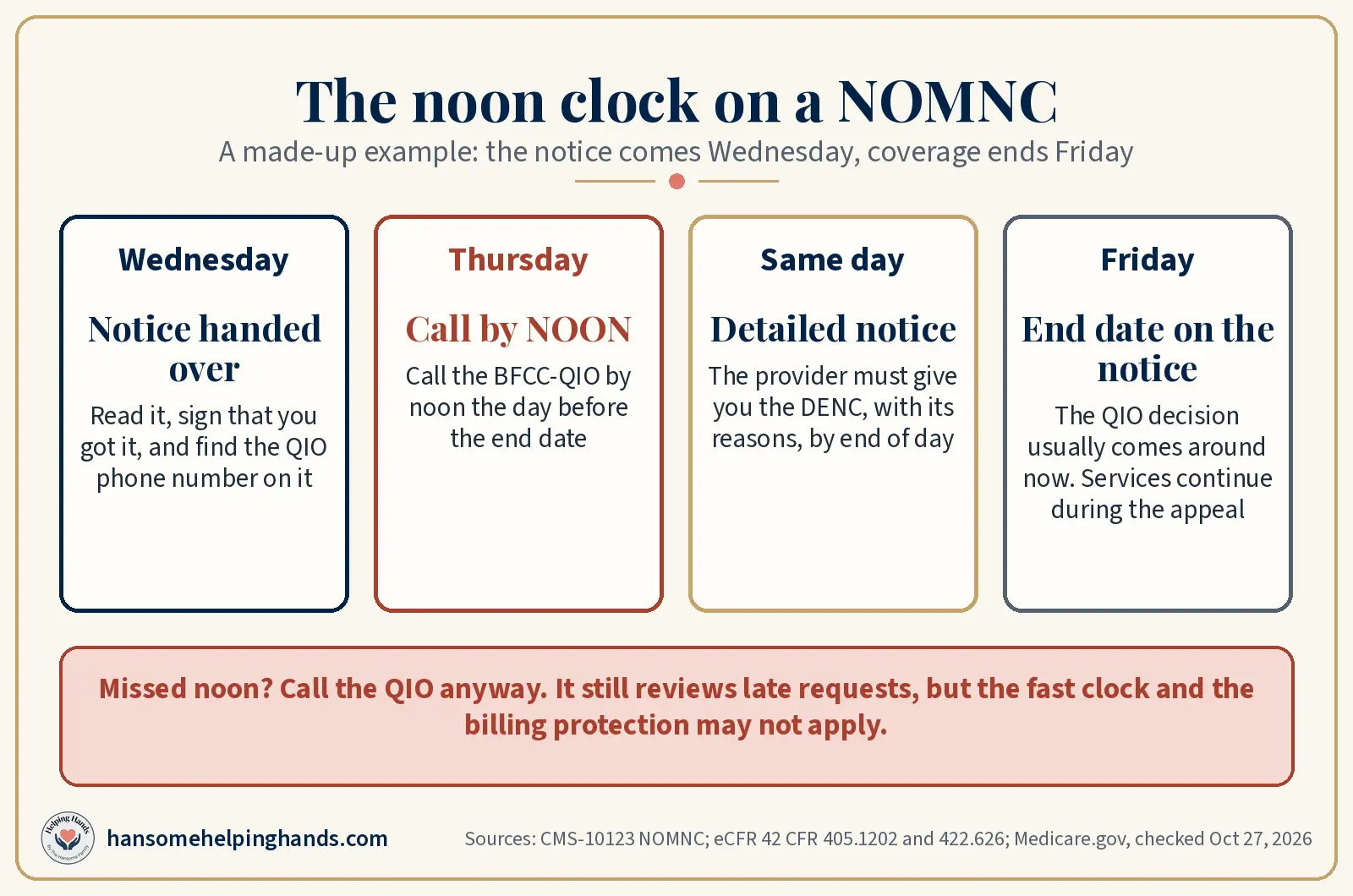
Step 1: Find two things on the notice
Circle the end date and the QIO phone number. Write "Call by noon on [the day before]" at the top of the page.
Step 2: Sign for receipt, not agreement
The signature line says you received and understand the notice. It is not a promise that you agree. The federal rule says that if someone refuses to sign, the provider can note it, and that day still counts as the day the notice was received. So refusing doesn't pause the clock.
Step 3: Call the QIO before noon
Call as soon as you can. The notice says to ask "as soon as possible." The QIO will tell the provider the same day.
Step 4: Call the doctor the same day
For home health and outpatient rehab under Original Medicare, the federal rule ties the fast review to a doctor certifying that stopping may put health at significant risk. Even in a nursing home, a doctor or therapist who disagrees with the end date is worth adding to the call.
Step 5: Read the detailed notice
Once you appeal, the provider must give you a Detailed Explanation of Non-Coverage (DENC) by the end of that same day. It lists the facts it used and the rule it relied on. Tell the QIO anything that is wrong or missing.
Step 6: Ask for copies
You can ask for copies of everything the provider sent the QIO. The federal rule says the provider must send them by close of business the next day, and it may charge a reasonable copying fee.
Here is a short script you can read word for word:
Call script: asking the QIO for a fast appeal
"Hi, I'm calling to ask for a fast appeal of a Notice of Medicare Non-Coverage for [name], date of birth [date]. The [skilled nursing facility, home health agency, or hospice] is [provider name], and the end date on the notice is [date]. We got the notice on [date]. We think the services are ending too soon because [one sentence, for example: she still can't walk to the bathroom safely]. Can you give me a reference number, and tell me when to expect your call?"
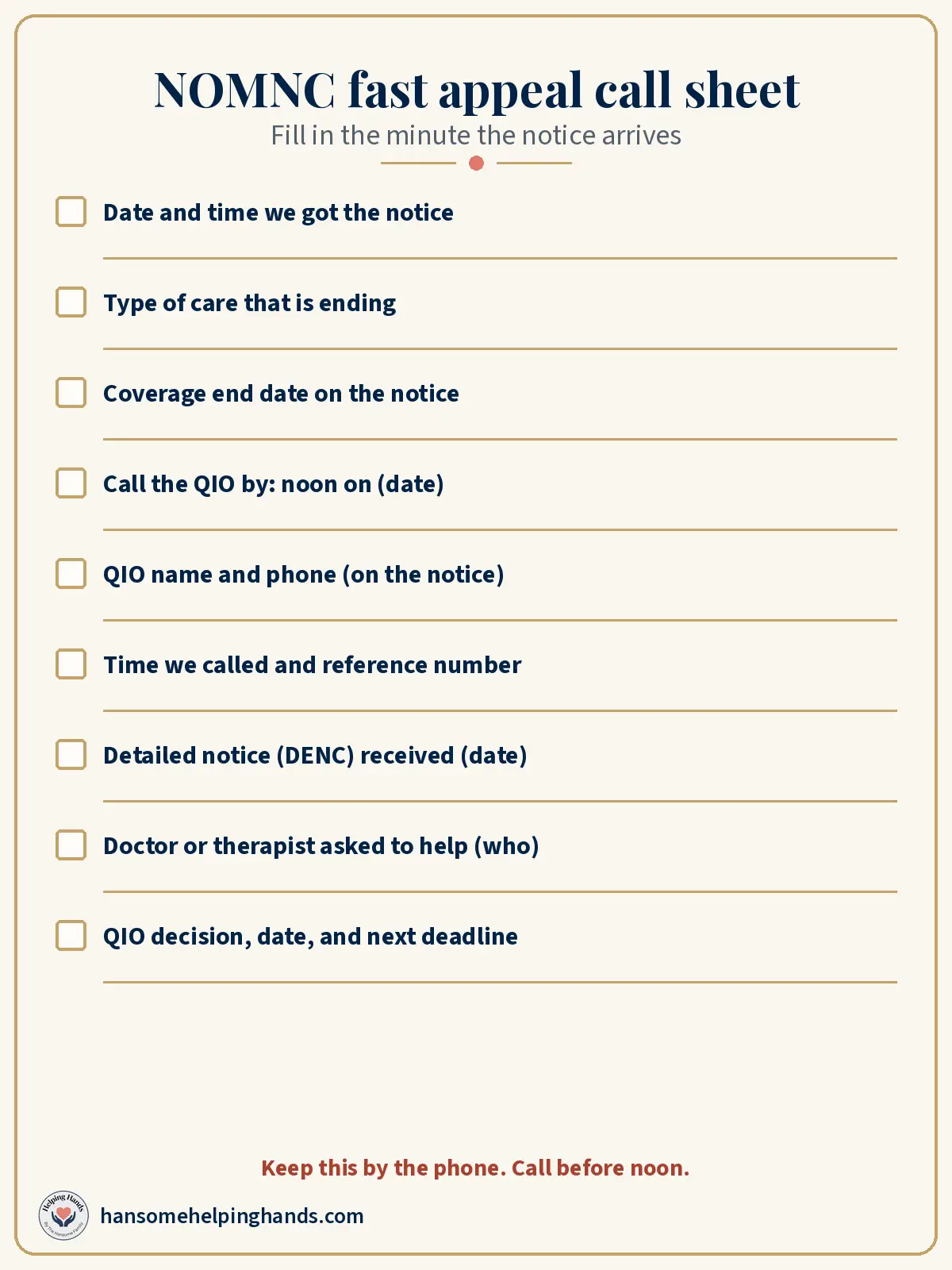
One thing we learned building our NOMNC Fast Appeal File: on the real CMS notice, the noon deadline sits in the middle of a bullet list, under the end date that's printed in large type. That's why our kit's cover page gives "Noon day before end date. Call the QIO" its own banner, and why the call sheet below puts it on line 4, right under the end date.

How long does a NOMNC fast appeal take?
Usually a couple of days. Under Original Medicare, the federal rule gives the QIO 72 hours from your request. In a Medicare Advantage plan, it decides by close of business the day after it gets the records it needs. The notice says the decision generally comes within two days after the end date, or by it in a health plan.
| Step | Original Medicare | Medicare Advantage plan |
|---|---|---|
| Ask the QIO | By noon the day before the end date | By noon the day before the end date |
| Detailed notice (DENC) | By end of the day the QIO calls the provider | By end of the day the QIO calls the plan |
| QIO decision | Within 72 hours of the request | By close of business the day after it has the records |
| Lost? Next step | Ask the QIC for a fast reconsideration by noon the next day; it decides in 72 hours | Ask the QIO to reconsider within 60 days; it decides within 14 days |
Did you know? "She has plateaued" is not, by itself, a reason to stop coverage. Under the Jimmo settlement, CMS says Medicare covers skilled nursing and therapy in nursing facilities, home health, and outpatient therapy when they're needed to maintain function or slow decline, as long as the other rules are met. CMS: Jimmo Settlement
What happens after the QIO decides?
If the QIO agrees services are ending too soon, Medicare (or the plan) may keep covering them, depending on care needs, and a later end date needs a new notice. If it agrees with the provider, you won't owe for care before the end date, but you may have to pay for care after it.
That second case is where money matters. In 2026, Medicare.gov lists skilled nursing coinsurance of $217 a day for days 21 to 100, and once Medicare coverage ends, you may have to pay for the care yourself. Ask the provider for the private pay daily price before you decide whether to stay while you take the next step.
Under Original Medicare, the federal rule says the provider can't bill you for the disputed days until the fast review, and the fast reconsideration if you ask for one on time, is finished.
What if we missed the noon deadline?
Call the QIO anyway. The current federal rules say the QIO still accepts a late request and decides as soon as possible, but the fast timeline and the billing protection don't apply. You may have to pay for care after the end date unless the decision goes your way. Call the same day you notice.
Official sources word this differently, so here is the side by side:
| Source | What it says |
|---|---|
| The NOMNC itself (CMS-10123) | "If you miss the deadline to ask for an immediate appeal, you may still have appeal rights." |
| Federal rules (42 CFR 405.1202 and 422.626) | The QIO accepts a late request and decides as soon as possible, without the fast clock or the billing protection |
| Medicare.gov fast appeals page and booklet 11525 | You can ask your plan for a fast reconsideration, but services are only covered if the decision is in your favor |
Our take: if you are a few hours late, call the QIO first and say exactly when you got the notice. If you are in a Medicare Advantage plan, also call the plan and ask about a fast reconsideration. Write down what each one tells you.
Quiz: when is the deadline?
Most mix-ups are about the clock, not the medicine. Here are six made-up situations. Decide what you would do, then tap each card to check it against the notice and the federal rules. These are practice examples, not advice for your family, so always go by the date and instructions on your own notice.
Case 1: Dad's rehab hands him a NOMNC on Tuesday. The end date is Thursday. When is the deadline?
Noon on Wednesday, the day before the end date. Put it on the fridge and in your phone.
Case 2: Mom refuses to sign the notice because she's upset. Does that stop the clock?
No. The federal rule lets the provider note the refusal, and that day counts as the day she got it. She can sign to show she received it and still appeal.
Case 3: The home health nurse visits Mondays and Thursdays. The last covered visit is a Thursday. When should the notice come?
By the Monday visit. When care isn't daily, CMS says the notice comes by the second to last visit.
Case 4: Grandma is an inpatient in the hospital and is told she goes home tomorrow. Is this a NOMNC?
No. Hospital inpatients get the Important Message from Medicare, and the deadline is the planned discharge day. Follow that notice instead.
Case 5: The therapist says Dad "isn't improving anymore." Is that the end of covered therapy?
Not automatically. Under the Jimmo settlement, skilled care to maintain function or slow decline can be covered. Ask the doctor or therapist whether he still needs skilled care, and tell the QIO.
Case 6: You call the QIO at 2 p.m., two hours after the deadline. Is it worth it?
Yes. The QIO still reviews late requests. The fast clock and the billing protection may not apply, so ask the provider what the extra days would cost.
Tap to tick, your progress saves on this device
Myth or fact: what trips families up?
Most myths make families give up before they call. The fast appeal is quick, it doesn't need a lawyer or anything written, and services keep going while it runs. The notice is also not a final ruling. Tap each card to check the official answer before you decide what to do for Mom or Dad.
Myth: signing the NOMNC means we agree that care should end.
Fact: the signature only shows you received and understand the notice. You can sign and appeal.
Myth: we need a lawyer or a written letter to appeal.
Fact: the notice says you don't have to prepare anything in writing. A phone call to the QIO starts it.
Myth: Medicare covers 100 days of rehab, so she has days left.
Fact: Medicare.gov says Part A limits skilled nursing coverage to 100 days per benefit period. It is a ceiling, not a promise. Coverage lasts only while she still meets Medicare's rules, like needing daily skilled care.
Myth: the provider decides the appeal.
Fact: the BFCC-QIO, an independent reviewer, decides. The provider has to prove its case.
Myth: "two days' notice" means 48 hours.
Fact: CMS says it is two calendar days, not a 48-hour requirement.
Myth: once you appeal, services stop until the decision.
Fact: the notice says services continue during the appeal.

Where can we get free help with a NOMNC?
Start with the QIO named on the notice, which answers questions as well as taking appeals. For unbiased help, call your State Health Insurance Assistance Program at shiphelp.org. SHIP counseling is free and not tied to any insurance company. You can also call 1-800-MEDICARE (1-800-633-4227, TTY 1-877-486-2048) with questions.
If the QIO's phone number on the notice is hard to read, Medicare.gov's fast appeals page points you to the two QIO websites, Commence and Acentra, and says to check them to be sure you have the right one for your state.
Coming home soon? Our hospital discharge checklist covers the questions to ask before anyone leaves, and our Hospital Discharge Go Sheet puts the medicines, follow-ups, and who-does-what on one page. If a Medicare Advantage plan is the problem, see what to do when Mom's plan is ending or her doctor left the network. For the bigger picture, start at our Medicare and Medicaid help hub.
Want it on paper? Our Services Ending Too Soon: NOMNC Fast Appeal File is a 15-page printable for this exact moment: a NOMNC decoder, a noon deadline worksheet, a "what we received" log, a script for asking about the detailed notice, an evidence checklist, a Jimmo pointer, Original Medicare vs Medicare Advantage notes, QIO call scripts, an appeal tracker, and a fridge card. It contains no government forms, and you never need it to appeal: the appeal itself is a phone call to the QIO. Get it on Gumroad for $12.99 (price checked October 27, 2026) or see it on Etsy.
Frequently asked questions
Can I ask for the fast appeal for my parent?
A family member can help. The notice can be signed by the patient or a representative, and the federal rule says one of them must be available to answer the QIO's questions. If Mom can talk, have her on the call to say she wants the appeal, and ask the QIO what it needs from you.
What can we do if Medicare denied home health care?
It depends on the kind of no. If home health is ending and you got a NOMNC, use the fast appeal on this page. If a Medicare Advantage plan refused to approve care, ask the plan to reconsider within 65 days of its denial notice. If Original Medicare denied a bill, follow the steps on the Medicare Summary Notice.
Does a NOMNC end all of Mom's Medicare?
No. It is about one provider's Medicare covered services, like the rehab stay or the home health visits. Her Medicare card, doctor visits, and drug plan go on as before. The federal rule also says a NOMNC is for ending covered services, not cutting back on them; home health uses a different notice when it only reduces care.
What if we never got a NOMNC and the services are ending?
Ask for it. Medicare.gov says that if you do not get the notice, you should ask your provider for it. The federal rule says that when the QIO finds the notice was not valid, coverage continues until at least 2 days after a valid notice is given. Call the QIO anyway and tell them what happened.
Do we have to leave the rehab or stop home health on the end date?
Not during a timely appeal. The notice says services continue during the appeal. If the QIO agrees coverage should end, Medicare.gov says you will not owe for care before the end date, but you may have to pay for care after it. Ask the provider for the daily price before deciding.
Please note: This guide explains official rules in plain English. It is not legal, medical, or insurance advice and we are not affiliated with Medicare, any government agency, any QIO, or any provider or plan. Confirm details with the QIO named on your notice, Medicare (1-800-MEDICARE), your State Health Insurance Assistance Program (SHIP), or an elder law attorney.
Sources
- CMS: FFS and MA NOMNC/DENC (forms CMS-10123 and CMS-10124, effective January 2025). Checked 2026-10-27 (notice downloaded; OMB expiration 11/30/2027)
- CMS: Notice instructions for the NOMNC (CMS-10123). Checked 2026-10-27 (two calendar days, not 48 hours)
- Medicare.gov: Fast appeals. Checked 2026-10-27
- Medicare.gov: Your protections (NOMNC, DENC, and home health notices). Checked 2026-10-27
- Medicare.gov publication 11525: Medicare Appeals (April 2026). Checked 2026-10-27
- eCFR: 42 CFR 405.1200, 405.1202, and 405.1204 (Original Medicare notices, fast reviews, and the next step). Checked 2026-10-27 (eCFR up to date as of 2026-10-23)
- eCFR: 42 CFR 422.624 and 422.626 (Medicare Advantage notices and fast track appeals). Checked 2026-10-27
- CMS: Jimmo Settlement (care to maintain or slow decline). Checked 2026-10-27
- Medicare.gov: Skilled nursing facility care (2026 costs). Checked 2026-10-27 ($217 a day for days 21 to 100 in 2026)
- Commence Health BFCC-QIO. One of the two BFCC-QIOs, depending on your state
- Acentra Health BFCC-QIO. The other BFCC-QIO, depending on your state
- SHIP: State Health Insurance Assistance Programs. Free local Medicare counseling
Save this guide for later
Keep reading
- Hospital Discharge Checklist: What to Ask Before Mom or Dad Leaves
- The Pharmacy Said No: How to Ask for a Part D Coverage Determination
- Mom's Medicare Advantage Plan Is Ending or Her Doctor Left: What Now?
- Medicare and Medicaid Help for Families: start here
- The Medicare Prescription Payment Plan: Spreading Drug Costs Across the Year
- Medicare Savings Programs: Help Paying the Part B Premium
- Extra Help for Medicare Drug Costs: Who Qualifies and How to Apply
- Leaving Medicare Advantage: How the Medigap Trial Right Works
- Your Medicare Plan's Annual Notice of Change: What to Check Before December 7
- Medicaid Look-Back Period in Plain English: Myths vs Facts
- Medicare Open Enrollment: A Kitchen-Table Checklist for Helping a Parent
- Who to Notify When Someone Dies: A Printable US Checklist
- How to Prepare for an IEP Meeting: A Parent's Countdown Checklist
- Dementia Behavior Log: How to Spot the Patterns the Doctor Needs to See
- Questions to Ask When Touring Assisted Living (and What to Watch For)
- All guides