
Part of our When a Parent Dies guide
Who to Notify When Someone Dies: A Printable US Checklist

Here's some good news hiding inside a long list: the call many families dread most, Social Security, is usually made for you. Funeral homes generally report the death, and Social Security tells Medicare.
Start with close family, the funeral home, and the employer if they still worked. The funeral home usually reports the death to Social Security, which tells Medicare. Over the next few weeks, you or the executor notify the VA if they served, the bank, credit card companies, insurers, the pension, credit bureaus, the motor vehicles office, and state benefits offices.
This guide is for US families sorting out who to tell after a parent or spouse dies. You get a "who already knows?" quiz, the calls sorted into three waves, a table of government offices, a short script for each call, myth vs fact cards, and a free printable call log.
Did you know? Social Security can't pay benefits for the month a person dies. So if Dad died in July, the deposit that arrives in August (which pays for July) has to go back. If it came by direct deposit, USA.gov says to tell the bank as soon as possible and ask it to return that payment and any that came later. USA.gov: Report the death of a Social Security or Medicare beneficiary
Who do you notify first when someone dies?
In the first day or two, tell close family and friends, call the funeral home, and let the person's employer know if they were working. Ask someone to check on pets, mail, and the home. Ask the funeral home whether it will report the death to Social Security. Almost everything else can wait a few days.
There is no prize for finishing the list this week. The first calls are about people, not paperwork:
- Close family and friends. Pick one or two relatives to pass the news along, so you are not making 30 calls yourself.
- The funeral home. Ask it to confirm that it will report the death to Social Security. You will need the person's Social Security number.
- The employer, if they were still working. Ask about a final paycheck and any workplace life insurance.
- Whoever can watch the home. Someone to feed the cat, bring in the mail, and lock the door.
Our when a parent dies guide covers the very first hours, including your rights with funeral homes.

Who already gets told for you?
If a funeral home is involved, it generally reports the death to Social Security, and Social Security tells Medicare. That is about where the automatic part ends. Banks, credit card companies, insurers, the VA, credit bureaus, the motor vehicles office, and state benefits offices usually need to hear it from the family or the executor.
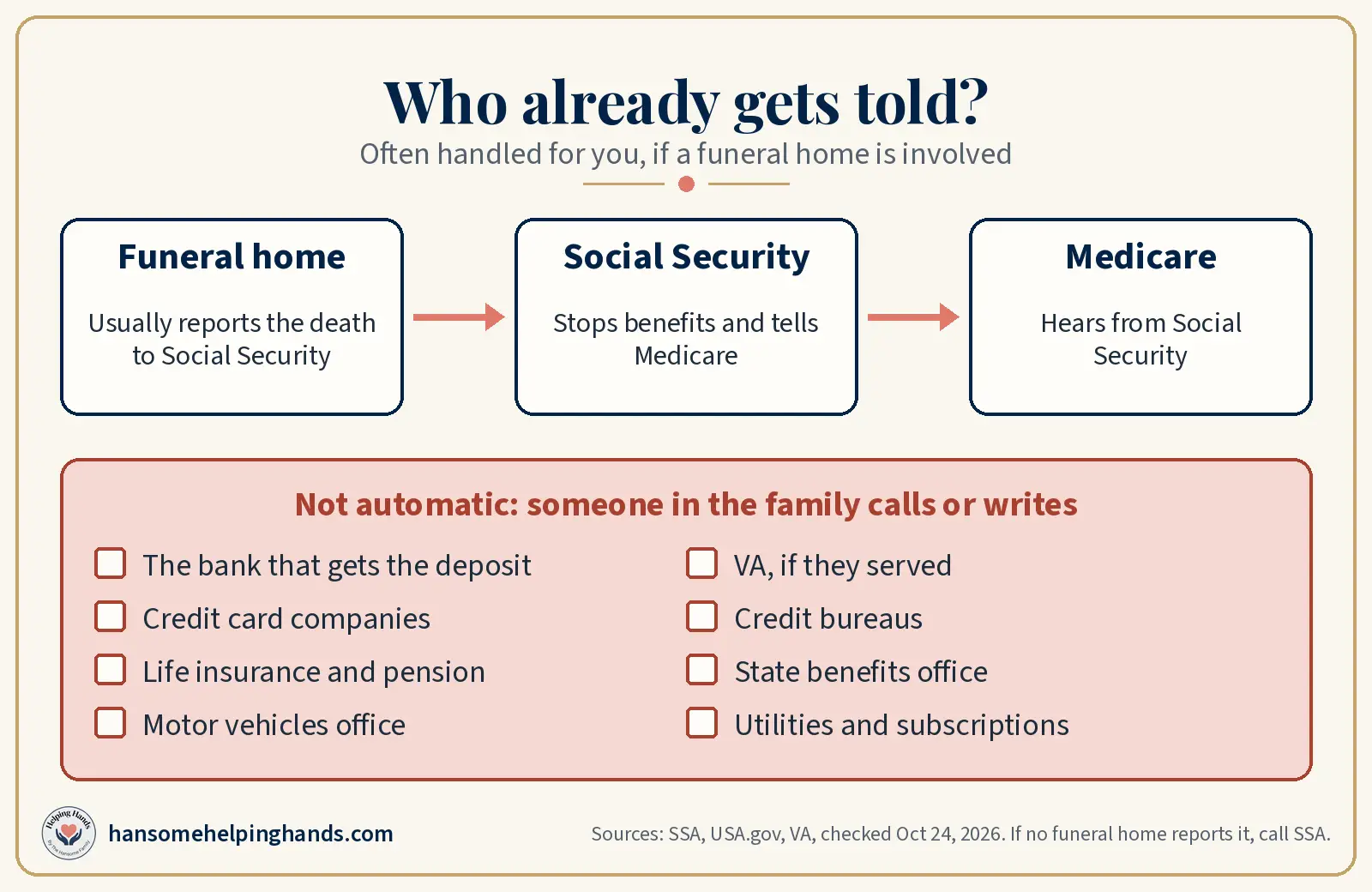
Try the quiz. For example, imagine Grandpa just died at 84. He got Social Security by direct deposit, served in the Army, and had a credit card, a car, and a passport. Who already knows? Tap each card.
Social Security?
Probably. Social Security says funeral homes generally tell it when someone dies. If no funeral home is involved or it does not report the death, call 1-800-772-1213 (TTY 1-800-325-0778) with his name, Social Security number, date of birth, and date of death.
Medicare?
Yes, through Social Security. USA.gov says Social Security will notify Medicare, so there is no separate Medicare call for the death report.
The bank where his Social Security lands?
No. Tell the bank yourself and ask it to return the payment for the month he died and any after that.
The VA?
Not automatically. The VA asks survivors to report the death as soon as possible so payments stop and nobody ends up owing money back. Calling is fastest: 800-827-1000 (TTY 711), then select 5. Ask about burial and survivor benefits on the same call.
The credit bureaus?
Not automatically. The VA's privacy office recommends notifying Equifax, Experian, and TransUnion so his credit report shows a deceased notice. The bureaus usually ask for a certified death certificate and proof that you are the spouse or the legal representative.
The IRS?
There is no death report to file. Instead, the IRS says someone files his final income tax return for the year he died, reporting income up to the date of death. If a refund is due, Form 1310 claims it.
Which government agencies do you have to notify when someone dies?
Social Security comes first, usually through the funeral home. Then, depending on the person's life, the VA, the state motor vehicles office, the state social services office for benefits like SNAP or Medicaid, the local election office, the State Department for a passport, and the IRS through a final tax return. Military and federal retirees add DFAS or OPM.
USA.gov's page Agencies to notify when someone dies is the official master list. Here is the same list in plain English. Most offices want the Social Security number and a certified death certificate.
| Who | When it applies | What to do |
|---|---|---|
| Social Security (and Medicare) | Almost everyone | Usually done by the funeral home. Otherwise call 1-800-772-1213. Phone or in person only. |
| VA | Veterans, or anyone getting VA benefits | Call 800-827-1000, select 5. Ask about burial and survivor benefits. |
| Motor vehicles office | Driver's license, state ID, or a car | Cancel the license or ID and transfer the car title. |
| State social services office | SNAP, TANF, rental help, or Medicaid | Cancel the benefit payments. |
| Local election office | Registered voters | Cancel the voter registration. |
| State Department | A valid US passport | Mail it for cancellation (optional). It can be sent back to you. |
| IRS | Anyone who needs to file | File the final return (Form 1040 or 1040-SR). |
| DFAS or OPM | Military retirees, or federal employees and retirees | Report the death; ask about survivor payments. |
| US embassy or consulate | A US citizen who died abroad | Report the death; ask about the Consular Report of Death Abroad. |
Sources: USA.gov, Social Security, the VA, the IRS, and the State Department.
While you have Social Security on the phone, ask about survivor benefits. Social Security says a spouse might get a one-time payment of $255, and certain family members may get monthly survivor benefits.
Who to notify about money, the house, and accounts
Next come the businesses: banks and credit unions, credit card companies, the credit bureaus, life insurance companies, any pension or annuity, and then utilities, phone, internet, and subscriptions. USA.gov lists all of these. Banks, insurers, and pensions usually want a certified copy, while a subscription may only need a photocopy or a phone call.
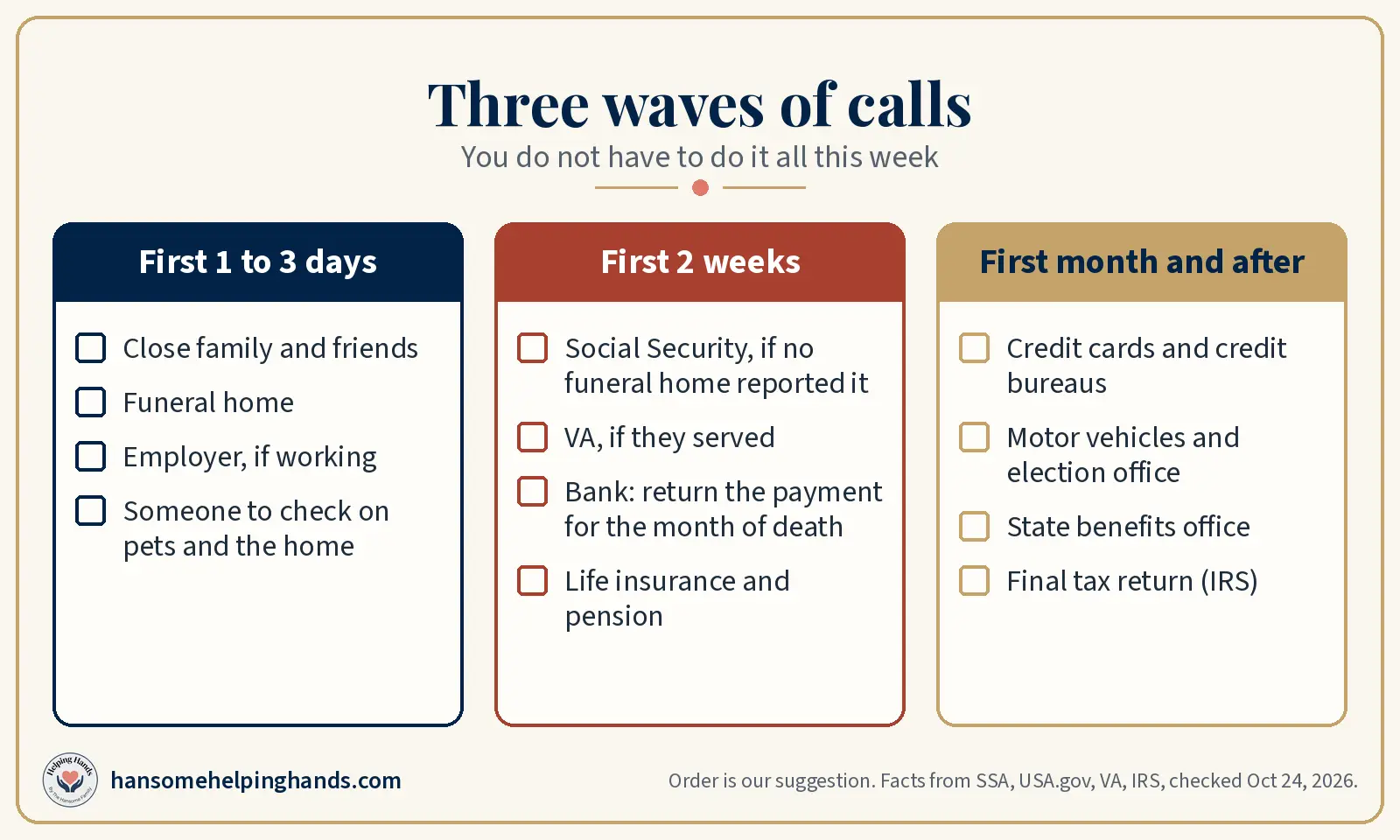
A few things worth knowing before you dial:
- Banks: ask about any Social Security payment that needs to go back, joint accounts, and autopays that should stop.
- Credit card companies: tell them the cardholder died and ask them to close the account. Don't pay the balance from your own money until you know who owes it (see below).
- Life insurance and pensions: ask what they need to start a claim. Have the policy or account number ready.
- Utilities and subscriptions: some move to the spouse's name; others just close. A photocopy of the death certificate is often enough. USA.gov says to check with each one.
When we made the call log in our First 72 Hours checklist, the line we kept adding space for was "Spoke to / reference number." A name and a reference number save you from telling the whole story twice when you call back.
Did you know? The obituary can tip off scammers. The VA's privacy office, citing AARP, warns that scammers use names from obituaries to pose as long-lost relatives, and suggests leaving out the birthdate, middle name, home address, birthplace, and mother's maiden name. VA Privacy: Reporting a Veteran's death, tips for survivors
What about debts and debt collectors?
The FTC's page Debts and deceased relatives says debts are paid from the person's estate, and family members usually don't have to pay them from their own money. There are exceptions: a cosigned loan, some spouses depending on state law, and an executor who skips the state's probate rules. Collectors can discuss the debt only with the spouse, the executor or personal representative, and a few others. If a collector pressures you, report it at ReportFraud.ftc.gov or to your state attorney general.
What do you say when you call?
Keep it short. Say who died, the date, your relationship, and what you need: stop payments, close or transfer the account, or start a claim. Ask what proof they need, where to send it, and whether a copy works instead of a certified death certificate. Write down the name of the person you spoke to and a reference number.
A 20 second call script (copy it):
"Hi, I'm calling to report a death. My father, [full name], died on [date]. His account or policy number is [number]. I'm his [son / daughter / executor]. What do you need from me to [close the account / start a claim / stop payments], and can I send a copy of the death certificate instead of a certified one? Could I have your name and a reference number for this call?"
Then fill in a line on your log. Tick the box below as you go; your ticks save on this device and the list prints.
Tap to tick, your progress saves on this device
Want this on paper with room to write? See what's inside the First 72 Hours After a Death Checklist.

Myth or fact: what trips families up?
Mostly assumptions. Families think the death certificate must come before any call, that Social Security will stop every payment on its own, that the children have to pay the parent's bills, or that every place needs a certified copy. Each of those is wrong or only partly true. Tap each card for the official answer.
Myth: we can report the death to Social Security online.
Fact: USA.gov says Social Security only accepts death reports by phone or in person, not by email or online. Most families don't need to, because the funeral home usually does it.
Myth: you can't call anyone until the death certificate arrives.
Fact: you can start. USA.gov says you can begin a Social Security report without the death certificate, though you will need it later. Many companies will open a file over the phone and wait for the paperwork.
Myth: the last Social Security deposit is ours to keep.
Fact: Social Security can't pay for the month of death, so the payment that arrives the next month must go back.
Myth: the kids have to pay Mom's credit cards.
Fact: the FTC says family members usually don't have to pay a relative's debts from their own money. Debts are paid from the estate, with exceptions such as cosigned loans.
Myth: every place needs a certified death certificate.
Fact: USA.gov says you need certified copies for government agencies, bank and credit card accounts, life insurance, and pensions, but a photocopy may be enough for something like a subscription. Ask first.
Myth: the VA finds out on its own.
Fact: the VA asks survivors to report a Veteran's death as soon as possible, so payments stop and survivors avoid owing money back.

Where can we get free help?
For government questions, USA.gov answers free at 1-844-USAGOV1 (1-844-872-4681). Social Security, the VA, and your state offices handle their own benefits. The funeral home can usually help order certified copies. For debts or the estate, the FTC suggests a lawyer, and legal aid may be free depending on your income.
Not sure how many certified copies to order? Our death certificate counting guide has a five minute worksheet. If you are planning ahead for your own parents, what to put in a death binder shows how to write down every account, so this list is easier for whoever uses it next.
If you'd rather have the whole first week laid out on paper, our First 72 Hours After a Death Checklist has call and text scripts, a notification log, and a death certificate order log.
Want this on paper, ready to hand to one family member? The First 72 Hours After a Death Checklist is a 13-page printable with a first 24 hours page, word-for-word call scripts for the funeral home, bank, employer, Social Security, and family, a notification log, a funeral price comparison, and a death certificate order log. It is not a legal document, and everything on this page works without it. Get it on Gumroad for $6.99 (price checked October 24, 2026) or see it on Etsy.
Frequently asked questions
Do I need the death certificate before I report a death to Social Security?
No, not to start. USA.gov says that if you report the death yourself instead of through the funeral director, you can begin without the death certificate, but you will need it later to complete the report. Social Security only takes death reports by phone or in person, not by email or online. Call 1-800-772-1213 (TTY 1-800-325-0778).
Do we have to pay Mom's credit card debt?
Usually not from your own money. The FTC says debts are paid from the estate, and if the estate runs out, the debt usually goes unpaid. Exceptions include a cosigned loan, some spouses depending on state law, and an executor who skips state probate rules. If you are unsure, ask a lawyer; legal aid may be free.
Can a debt collector call me about Dad's debts?
Only certain people can discuss the debt: the spouse, the executor or personal representative, a legal guardian, a lawyer, and a few others. The FTC says a collector may contact other relatives, usually once, only to get the representative's contact details, and must not discuss the debt with them. Report problems at ReportFraud.ftc.gov or to your state attorney general.
What should we do with the passport?
You can keep it or send it to be canceled. The State Department says to mail the valid passport, a certified copy of the death certificate, and a letter asking for cancellation and either return or destruction to its Consular Lost and Stolen Passport Unit in Sterling, Virginia. USA.gov says canceling helps prevent identity theft.
What if the person died outside the United States?
Notify the US embassy or consulate in that country. USA.gov says the embassy can help with local authorities, arrangements, and documents, and it issues a Consular Report of Death Abroad that works in the US as proof of death. Social Security also says to report the death of a US citizen abroad to the nearest embassy or consulate.
Please note: This guide is general education, not legal or financial advice. Rules vary by state. For your situation, talk with an estate attorney, the funeral home, or the agency involved.
Sources
- USA.gov: Agencies to notify when someone dies. Checked 2026-10-24 (page last updated August 31, 2026)
- USA.gov: Report the death of a Social Security or Medicare beneficiary. Checked 2026-10-24 (phone or in person only; return the payment for the month of death)
- Social Security Administration: What to do when someone dies. Checked 2026-10-24 (funeral homes generally report; 1-800-772-1213; $255 lump sum)
- VA: How to report the death of a Veteran to VA. Checked 2026-10-24 (call 800-827-1000, TTY 711, select 5)
- VA Privacy: Reporting a Veteran's death, resources and tips for survivors. Checked 2026-10-24 (credit bureaus; obituary details to leave out)
- IRS: File the final income tax returns of a deceased person. Checked 2026-10-24 (Form 1040 or 1040-SR; Form 1310 for a refund)
- FTC: Debts and deceased relatives. Checked 2026-10-24
- U.S. Department of State: Cancel the passport of a deceased relative. Checked 2026-10-24 (page last updated May 12, 2026)
- USA.gov: How to get a certified copy of a death certificate. Checked 2026-10-24
Save this guide for later
Keep reading
- How Many Death Certificates Do I Need? Count Yours in 5 Minutes
- Death Binder Checklist: What to Put in an In Case of Death Binder
- When a Parent Dies: start here
- Got a NOMNC? How a Medicare Fast Appeal Works
- The Medicare Prescription Payment Plan: Spreading Drug Costs Across the Year
- The Pharmacy Said No: How to Ask for a Part D Coverage Determination
- Medicare Savings Programs: Help Paying the Part B Premium
- All guides