
Part of our Medicare and Medicaid Help for Families guide
Does Medicare Pay for Home Help? Home Health vs Home Care, Sorted

Picture this: it's the holiday visit, Mom's fridge is nearly empty, and someone at the table says, "Medicare covers home care, right?" Mostly, no. But it covers more than most families think.
Medicare pays for home health, not home care. Home health is part-time skilled nursing or therapy that a doctor orders for someone who is homebound, from a Medicare-certified agency, and covered visits cost $0. Help with bathing, meals, and cleaning on its own is home care, which families pay for privately or through Medicaid, the VA, or PACE.
This guide is for US families noticing that a parent needs help at home. You get the difference in plain English, the four gates Medicare checks, a "which is it?" sorting quiz, myth vs fact cards, a checklist, and a free printable call sheet.
Did you know? "Homebound" doesn't mean never leaving the house. Medicare's own booklet says a person can still count as homebound with an occasional trip to the barber, a walk around the block, or a family reunion, funeral, or graduation, and can still go to adult day care or religious services. Medicare & Home Health Care (CMS 10969)
What is the difference between home health and home care?
Home health is medical care at home: a nurse or therapist visits on a schedule a doctor ordered, to treat an illness or injury or keep it from getting worse. Home care is everyday help: bathing, dressing, meals, cleaning, errands, and company. Medicare covers home health when the rules are met. It doesn't cover home care on its own.
The names sound alike, and plenty of agencies offer both, which is why families get mixed up. Here is how Medicare sees them, from Medicare.gov's home health page and its long-term care page:
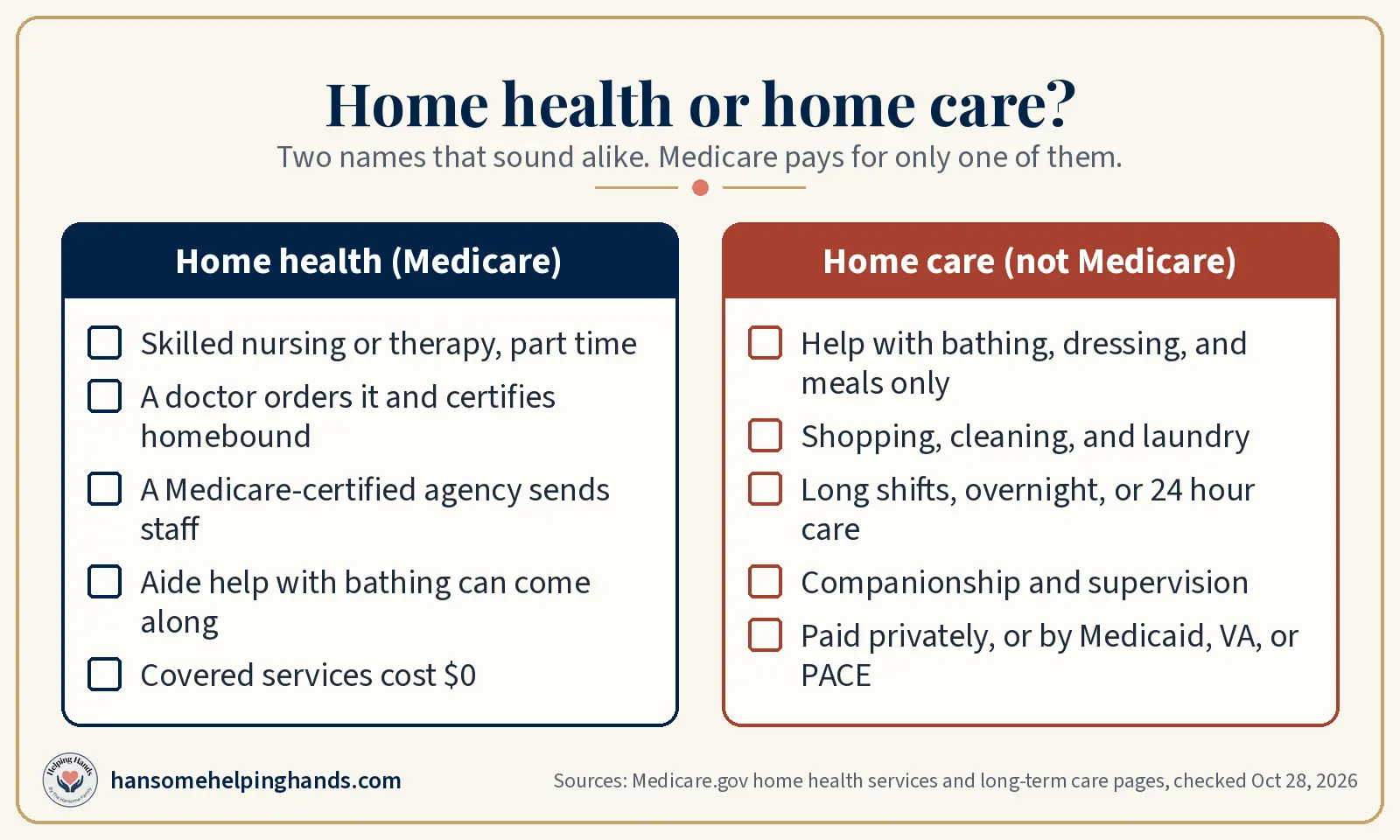
| Question | Home health | Home care |
|---|---|---|
| What is it? | Skilled nursing, physical, speech, or occupational therapy, plus aide help | Help with daily tasks, meals, cleaning, and company |
| Who orders it? | A doctor or allowed provider, with a care plan | The family, or a Medicaid or VA program |
| How much of it? | Part-time visits, not shifts | Whatever you arrange, up to 24 hours |
| Does Medicare pay? | Yes, $0 for covered services | No, when it is the only care needed |
Does Medicare pay for a home health aide?
Yes, but only as part of home health. Medicare covers part-time aide visits for help like bathing, dressing, and walking only while your parent also gets skilled nursing, physical therapy, speech therapy, or continuing occupational therapy. An aide alone, with no skilled care, is home care, and Medicare doesn't pay for it.
The federal rule calls aide visits "dependent services," because they hang on the skilled care. When the last skilled visit ends, the aide visits stop being covered too, except in a few unexpected situations like a hospital admission (42 CFR 409.45).
The same rule lists what a covered aide visit can include: bathing, dressing, grooming, help using the bathroom, help walking and moving from bed to chair, simple dressing changes, and help with medicines Mom normally takes herself.
Did you know? During a covered visit for hands-on care, a Medicare home health aide may also do small extras that go with it, like changing the bed linens, doing personal laundry, or making a light meal. They just can't be the reason for the visit. eCFR: 42 CFR 409.45(b)(4)
One more line in that rule surprises families. Aide visits are covered when there is no able or willing caregiver to do that task, or when the patient doesn't want to use the one who is there. So a daughter is not required to give Mom her shower just because she lives nearby.

Who qualifies for Medicare home health?
Your parent must be under a doctor's care with a care plan, need part-time skilled nursing or physical or speech therapy (or continuing occupational therapy), be homebound, and get care from a Medicare-certified agency. A doctor or allowed provider must also see your parent face to face for the reason care is needed.
Think of it as four gates. All four have to be open, and only the doctor and the agency can open them. The family's job is to ask the right questions.
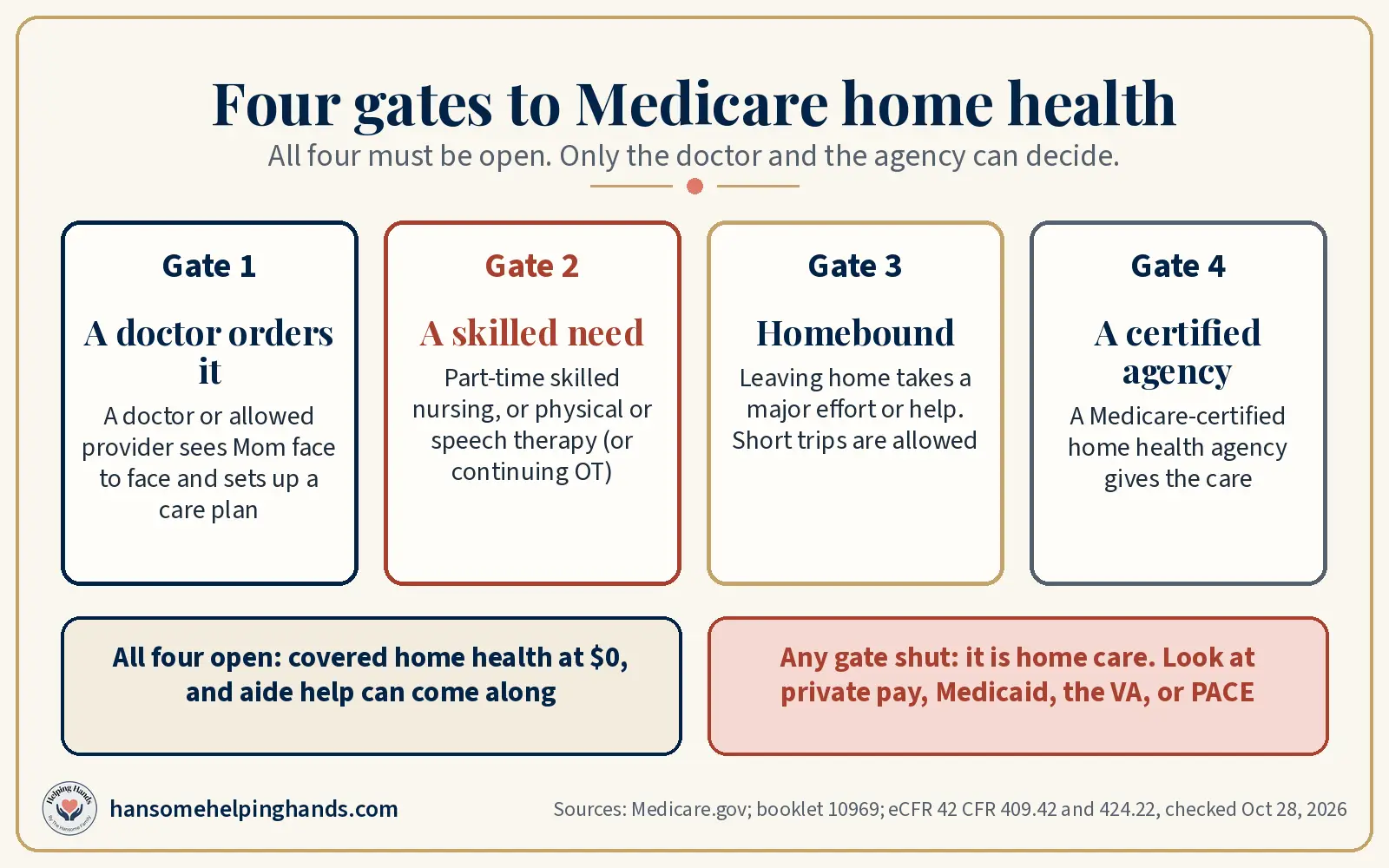
Gate 1: A doctor orders it
A doctor or allowed provider (like a nurse practitioner or physician assistant) sets up the care plan and reviews it regularly. The federal rule says the face-to-face visit must happen no more than 90 days before care starts or within 30 days after, and it can sometimes be a telehealth visit (42 CFR 424.22).
Gate 2: A skilled need
Skilled means care that needs a nurse's or therapist's skills: wound care, injections, IV or tube feeding, teaching about new medicines or diabetes, or therapy. Medicare won't cover a nursing visit that is only for drawing blood.
Gate 3: Homebound
Leaving home isn't recommended, or it takes a major effort or help from a cane, walker, wheelchair, special transportation, or another person. Medical trips and short, occasional outings are fine.
Gate 4: A Medicare-certified agency
You have a say in which agency you use. Compare agencies on Medicare's Care Compare. A Medicare Advantage plan may require an agency in its network, so call the plan first.
One thing we learned building our Home Health vs Home Care Decoder File: families want a yes or no box for "Is Mom homebound?", but the family can't decide that. The doctor certifies it. So the kit's gates worksheet has three columns instead, "Ask doctor," "Ask agency," and "Notes," and the homebound page is for writing down what you have seen, like how many times she left the house this month and what help she needed.
How many hours a day does Medicare home health cover?
Not many. Home health comes in visits, not shifts. Medicare.gov says skilled nursing and aide time combined is usually up to 8 hours a day and 28 hours a week, sometimes up to 35 for a short time. Most families see a few visits a week, and Medicare never pays for 24-hour care at home.
The official pages word the limit a little differently, so here they are side by side:
| Source | What it says |
|---|---|
| Medicare.gov home health page | Up to 8 hours a day (nursing and aide combined), 28 hours a week at most; for a short time, less than 8 hours a day and up to 35 a week |
| Booklet 10969, "part-time or intermittent" | Fewer than 8 hours each day and 28 or fewer hours each week (up to 35 in some limited situations) |
| Booklet 10969, "intermittent" skilled nursing | Needed fewer than 7 days a week, or daily for less than 8 hours a day for up to 21 days (longer only in exceptional cases) |
Our take: the exact cap matters less than the schedule in your parent's plan of care. Ask the agency, "How many visits a week, from whom, and for how long?" and write the answer down. If Mom needs someone there most of the day, that extra time is home care.
What does Medicare home health cost?
Covered home health services cost $0, with no deductible for the visits. Medical equipment like a walker or wheelchair is billed separately: after the Part B deductible, you pay 20% of the Medicare-approved amount. If the agency thinks Medicare won't pay for something, it must tell you first, in writing.
That written warning is the Advance Beneficiary Notice (ABN). Booklet 10969 says the agency gives it before a service or supply Medicare probably won't cover, for example because the care is only personal care, or your parent isn't homebound. You can still ask the agency to bill Medicare for an official decision.
Two other notices matter later. A Home Health Change of Care Notice (HHCCN) comes before the agency cuts back or stops some services. A Notice of Medicare Non-Coverage (NOMNC) comes at least 2 days before all covered services end, and it starts a fast appeal clock. Our guide to how a Medicare fast appeal works walks through that one.
In a Medicare Advantage plan, home health is covered too, but costs, network agencies, and approval rules come from the plan. Call the number on the card before care starts.
Quiz: home health or home care?
Most mix-ups come from the word "home." Here are eight made-up situations. Decide which kind of help each one is, then tap the card to check it against Medicare's rules. These are practice examples, not a coverage decision for your family, so the doctor, agency, or plan has the final word.
Case 1: Dad is home after hip surgery. He needs physical therapy three times a week and can barely make it to the car.
Likely home health. Physical therapy is a skilled need, and leaving home takes a major effort. Ask the surgeon or doctor to order it.
Case 2: Mom is steady on her feet but has stopped cooking and cleaning. She needs someone a few hours a day.
Home care. Meals and housework with no skilled need aren't covered by Medicare. Look at private pay, Medicaid, the VA, or PACE.
Case 3: A nurse comes twice a week for Mom's wound. Can an aide also help her shower?
Usually yes. While skilled nursing continues, part-time aide visits for bathing can be part of the plan of care. Ask the agency to add it.
Case 4: Grandpa can't be alone at night. The family wants someone there every night.
Home care. Medicare doesn't pay for 24-hour care at home, and an overnight shift is far past part-time.
Case 5: The only medical visit Mom needs is a monthly blood draw.
Not enough on its own. Medicare won't cover a home nursing visit that is only for drawing blood.
Case 6: Dad goes to adult day care and to church on Sundays. Does that mean he isn't homebound?
Not by itself. Medicare's booklet says you can still get home health if you go to adult day care or religious services.
Case 7: Mom's wound healed and the nurse visits are ending. Can the aide keep coming?
Not under Medicare. Aide visits depend on the skilled care, so they end with it. If you think care is ending too soon, the NOMNC explains the fast appeal.
Case 8: Dad has a Medicare Advantage plan. Can the family pick any agency?
Maybe not. The plan may require an agency in its network and approval first. Call the plan before the first visit.
If it is home care, who pays?
Usually the family, unless a program steps in. Medicare and most Medigap policies don't pay for long-term care at home. Medicaid may, if your parent qualifies in your state. Veterans may get VA aide help. PACE covers home care for some people 55 and older. Long-term care insurance may also pay.

Here are the doors to knock on, in the order most families try them:
- Medicaid: Medicare.gov says you may be eligible for long-term care through Medicaid if you meet your state's rules. Ask your state Medicaid office about in-home services. If nursing home Medicaid might come up later, read our guide to the Medicaid look-back period.
- The VA: for enrolled veterans, the VA's Homemaker and Home Health Aide program can help with bathing, dressing, eating, and even grocery shopping. Ask a VA social worker.
- PACE: PACE is for people 55 and older who need a nursing home level of care but can live safely at home with help. It covers home care and personal care, and it is only in some areas.
- Long-term care insurance: if your parent bought a policy years ago, find it and call the company about home care benefits.
- Local help: the Eldercare Locator (1-800-677-1116) connects you with your local Area Agency on Aging for meals, rides, and caregiver support.
How do you start Medicare home health?
Ask your parent's doctor, or the hospital discharge planner, whether home health makes sense and to order it. The doctor confirms the four gates, gives you a list of agencies, and sends the referral. The agency then visits to assess your parent and works with the doctor on the plan of care.
Step 1: Ask the doctor the right question
Say: "Does Mom need skilled nursing or therapy at home, and is she homebound? Can you order home health?" Asking for "home care" can send the conversation in the wrong direction.
Step 2: Pick the agency
Medicare.gov says the doctor should give you a list of agencies that serve your area, and must tell you if they have a financial interest in any of them. Check each one on Care Compare.
Step 3: Get the costs in writing
Before care starts, the agency should tell you, out loud and in writing, what Medicare will pay and anything it won't.
Step 4: Keep the schedule and the notices together
Write down who visits, how often, and what they do. Keep any ABN, HHCCN, or NOMNC in the same folder.
Coming home from the hospital? Our hospital discharge checklist covers what to ask before anyone leaves, and our Hospital Discharge Go Sheet keeps the home health order, medicines, and follow-ups on one page.
Tap to tick, your progress saves on this device
Myth or fact: what trips families up?
Most myths push families one of two wrong ways: paying for care Medicare would cover, or counting on Medicare for help it never pays for. Tap each card to check the official answer before anyone sets a budget, hires help, or tells Mom what Medicare will and won't do for her.
Myth: Medicare covers a caregiver at home as long as a doctor says Mom needs one.
Fact: Medicare covers part-time home health with a skilled need. It doesn't pay for custodial care when that is the only care she needs.
Myth: homebound means Mom can never leave the house.
Fact: medical trips and short, occasional outings, like the barber or a family event, are allowed.
Myth: home health costs the same 20% as a doctor visit.
Fact: covered home health services cost $0. The 20% applies to medical equipment like a walker.
Myth: Medicare home health only lasts a few weeks.
Fact: Medicare.gov says visits are unlimited while she qualifies. The doctor recertifies at least every 60 days.
Myth: Medigap fills the gap and pays for home care.
Fact: Medicare.gov says Medigap doesn't pay for long-term care, including non-medical care at home.
Myth: the hospital picks the agency, and we have no choice.
Fact: you have a say, and the doctor or discharge planner should honor your choice, though your plan or agency availability can limit it.
Where can we get free help sorting this out?
Call your State Health Insurance Assistance Program (SHIP) at shiphelp.org for free, unbiased Medicare counseling. Call 1-800-MEDICARE (1-800-633-4227, TTY 1-877-486-2048) with coverage questions. For home care options, the Eldercare Locator at 1-800-677-1116 connects you with your local Area Agency on Aging.
For the bigger picture, start at our Medicare and Medicaid help hub and our caring for aging parents hub. If memory changes are part of the picture, our dementia behavior log helps you bring clear notes to the doctor visit where home health gets ordered.
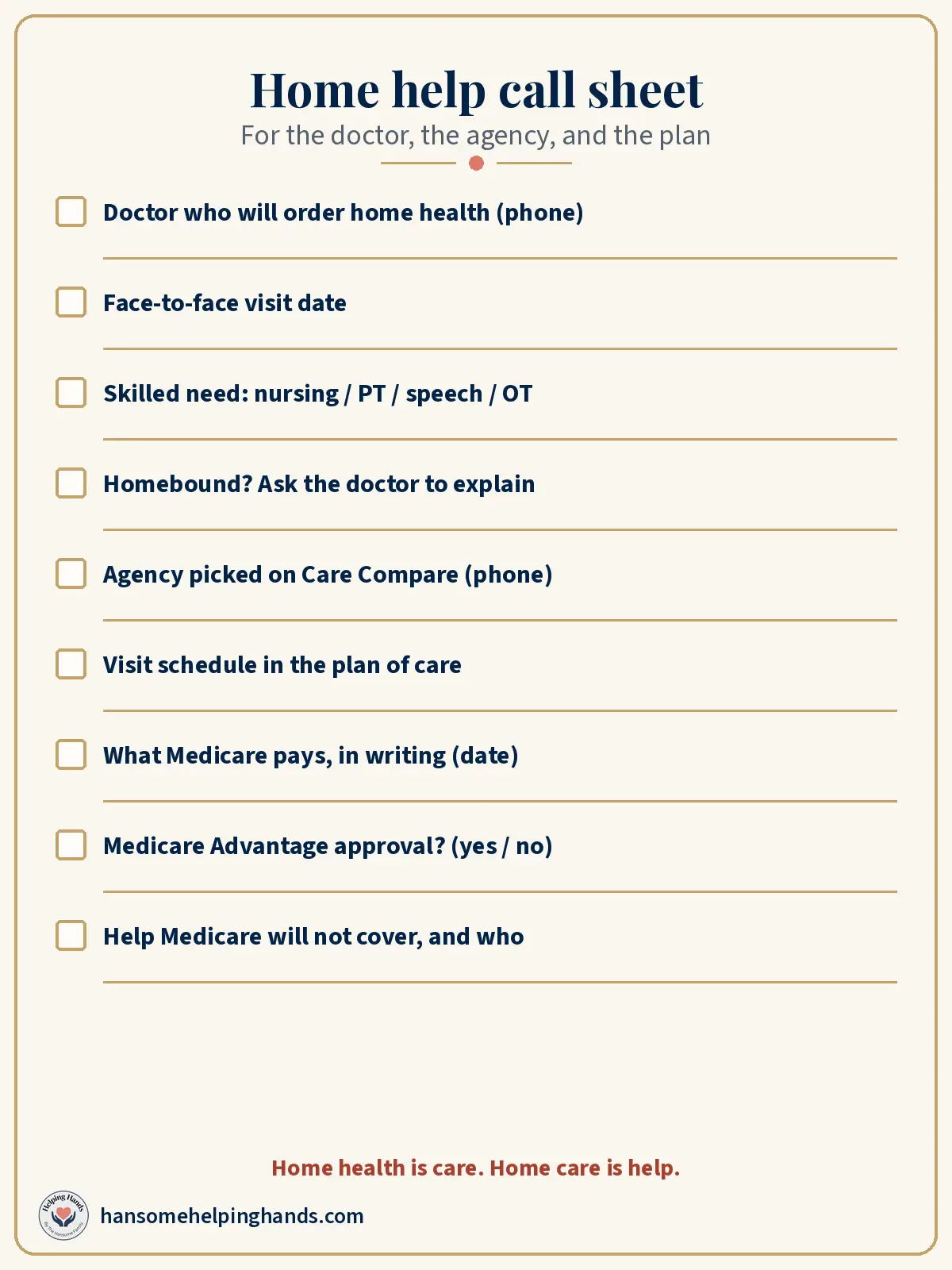
Want it on paper? Our Does Medicare Cover Home Help? Home Health vs Home Care Decoder File is a 15-page printable for this exact moment: a myth vs fact board, an eligibility gates worksheet, homebound observation notes, a covered vs not covered checklist, a Care Compare agency grid, questions to ask, an ABN, HHCCN, and NOMNC decoder, call scripts and a log, a "when home health is not the fit" page, and a fridge card. It contains no government forms, and you never need it to get care: the doctor's order starts home health. Get it on Gumroad for $12.99 (price checked October 28, 2026) or see it on Etsy.
Frequently asked questions
Does Medicare pay a family member to take care of a parent?
No. Medicare pays a Medicare-certified home health agency for covered visits, not relatives. Some state Medicaid programs and some VA programs can pay for in-home help. Ask your state Medicaid office, the VA, or the Eldercare Locator at 1-800-677-1116 what exists where your parent lives.
Does Medicare cover home care for someone with dementia?
Medicare covers home health for a person with dementia on the same terms as anyone else: a doctor orders it, there is a skilled need, and the person is homebound. Supervision and help with daily tasks alone are home care, which Medicare does not pay for. Medicaid, the VA, or PACE may help.
Does Medigap pay for home care?
No. Medicare.gov says Medicare and most health insurance, including Medigap, do not pay for long-term care, which includes non-medical help at home. Medigap does help with costs of services Medicare covers. For covered home health that matters little, since Medicare home health visits already cost $0.
How long can Medicare home health last?
There is no set number of visits. Medicare.gov says that if you qualify, you can get unlimited home health visits. The doctor has to recertify the need at least every 60 days, and coverage stops when the skilled need ends. If the agency says covered care is ending, you get a written notice.
Does Mom need a hospital stay first to get home health?
No. The eligibility rules on Medicare.gov do not require a hospital stay. Many families first hear about home health at discharge, but a doctor can order it after an office or telehealth visit, as long as the face-to-face visit is related to the reason she needs care and happens within the required time.
Please note: This guide explains official rules in plain English. It is not legal, medical, or insurance advice and we are not affiliated with Medicare, Medicaid, the VA, or any home health agency or plan. Confirm details with your parent's doctor, the home health agency, Medicare (1-800-MEDICARE), your State Health Insurance Assistance Program (SHIP), or an elder law attorney.
Sources
- Medicare.gov: Home health services. Checked 2026-10-28 ($0 for covered services; 8 hours a day combined, 28 a week, up to 35 short term)
- Medicare.gov: Medicare & Home Health Care (CMS 10969, July 2025). Checked 2026-10-28 (homebound examples, intermittent definition, ABN and HHCCN)
- Medicare.gov: Medicare's Home Health Benefit (CMS 11357, August 2025). Checked 2026-10-28
- Medicare.gov: Long-term care. Checked 2026-10-28 (not covered by Medicare or most Medigap)
- eCFR: 42 CFR 409.42 and 409.45 (who qualifies, and home health aide services). Checked 2026-10-28 (eCFR up to date as of 2026-10-26)
- eCFR: 42 CFR 424.22 (doctor certification and the face-to-face visit). Checked 2026-10-28 (90 days before or 30 days after the start of care; recertify every 60 days)
- Medicare.gov: PACE. Checked 2026-10-28
- VA: Homemaker and Home Health Aide Care. Checked 2026-10-28
- Medicare.gov Care Compare: home health agencies
- Eldercare Locator (Administration for Community Living). Finds your local Area Agency on Aging; 1-800-677-1116
- SHIP: State Health Insurance Assistance Programs. Free local Medicare counseling
Save this guide for later
Keep reading
- Got a NOMNC? How a Medicare Fast Appeal Works
- Hospital Discharge Checklist: What to Ask Before Mom or Dad Leaves
- Medicaid Look-Back Period in Plain English: Myths vs Facts
- Dementia Behavior Log: How to Spot the Patterns the Doctor Needs to See
- Medicare and Medicaid Help for Families: start here
- The Medicare Prescription Payment Plan: Spreading Drug Costs Across the Year
- The Pharmacy Said No: How to Ask for a Part D Coverage Determination
- Medicare Savings Programs: Help Paying the Part B Premium
- Extra Help for Medicare Drug Costs: Who Qualifies and How to Apply
- Mom's Medicare Advantage Plan Is Ending or Her Doctor Left: What Now?
- Leaving Medicare Advantage: How the Medigap Trial Right Works
- Your Medicare Plan's Annual Notice of Change: What to Check Before December 7
- Medicare Open Enrollment: A Kitchen-Table Checklist for Helping a Parent
- Who to Notify When Someone Dies: A Printable US Checklist
- How to Prepare for an IEP Meeting: A Parent's Countdown Checklist
- Questions to Ask When Touring Assisted Living (and What to Watch For)
- Who Will Take Care of My Pet If I Die? Myths, Facts, and a Simple Plan
- All guides