
Part of our Pet Emergency Plan guide
Pet Medical Records Template: What to Keep, and Why a Shelter May Ask for It

Quick question: if you had to leave home in 20 minutes with your dog, could you prove the rabies shot is current? A pet medical records template fits on one page: your pet's description, microchip number, rabies and other vaccine dates, medicines, allergies, recent tests, and your vet. The CDC lists these records for every pet kit.
This guide is for US dog and cat owners who want their pet's records in one place before they need them. You'll find a few myths that trip people up, a free one-page summary you can tick off and print, and where to keep the copies so one is always within reach.
Did you know? The CDC says owners of dogs, cats, and ferrets should provide proof of rabies vaccination when entering an evacuation shelter. It also warns that many evacuation centers, such as Red Cross centers, do not allow pets at all, so plan a backup place too. CDC: Pets in Evacuation Centers
Pet records myths: tap to see the facts
Most of us assume the vet's office or the microchip has everything covered. In an emergency, that's often not enough, because the clinic may be closed or far away, and a chip doesn't hold shot history. Tap each myth to see what the CDC and Ready.gov actually say, and why it matters.
Myth: "My vet has everything on file, so I don't need copies."
Your vet's file can't help you at 2 a.m. in another county, or if the clinic is in the same storm. The CDC lists photocopied vet records, the rabies certificate, and vaccinations in its pet kit documents list.
Myth: "The microchip holds my dog's medical history."
A chip is an ID number that links to your contact details at the chip company. It doesn't store vaccines or medicines. Ready.gov says to keep your address and phone number up to date with the chip company.
Myth: "The rabies tag on the collar is proof enough."
A tag is handy, but the CDC lists the rabies certificate itself as a document for your kit. Keep a copy of the certificate, not only the tag.
Myth: "Records are only for dogs that travel."
The CDC also lists recent photos, a written description, proof of ownership or adoption, and your contact information. Those help with a lost pet, a new sitter, or a boarding stay, not only a trip.
Myth: "A photo on my phone is all I need."
Phones die and get lost. Ready.gov says to keep copies of documents in a waterproof container and available electronically. Do both.
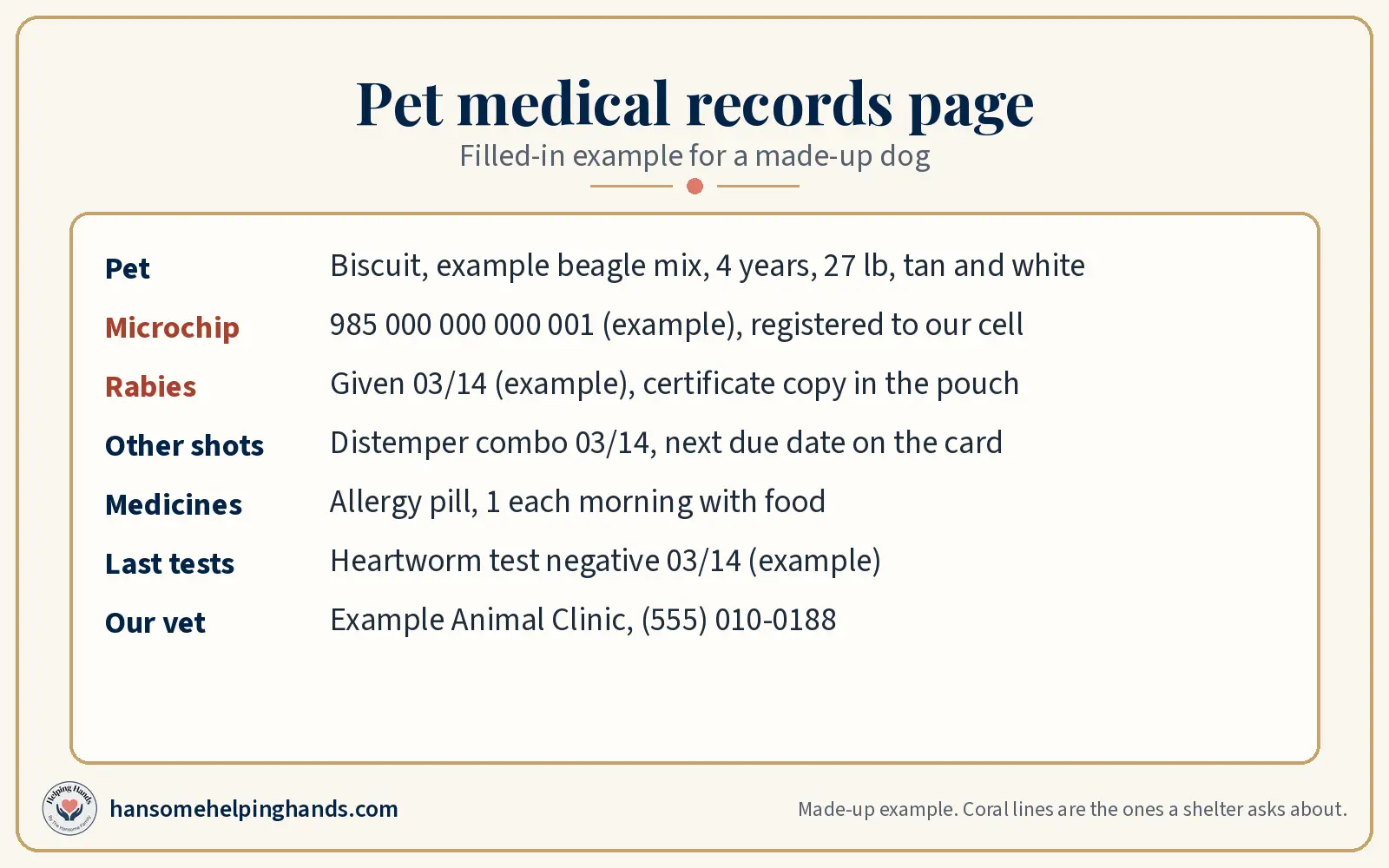
What should a pet medical records template include?
Start with the CDC's pet kit document list: vet records, rabies certificate, vaccinations, a medical summary, prescriptions, the latest heartworm test for dogs or FeLV and FIV test for cats, a description, recent photos, microchip details, and your contacts. Our free summary below fits those on one page per pet.
Tap to tick, your progress saves on this device
Want this on paper with room to write? See what's inside the Pet Emergency Binder.
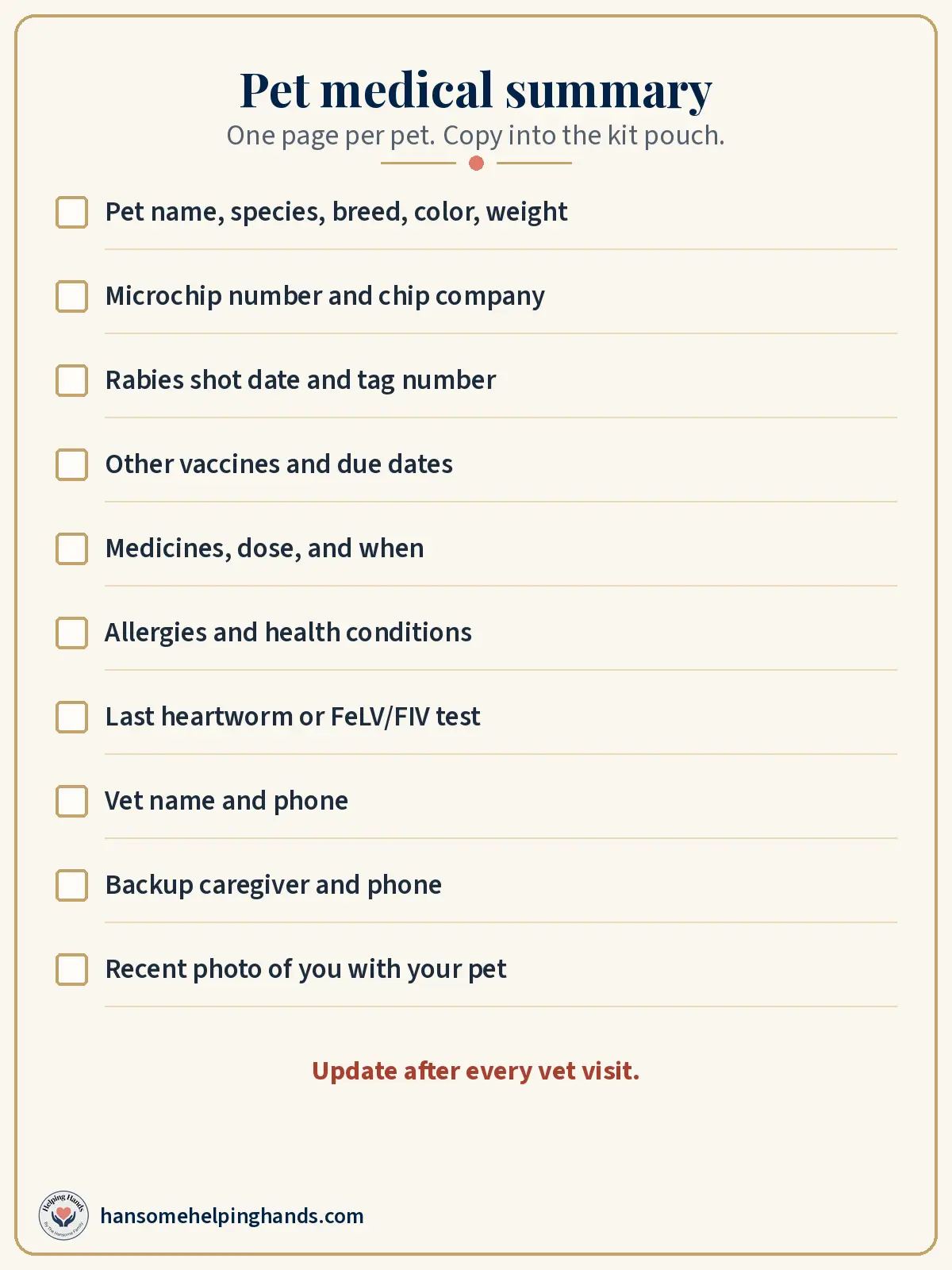
That last line sounds odd until you need it. Ready.gov explains that a picture of you and your pet together helps you document ownership and lets others help identify your pet if you get separated. The CDC adds proof of ownership or adoption records, so tuck a copy of those behind the summary.

Why would a shelter ask for my pet's records?
Shelters house lots of animals close together, so disease control matters. The CDC says owners of dogs, cats, and ferrets should show proof of rabies vaccination when entering an evacuation shelter. Medicines and health notes also help staff care for your pet if you're separated for a while.
Here's the catch: you'll usually need the records exactly when the vet's office is hardest to reach. Picture this, as an example: a wildfire warning goes out on a Sunday evening. The clinic is closed, the roads are busy, and the shelter desk asks for rabies proof. A copy already in the bag turns a stressful moment into a two minute check in.
The CDC's emergency page also suggests finding a vet or animal hospital near wherever you might stay, and adding that contact to your kit. It's one more line for the summary page.
Where should I keep copies of my pet's records?
Keep paper copies in a waterproof bag in your pet emergency kit, photos of every page on your phone, and one more copy with a relative or friend. Ready.gov recommends a waterproof container and electronic copies, and its buddy system idea means someone else can step in.
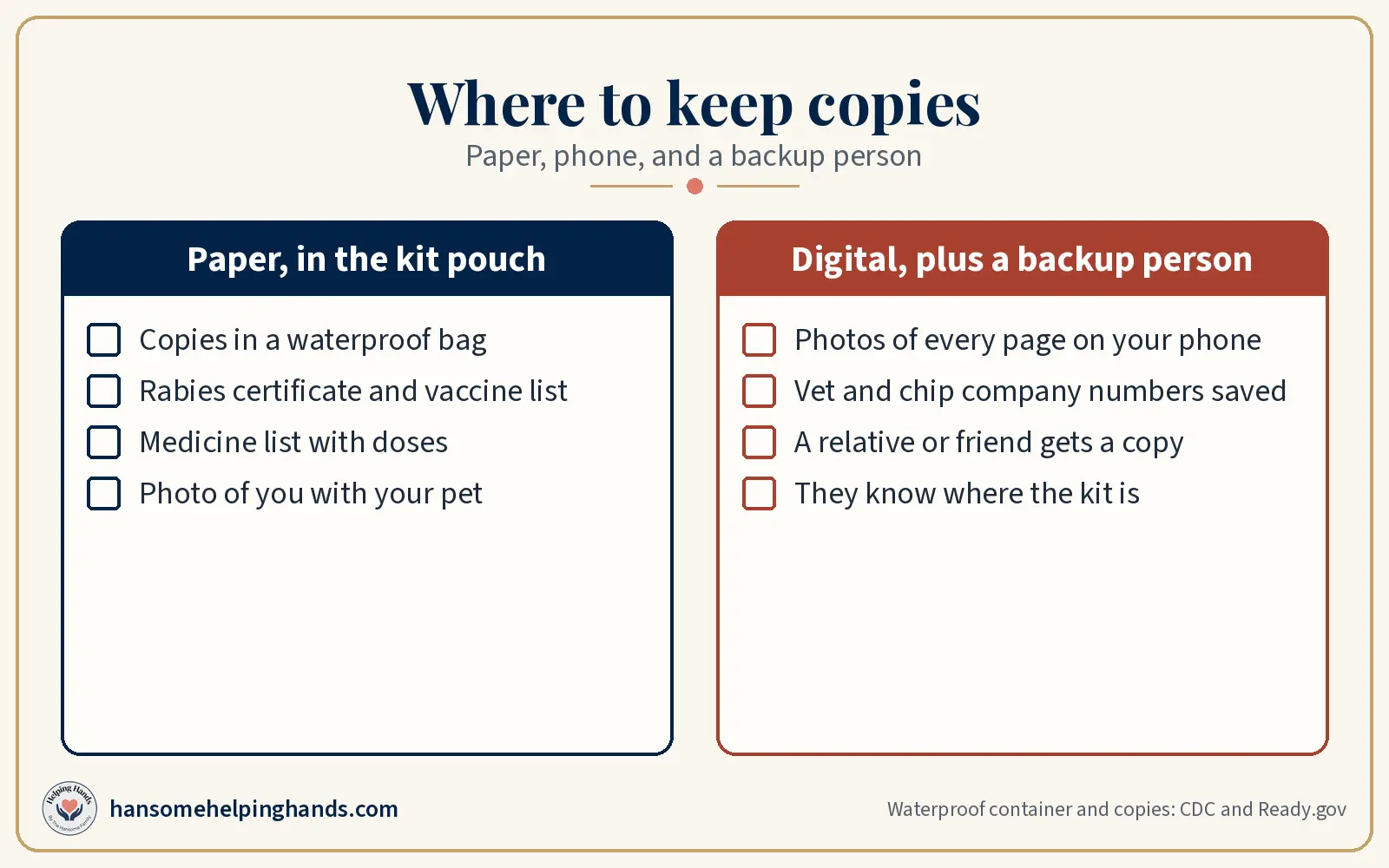
One thing we learned building our own pet binder: the records page gets out of date faster than any other page. A new allergy pill or a booster shot changes it. So we keep the summary as the first page behind the pet's profile and update it in the car right after each vet visit, while the details are fresh.

Your next step tonight
Pick one pet, open your vet's app or call the clinic, and ask for the vaccine history and rabies certificate. Fill in the summary above, snap a photo of it, and put the paper in a zip bag with your pet supplies. That's the hardest page done.
Then check the rest of the bag with our pet emergency kit checklist, which compares what the CDC, ASPCA, AVMA, and Ready.gov say to pack. If a sitter will be in charge while you travel, the same summary belongs with our cat sitter instructions or your dog's care notes. For the longer question of who will take care of my pet if I die, put a caregiver name on the same page. And our pet emergency plan hub pulls it all together.
If you'd rather not build the pages yourself, our Pet Emergency Binder has pet profiles, vet and medication pages, a go bag checklist, and an evacuation plan, ready to print.
Frequently asked questions
Can I ask my vet for a copy of my pet's records?
Yes, most clinics will print or email a copy when you ask, and the CDC suggests asking your veterinarian for help putting your pet kit together. Ask for the vaccine history, the rabies certificate, recent test results, and the current medicine list. Many clinics also have a client app or portal where you can download them.
How often should I update my pet's medical records page?
Update it after every vet visit, new medicine, or change of phone number or address. Ready.gov also says to review your pet kit regularly so food and medicines stay fresh, so a good habit is to check the records page at the same time you check the kit, a few times a year.
Does a microchip replace paper records?
No. A microchip helps someone identify your pet and reach you, but it does not carry vaccine or medicine history. Ready.gov says to keep your address and phone number up to date with the chip company. Write the chip number and the company name on your records page too.
Should a cat have its own records page?
Yes, one page per pet. Cats have a few different lines, like the most recent FeLV and FIV test result the CDC lists for cats, instead of the heartworm test it lists for dogs. If your cat hides when stressed, write down favorite hiding spots as well.
Please note: This guide is general education, not veterinary advice. Ask your veterinarian which records and vaccines your pet needs, and check with your local emergency management office about pet shelter rules where you live.
Sources
- CDC: Build a Pet Disaster Preparedness Kit. Checked 2026-10-10
- CDC: Pets in Evacuation Centers. Checked 2026-10-10
- CDC: Be Prepared, Pet Safety in Emergencies. Checked 2026-10-10
- Ready.gov: Prepare Your Pets for Disasters. Checked 2026-10-10 (page last updated March 20, 2026)
Save this guide for later

Keep reading
- Pet Emergency Kit Checklist: What Official Lists Agree On
- Who Will Take Care of My Pet If I Die? Myths, Facts, and a Simple Plan
- Cat Sitter Instructions: What Your Cat Would Want the Sitter to Know
- Pet Emergency Plan: start here
- Got a NOMNC? How a Medicare Fast Appeal Works
- The Medicare Prescription Payment Plan: Spreading Drug Costs Across the Year
- The Pharmacy Said No: How to Ask for a Part D Coverage Determination
- Who to Notify When Someone Dies: A Printable US Checklist
- All guides