
Part of our Pet Emergency Plan guide
Pet Emergency Kit Checklist: What Official Lists Agree On

Here's the surprise: four trusted US sources can't agree on how much pet food to store, and their answers run from 3 days to 2 weeks.
A pet emergency kit should hold food and water, a two-week supply of medicine, copies of vet and vaccination records, recent photos, microchip details, a leash, collar with ID, and carrier for each pet, a first aid kit, sanitation supplies like litter and bags, and a few familiar comfort items.
Four trusted US sources publish pet kit lists: the Centers for Disease Control and Prevention (CDC), the ASPCA, the American Veterinary Medical Association (AVMA), and Ready.gov. They mostly agree. Where they do not is how much food and water to store. Here is what each one says, how we would pack, and a quick myth check at the end.
Did you know? The ASPCA will mail you a free rescue alert sticker for your front door that tells responders how many pets are inside, but it can take 6 to 8 weeks to arrive. Order it on a calm day, not when a storm is already on the news. ASPCA: Disaster Preparedness
Where do the official pet kit lists agree and disagree?
All four lists agree on medicine, records, photos, ID, a carrier, and sanitation supplies. They differ on food and water. The CDC says two weeks of each. The ASPCA says 7 to 10 days of food and at least 7 days of water. The AVMA says 3 to 7 days of food and at least 7 days of water.
| Item | CDC | ASPCA | AVMA | Ready.gov |
|---|---|---|---|---|
| Food | 2-week supply per animal | 7 to 10 days, rotate every two months | 3 to 7 days | Several days' supply |
| Water | 2-week supply per animal | At least 7 days per person and pet | At least 7 days | Several days' supply |
| Medicine | 2-week supply | 2-week supply | 2-week supply | An extra supply |
| Records | Vet, rabies, vaccine, prescriptions, medical summary | Copies or USB of medical records | Medical records, ID papers, proof of ownership | Registration and other documents, also stored electronically |
| Photos | Recent photos of each pet | Recent photos | Photo, preferably with you | Photo of you with your pet |
Sources: CDC, ASPCA, AVMA, and Ready.gov pages listed at the end of this article, checked October 1, 2026.

How we would pack
If you have room, follow the most generous list, the CDC's two weeks of food and water, because the ASPCA points out that an emergency can mean anything from a brief absence from home to a permanent evacuation. If space is tight, store at least a week and keep more at home for sheltering in place. Whatever you choose, write the date on the food and water so you know when to rotate it.
What supplies go in a pet emergency kit?
Beyond food, water, and medicine, the lists include non-spill bowls and a manual can opener, a leash, harness, and collar with ID, a sturdy carrier for each pet, a pet first aid kit, litter and a litter pan for cats, poop bags, paper towels, trash bags, disinfectant, a blanket, and familiar toys or bedding.
It helps to think of your kit as two kits: a bag of supplies you can carry, and a folder of papers that proves who your pet is and what they need.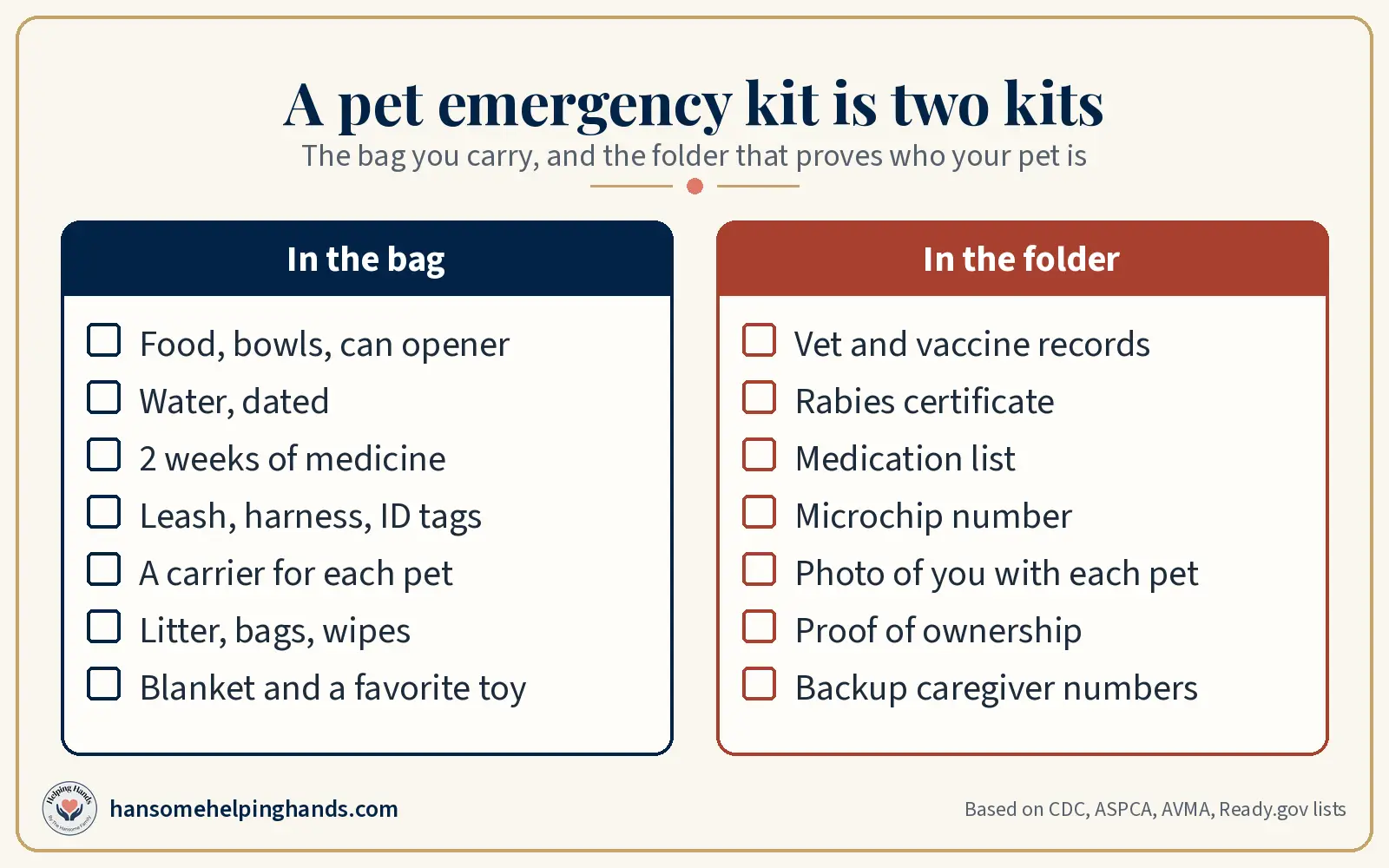
Tap to tick, your progress saves on this device

What paperwork goes in a pet emergency kit?
The CDC's document list is the most complete: photocopied vet records, the rabies certificate and vaccine records, a medical summary, prescriptions, recent photos, a written description of each pet, proof of ownership or adoption, microchip details, your contact information, and boarding instructions, all kept in a waterproof container.
This is the part most families skip, and it matters. The CDC notes that some shelters will not take pets that are not vaccinated, and Ready.gov points out that a photo of you with your pet helps prove ownership if you are separated.Tap to tick, your progress saves on this device
Want this on paper with room to write? See what's inside the Pet Emergency Binder.
To get all of the health details onto one page per pet, use our free pet medical records template.
Free download, no email needed: our Pet Emergency Binder free sample (PDF) has 4 real pages from the full binder: a pet emergency profile, pet medical records, a go-bag and evacuation checklist, and a lost pet action plan. Print it tonight and put it in the folder half of your kit.
Which pet emergency myths trip families up?
The most common mix-ups are thinking every shelter takes pets, that three days of food is always enough, that the vet's records are all you need, and that a microchip works on its own. Tap each myth to see what the official sources actually say.
Myth: any emergency shelter will take my pet.
Fact: Ready.gov says many public shelters and hotels do not allow pets inside, so it tells families to find a pet-friendly place before a disaster. Write two or three options on your plan.
Myth: three days of food is plenty.
Fact: three days is the low end of the AVMA's range. The CDC says two weeks, and the ASPCA says 7 to 10 days. If space allows, pack more than the minimum.
Myth: my vet has the records, so I don't need copies.
Fact: the CDC lists copies of vet and vaccine records in a pet kit, and notes that some shelters will not take pets that are not vaccinated. In an evacuation, your vet's office may be closed too.
Myth: a microchip is all the ID my pet needs.
Fact: Ready.gov says to keep your address and phone number current with the microchip company and to add an emergency contact who lives outside your area. A chip with an old number cannot call you.

How do I make a plan, not just a kit?
A kit only helps if you know where you will go and who will help. Ready.gov says to know a safe place for your pets before a disaster, since many shelters and hotels do not allow pets, and to set up a buddy system. The ASPCA also suggests a rescue alert sticker so responders know pets are inside.
- List two or three pet-friendly places to stay outside your area.
- Choose a nearby temporary caregiver and give them a key.
- Microchip your pets and keep the registration current.
- Practice getting each pet into its carrier.
- Bring pets indoors at the first sign of a storm or disaster, as both Ready.gov and the ASPCA advise.
Your backup caregiver needs the same basics a pet sitter does, so our guide on what to leave for a pet sitter doubles as their briefing. For evacuation routes, pet-friendly places to stay, and the rest of the plan, start with our pet emergency plan guide.
Frequently asked questions
How many days of food should be in a pet emergency kit?
Official lists disagree. The CDC says a 2-week supply of food for each animal, the ASPCA says 7 to 10 days, and the AVMA says 3 to 7 days. If you have the space, aim for the CDC's two weeks. If storage is tight, pack at least a week and rotate the food so it stays fresh.
How often should I check or rotate my pet emergency kit?
Check your kit every few months and whenever your pet's needs change. The ASPCA suggests rotating stored food and bottled water every two months, and the AVMA says to replace food, water, and medicines by their expiration dates. Update your records after every vet visit, move, or new phone number.
What documents should go in a pet emergency kit?
The CDC lists photocopied vet records, the rabies certificate, vaccination records, a medical summary, prescriptions, recent photos, a written description of each pet, proof of ownership or adoption, microchip details, and your contact information. Keep the papers in a waterproof container, and Ready.gov suggests also saving copies electronically.
What extra items do cats need in an emergency kit?
Cats need a litter box and litter, and the ASPCA suggests disposable aluminum roasting pans as easy travel litter trays. Pack a sturdy carrier for each cat, a towel or blanket, and a pillowcase, which the ASPCA lists for cats. Write down favorite hiding spots so you can find your cat quickly.
Where should I keep my pet emergency kit?
Keep the kit and leashes close to an exit, clearly labeled, and easy to carry, as the ASPCA recommends, and make sure everyone at home knows where it is. Ready.gov suggests two kits: a larger one for sheltering in place and a lighter one you can grab if you must evacuate.
Who will care for my pets if a disaster happens while I am away?
Set up a buddy system before you need it. Ready.gov suggests planning with neighbors, friends, or relatives who can care for or evacuate your pets if you cannot. The ASPCA recommends choosing a temporary caregiver who lives nearby and giving that person a set of keys. Write their details in your plan.
What should a pet emergency binder include?
A pet emergency binder is the paperwork half of your kit. It should hold one profile per pet with a recent photo and microchip number, vet and emergency clinic contacts, vaccine records, a medication log, care routines for a helper, an evacuation plan, and a lost pet action plan. Our 21-page printable Pet Emergency Binder covers each of these.
Is there a free printable pet emergency binder?
Yes. Our free Pet Emergency Binder sample is a 5-page PDF with 4 real pages from the 21-page binder: a pet emergency profile, pet medical records, a go-bag and evacuation kit checklist, and a lost pet action plan. It downloads free with no email, account, or sign-up. The full binder adds vet visit, medication, caregiver, evacuation, and fridge pages.
Is there a free printable for pet emergency information?
Yes. Besides the free binder sample, our free pet sitter instructions template PDF downloads with no email or account, and covers feeding, medicines, vet contacts, and who to call, which is most of what a helper needs on day one. For a full grab-and-go binder with evacuation and lost pet pages, see the Pet Emergency Binder.
Please note: This page is for general education only. It is not veterinary, medical, legal, or financial advice. Official guidance and phone numbers can change, so confirm them on the official sites linked here. We are not affiliated with any agency or organization we cite.
Sources
- CDC: Build a Pet Disaster Preparedness Kit (April 2024)
- CDC: Pets, Preparing for a Chemical Emergency. Source for the note that some shelters will not take unvaccinated pets
- ASPCA: Disaster Preparedness
- AVMA: Save the Whole Family, pet evacuation kit checklist (PDF)
- Ready.gov: Prepare Your Pets for Disasters (updated March 2026)
- ASPCA Animal Poison Control, (888) 426-4435. A consultation fee may apply
Save this guide for later
Keep reading
- What to Leave for a Pet Sitter: A Printable Checklist
- Pet Emergency Plan: start here
- Who Will Take Care of My Pet If I Die? Myths, Facts, and a Simple Plan
- Pet Medical Records Template: What to Keep, and Why a Shelter May Ask for It
- Got a NOMNC? How a Medicare Fast Appeal Works
- The Medicare Prescription Payment Plan: Spreading Drug Costs Across the Year
- The Pharmacy Said No: How to Ask for a Part D Coverage Determination
- Who to Notify When Someone Dies: A Printable US Checklist
- All guides