
Part of our New Puppy Guide guide
Your New Puppy's First Week, Day by Day (Printable Schedule)

Your new puppy's first week is mostly three things on repeat: potty breaks, meals, and naps, at the same times every day. Take the puppy out after sleeping, eating, and playing. Use the months plus one rule for the longest stretch between breaks, and feed a young puppy four small meals a day.
This guide is for families bringing home a puppy in the next few weeks, or who just did and are a little tired already. You'll get a day by day plan, a potty break chart by age, and a free checklist to print. Each day also has a short note on what you're probably thinking, and what the puppy is probably thinking. Those notes are for fun, starring Waffles, a made-up puppy.
Did you know? AKC's month plus one rule says to take your puppy's age in months and add one. That's about the most hours they can comfortably hold it, so a 3 month old can manage about 4 hours. AKC: Puppy Potty Training Timeline
How long can my puppy hold it?
Use AKC's month plus one rule as a ceiling, not a target: about 3 hours at 2 months, 4 hours at 3 months, 5 hours at 4 months, and 6 hours at 5 months. AKC adds that puppies can usually hold it longer while asleep and not active.

Your puppy's first week, day by day
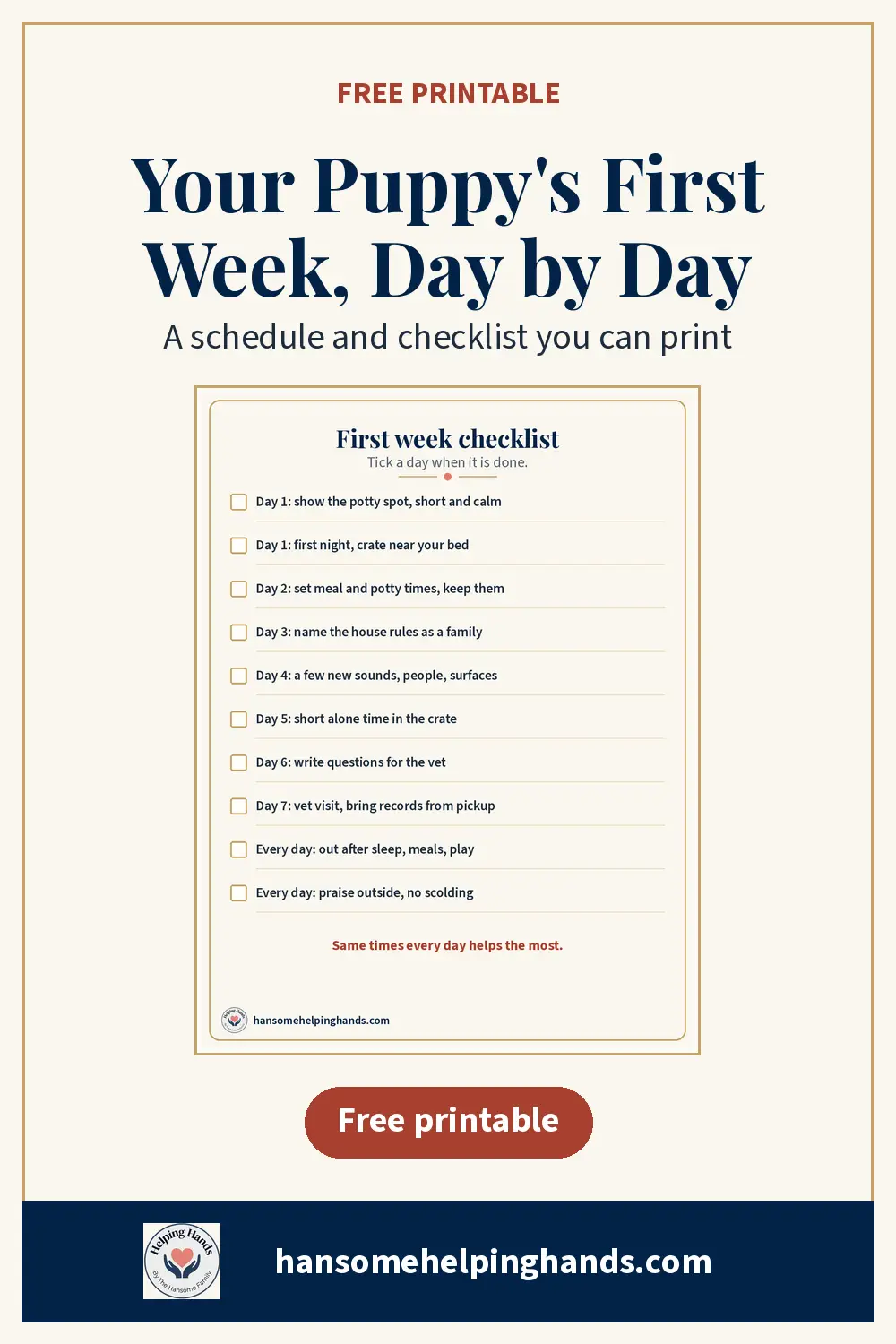
Day 1 is about the potty spot and a calm first night. Days 2 and 3 set the schedule and house rules. Days 4 and 5 add small new experiences and short alone time. Days 6 and 7 are for vet questions and the first checkup. Tick each one below as you go.
Day 1: Welcome home. Carry the puppy straight to the potty spot before going inside, then keep the first evening quiet. AKC suggests keeping the crate in or near your bedroom so you'll hear a whimper at night. You: "Why is something so small so loud at 2 a.m.?" Waffles: "New room, new smells, where is everybody?"
Day 2: Pick the times and keep them. Write down meal times and potty times and stick to them. The ASPCA says puppies 8 to 12 weeks old need four meals a day. AKC suggests no food in the 2 hours before bedtime. You: "Is this a schedule or a second job?" Waffles: "Breakfast happens at 7. I will remind you at 6:58."
Day 3: Agree on house rules. Is the couch allowed? Who does the late break? Decide as a family, because mixed signals confuse a puppy. You: "Nobody let him on the couch." Waffles, already on the couch: "Define couch."
Day 4: Small new things. A vacuum running in another room, a hat, a new floor surface. Keep it short and upbeat, and ask your vet about other dogs and public places until shots are done. Waffles: "The vacuum is a monster. Oh, a treat. The vacuum is fine."
Day 5: A little alone time. Short, calm stretches in the crate with a safe chew toy, while you're home, so being alone isn't scary later.
Day 6: Questions for the vet. Write down everything you've noticed: eating, sleeping, potty habits, anything odd. The breeder or shelter papers go in the same folder.
Day 7: The first checkup. Bring your questions and the records from pickup. Then add the vaccine dates to your puppy's records page.
Tap to tick, your progress saves on this device
Want this on paper with room to write? See what's inside the New Puppy Command Center.


What should the puppy's daily schedule look like?
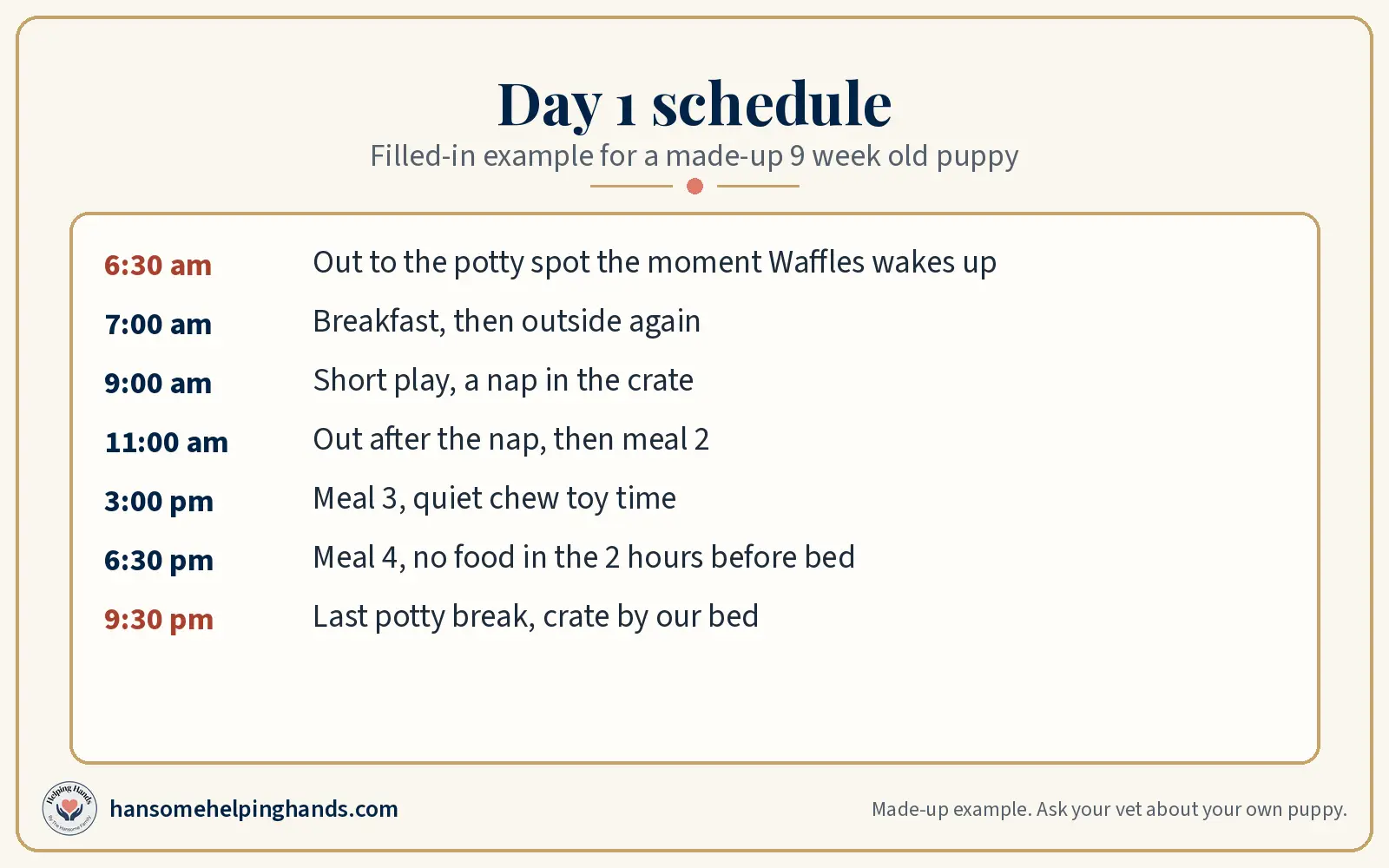
A simple day follows the puppy, not the clock alone: out the moment they wake, a meal, out again, play, a nap, and repeat. AKC says to take the puppy out after sleeping, eating, and playing. The last break comes right before bed.
The hero image at the top shows a sample day 1 for Waffles: out at 6:30 a.m., breakfast at 7, naps between play, four meals, and a last break at 9:30 p.m. It's an example, so move the times to fit your home. What matters is that they stay the same every day.
One thing we learned building our own puppy planner: the schedule only works if everyone can see it. We put the day's times on the fridge and a tick box by each one, so whoever is home knows if the last break already happened.

Your next step tonight
Print the checklist above, pick your meal and potty times, and set phone alarms for the first two days. Put the crate where you'll hear it at night. That's most of week one decided before the puppy even arrives.
Then pack the basics in one bag with our pet emergency kit checklist, and start a pet medical records page after the first vet visit. Our new puppy guide pulls it all together.
If you'd rather have it all ready to print, our New Puppy Command Center has a daily schedule by age, a potty training grid, a crate training plan, a feeding log, and vet records pages.
Frequently asked questions
How often should a new puppy go out to potty?
Take your puppy out right after waking up, after eating, and after playing, as AKC suggests. Between those, AKC's month plus one rule is a guide to the longest stretch: a 3 month old can hold it about 4 hours. Younger puppies need breaks more often, so set a phone alarm the first few days.
How many times a day should a puppy eat?
The ASPCA says puppies 8 to 12 weeks old need four meals a day, puppies three to six months old three meals, and puppies six months to one year two meals. Ask your vet how much to feed, since amounts depend on the food and the puppy.
Should the crate be in my bedroom the first night?
AKC notes that keeping the crate in or near your bedroom lets you hear your puppy whimper or whine if they need to go out during the night. Many families start there and move the crate later once nights are calm.
What if my puppy has an accident in the house?
It's normal in week one. Clean it up well, then take the puppy out more often. AKC says a 6 month old puppy is usually dependable most of the time if training starts early, so expect accidents for a while and keep the routine steady.
Please note: This guide is general education, not veterinary advice. Ask your veterinarian about vaccines, feeding amounts, and when your puppy is ready for new places and other dogs.
Sources
- AKC: Puppy Potty Training Timeline and Tips. Checked 2026-10-11 (updated Aug 11, 2026)
- ASPCA: General Dog Care. Checked 2026-10-11
Save this guide for later
Keep reading
- Pet Emergency Kit Checklist: What Official Lists Agree On
- Pet Medical Records Template: What to Keep, and Why a Shelter May Ask for It
- New Puppy Guide: start here
- Got a NOMNC? How a Medicare Fast Appeal Works
- The Medicare Prescription Payment Plan: Spreading Drug Costs Across the Year
- The Pharmacy Said No: How to Ask for a Part D Coverage Determination
- Who to Notify When Someone Dies: A Printable US Checklist
- All guides